
PUBLISHER: Global Market Insights Inc. | PRODUCT CODE: 1892679

PUBLISHER: Global Market Insights Inc. | PRODUCT CODE: 1892679
Superconducting Materials for Quantum Market Opportunity, Growth Drivers, Industry Trend Analysis, and Forecast 2025 - 2034
The Global Superconducting Materials for Quantum Market was valued at USD 14.7 billion in 2024 and is estimated to grow at a CAGR of 11.7% to reach USD 47.1 billion by 2034.
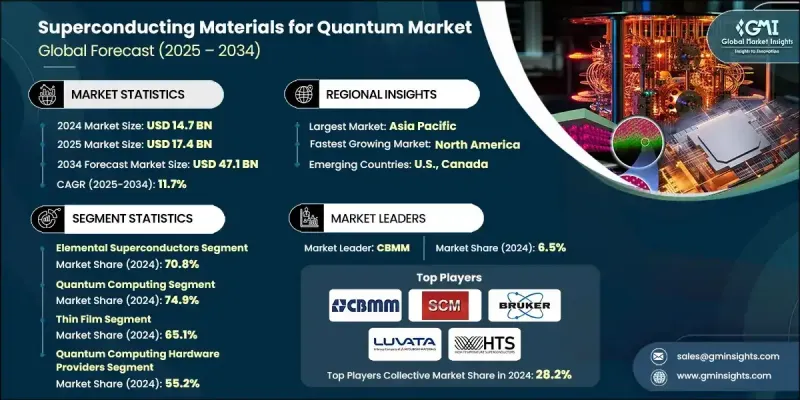
This sector is becoming a core pillar of the broader quantum technology landscape, supported by rapid advancements in quantum computing, sensing, and communication. Superconducting materials enable the creation of qubits and quantum circuits by offering near-zero electrical resistance, which is essential for maintaining coherence and reducing operational energy loss. Momentum is building as government bodies and private investors accelerate funding for quantum research and as industries such as pharmaceuticals, finance, and cybersecurity integrate quantum solutions into long-term strategies. Demand for scalable quantum processors continues to rise, driving innovation and commercialization efforts in superconducting components. Beyond computing, these materials are gaining traction in imaging systems, geological studies, and environmental monitoring. Although high costs and complex cooling requirements remain key barriers, particularly the need for reliable materials that perform at low temperatures, ongoing research focused on high-temperature superconductors aims to lower operational expenses and enhance stability. Continued progress in these technologies is expected to expand market opportunities in the coming years.
| Market Scope | |
|---|---|
| Start Year | 2024 |
| Forecast Year | 2025-2034 |
| Start Value | $14.7 Billion |
| Forecast Value | $47.1 Billion |
| CAGR | 11.7% |
The elemental superconductors segment accounted for a 70.8% share in 2024 and is projected to grow at an 11.7% CAGR through 2034. These materials, including niobium, lead, and tin, remain central to scientific and medical applications such as accelerator systems and diagnostic technologies. Their performance characteristics are widely established, yet their growth is tempered by the requirement for extremely low operating temperatures, which significantly increases cooling expenditure.
The quantum computing segment held a 74.9% share in 2024 and is set to grow at a CAGR of 11.6% from 2025 to 2034. Adoption is accelerating as more enterprises seek solutions capable of tackling complex computational challenges beyond the capabilities of traditional systems. This rising demand is inspiring larger investments in advanced hardware and software as quantum technology becomes more influential across sectors, including pharmaceuticals, logistics, and financial modeling. Major players in the technology ecosystem continue to support the scale-up of quantum computing capabilities worldwide.
North America Superconducting Materials for Quantum Market held a 31.8% share in 2024. The region's leadership is driven by substantial public and private investment, extensive research programs, and a strong semiconductor and electronics foundation that promotes rapid commercialization. Significant funding directed toward quantum hardware development is creating an environment conducive to the adoption and advancement of superconducting materials across the region.
Key companies active in the Global Superconducting Materials for Quantum Market include Alloy Hit, Bruker EAS (BEST), CBMM, Hitachi, Goodfellow, High Temperature Superconductors Inc., Luvata, Marketech International, Stanford Advanced Materials, and Super Conductor Materials Inc. (SCM). Companies competing in the Superconducting Materials for Quantum Market focus on several strategic initiatives to reinforce their standing. Many prioritize advancing material engineering to improve conductivity, stability, and performance at lower or more manageable temperatures, helping reduce cooling expenses. Firms are also strengthening partnerships with quantum hardware developers to integrate their materials more deeply into next-generation processors and sensing devices. Expanding production capabilities, enhancing quality control, and investing in precision fabrication technologies allow manufacturers to meet rising demand for highly reliable components.
Table of Contents
Chapter 1 Methodology & Scope
- 1.1 Market scope and definition
- 1.2 Research design
- 1.2.1 Research approach
- 1.2.2 Data collection methods
- 1.3 Data mining sources
- 1.3.1 Global
- 1.3.2 Regional/Country
- 1.4 Base estimates and calculations
- 1.4.1 Base year calculation
- 1.4.2 Key trends for market estimation
- 1.5 Primary research and validation
- 1.5.1 Primary sources
- 1.6 Forecast model
- 1.7 Research assumptions and limitations
Chapter 2 Executive Summary
- 2.1 Industry 360° synopsis
- 2.2 Key market trends
- 2.2.1 Regional
- 2.2.2 Material type
- 2.2.3 Application
- 2.2.4 Form
- 2.2.5 End Use
- 2.3 TAM Analysis, 2025-2034
- 2.4 CXO perspectives: Strategic imperatives
- 2.4.1 Executive decision points
- 2.4.2 Critical success factors
- 2.5 Future Outlook and Strategic Recommendations
Chapter 3 Industry Insights
- 3.1 Industry ecosystem analysis
- 3.1.1 Supplier landscape
- 3.1.2 Profit margin
- 3.1.3 Value addition at each stage
- 3.1.4 Factor affecting the value chain
- 3.1.5 Disruptions
- 3.2 Industry impact forces
- 3.2.1 Growth drivers
- 3.2.2 Industry pitfalls and challenges
- 3.2.3 Market opportunities
- 3.3 Growth potential analysis
- 3.4 Regulatory landscape
- 3.4.1 North America
- 3.4.2 Europe
- 3.4.3 Asia Pacific
- 3.4.4 Latin America
- 3.4.5 Middle East & Africa
- 3.5 Porter's analysis
- 3.6 PESTEL analysis
- 3.7 Price trends
- 3.7.1 By region
- 3.7.2 By Product type
- 3.8 Future market trends
- 3.9 Technology and Innovation landscape
- 3.9.1 Current technological trends
- 3.9.2 Emerging technologies
- 3.10 Patent Landscape
- 3.11 Trade statistics (HS code) ( Note: the trade statistics will be provided for key countries only)
- 3.11.1 Major importing countries
- 3.11.2 Major exporting countries
- 3.12 Sustainability and environmental aspects
- 3.12.1 Sustainable practices
- 3.12.2 Waste reduction strategies
- 3.12.3 Energy efficiency in production
- 3.12.4 Eco-friendly initiatives
- 3.13 Carbon footprint consideration
Chapter 4 Competitive Landscape, 2024
- 4.1 Introduction
- 4.2 Company market share analysis
- 4.2.1 By region
- 4.2.1.1 North America
- 4.2.1.2 Europe
- 4.2.1.3 Asia Pacific
- 4.2.1.4 LATAM
- 4.2.1.5 MEA
- 4.2.1 By region
- 4.3 Company matrix analysis
- 4.4 Competitive analysis of major market players
- 4.5 Competitive positioning matrix
- 4.6 Key developments
- 4.6.1 Mergers & acquisitions
- 4.6.2 Partnerships & collaborations
- 4.6.3 New Product Launches
- 4.6.4 Expansion Plans
Chapter 5 Market Estimates and Forecast, By Material Type, 2021-2034 (USD Billion) (Kilo Tons)
- 5.1 Key trends
- 5.2 Elemental Superconductors
- 5.2.1 Niobium (Nb)
- 5.2.2 Tantalum (Ta)
- 5.2.3 Aluminum (Al)
- 5.3 Superconducting Alloys & Compounds
- 5.3.1 Niobium-Titanium (Nb-Ti)
- 5.3.2 Niobium-Tin (Nb3Sn)
- 5.3.3 Niobium-Tantalum (Nb-Ta)
- 5.3.4 Niobium Titanium Nitride (NbTiN)
- 5.4 High-Temperature Superconductors (HTS)
- 5.4.1 YBCO (Yttrium Barium Copper Oxide)
- 5.4.2 REBCO (Rare-Earth Barium Copper Oxide)
- 5.4.3 BSCCO (Bismuth Strontium Calcium Copper Oxide)
Chapter 6 Market Estimates and Forecast, By Application, 2021-2034 (USD Billion) (Kilo Tons)
- 6.1 Key trends
- 6.2 Quantum computing
- 6.3 Quantum sensing
- 6.4 Quantum communication & networking
Chapter 7 Market Estimates and Forecast, By Form, 2021-2034 (USD Billion) (Kilo Tons)
- 7.1 Key trends
- 7.2 Thin films
- 7.3 Rods & wires
- 7.4 Sheets & foils
- 7.5 Powder
- 7.6 Others
Chapter 8 Market Estimates and Forecast, By End Use, 2021-2034 (USD Billion) (Kilo Tons)
- 8.1 Key trends
- 8.2 Quantum computing hardware providers
- 8.3 Defense & aerospace
- 8.4 Healthcare & life sciences
- 8.5 Infrastructure & geophysics
- 8.6 Telecommunications
- 8.7 Scientific research institutions
Chapter 9 Market Estimates and Forecast, By Region, 2021-2034 (USD Billion) (Kilo Tons)
- 9.1 Key trends
- 9.2 North America
- 9.2.1 U.S.
- 9.2.2 Canada
- 9.3 Europe
- 9.3.1 Germany
- 9.3.2 UK
- 9.3.3 France
- 9.3.4 Spain
- 9.3.5 Italy
- 9.3.6 Rest of Europe
- 9.4 Asia Pacific
- 9.4.1 China
- 9.4.2 India
- 9.4.3 Japan
- 9.4.4 Australia
- 9.4.5 South Korea
- 9.4.6 Rest of Asia Pacific
- 9.5 Latin America
- 9.5.1 Brazil
- 9.5.2 Mexico
- 9.5.3 Argentina
- 9.5.4 Rest of Latin America
- 9.6 Middle East and Africa
- 9.6.1 Saudi Arabia
- 9.6.2 South Africa
- 9.6.3 UAE
- 9.6.4 Rest of Middle East and Africa
Chapter 10 Company Profiles
- 10.1 Alloy Hit
- 10.2 Bruker EAS (BEST)
- 10.3 CBMM
- 10.4 Hitachi
- 10.5 Goodfellow
- 10.6 High Temperature Superconductors Inc. (HTSI)
- 10.7 Luvata
- 10.8 Marketech International
- 10.9 Stanford Advanced Materials
- 10.10 Super Conductor Materials Inc. (SCM)

