
PUBLISHER: Global Market Insights Inc. | PRODUCT CODE: 1892699

PUBLISHER: Global Market Insights Inc. | PRODUCT CODE: 1892699
Implantable Drug Delivery Pump Market Opportunity, Growth Drivers, Industry Trend Analysis, and Forecast 2025 - 2034
The Global Implantable Drug Delivery Pump Market was valued at USD 79.1 million in 2024 and is estimated to grow at a CAGR of 8.3% to reach USD 173 million by 2034.
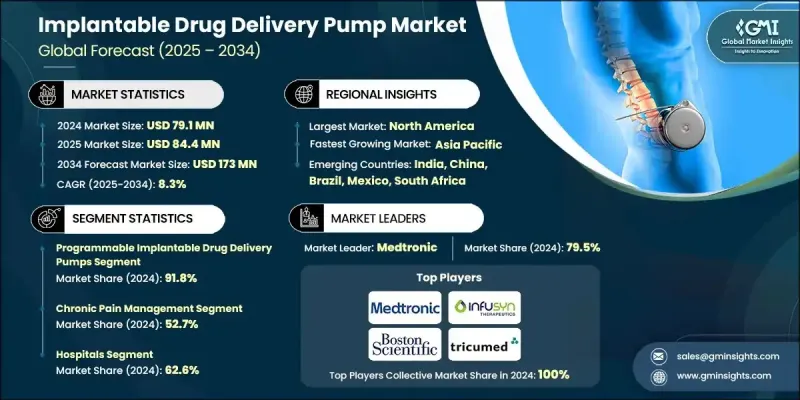
The rising prevalence of chronic pain, spasticity, and other long-term disorders is driving demand for advanced implantable pumps that ensure controlled and sustained drug delivery. Hospitals, specialty clinics, and ambulatory surgical centers are increasingly adopting these systems to enhance patient outcomes, manage chronic conditions more effectively, and improve operational efficiency. The market offers programmable and constant-rate pumps that provide precise, targeted therapy, reducing systemic side effects and improving adherence. Technological advancements, including miniaturized pump designs, biocompatible 3D-printed components, wireless telemetry, and remote patient monitoring, are enhancing device functionality, safety, and convenience, accelerating clinical adoption and encouraging broader use in chronic disease management globally.
| Market Scope | |
|---|---|
| Start Year | 2024 |
| Forecast Year | 2025-2034 |
| Start Value | $79.1 Million |
| Forecast Value | $173 Million |
| CAGR | 8.3% |
The programmable implantable drug delivery pumps segment held 91.8% share in 2024. These pumps are favored due to their ability to provide personalized, precise, and controlled drug administration. Clinicians can adjust dosages based on patient response, disease progression, and therapy needs, improving outcomes while minimizing adverse effects. This flexibility makes programmable pumps essential for chronic conditions requiring ongoing, precise medication delivery.
The chronic pain management segment accounted for a 52.7% share in 2024 and is expected to reach USD 87.9 million during 2025-2034. Rising cases of neuropathic, musculoskeletal, and post-surgical pain are fueling demand, as implantable pumps deliver analgesics directly and efficiently, ensuring rapid onset and enhanced therapeutic efficacy compared to oral or systemic treatments.
North America Implantable Drug Delivery Pump Market held a 61.8% share in 2024, supported by advanced healthcare infrastructure, strong reimbursement systems, and early adoption of innovative medical technologies. The high prevalence of chronic diseases in the region and the growing preference for minimally invasive therapies are driving pump adoption in hospitals and specialty clinics. Favorable regulatory pathways by the U.S. FDA and Health Canada further encourage rapid commercialization and innovation.
Major players operating in the Global Implantable Drug Delivery Pump Market include Medtronic, Infusyn Therapeutics, Boston Scientific (Integra Oncology), and Tricumed Medizintechnik. Companies in the implantable drug delivery pump market are focusing on strategies such as investing heavily in R&D to develop miniaturized, programmable, and remote-monitoring-enabled pumps. Strategic partnerships with hospitals, specialty clinics, and research institutions help expand their distribution networks and clinical adoption. Firms are also emphasizing global market expansion, enhancing regulatory compliance, and implementing targeted marketing strategies to raise awareness among clinicians and patients. Product differentiation through advanced telemetry, wireless communication, and customizable therapy options ensures competitive advantage, while ongoing innovation and service support strengthen brand loyalty and penetration in chronic disease management segments.
Table of Contents
Chapter 1 Methodology and Scope
- 1.1 Market scope and definitions
- 1.2 Research design
- 1.2.1 Research approach
- 1.2.2 Data collection methods
- 1.3 Data mining sources
- 1.3.1 Global
- 1.3.2 Regional/country
- 1.4 Base estimates and calculations
- 1.4.1 Base year calculation
- 1.4.2 Key trends for market estimation
- 1.5 Primary research and validation
- 1.5.1 Primary sources
- 1.6 Forecast model
- 1.7 Research assumptions and limitations
Chapter 2 Executive Summary
- 2.1 Industry 3600 synopsis
- 2.2 Key market trends
- 2.2.1 Regional trends
- 2.2.2 Product type trends
- 2.2.3 Application trends
- 2.2.4 End Use trends
- 2.3 CXO perspectives: Strategic imperatives
- 2.3.1 Key decision points for industry executives
- 2.3.2 Critical success factors for market players
- 2.4 Future outlook and strategic recommendations
Chapter 3 Industry Insights
- 3.1 Industry ecosystem analysis
- 3.2 Industry impact forces
- 3.2.1 Growth drivers
- 3.2.1.1 Rising prevalence of chronic pain, spasticity, and cancer
- 3.2.1.2 Advantages of targeted and controlled drug delivery
- 3.2.1.3 Technological advancements in pump design
- 3.2.1.4 Growing preference for minimally invasive therapies
- 3.2.2 Industry pitfalls and challenges
- 3.2.2.1 High device and implantation cost
- 3.2.2.2 Risk of device malfunction and infection
- 3.2.3 Market opportunities
- 3.2.3.1 Integration of IoT and remote monitoring
- 3.2.3.2 Rising demand for personalized medicine
- 3.2.1 Growth drivers
- 3.3 Growth potential analysis
- 3.4 Regulatory landscape
- 3.4.1 North America
- 3.4.2 Europe
- 3.4.3 Asia Pacific
- 3.5 Technological advancemnets
- 3.5.1 Current technological trends
- 3.5.1.1 Miniaturized implantable pumps
- 3.5.1.2 Programmable and patient-friendly infusion systems
- 3.5.1.3 Minimally invasive implantation techniques
- 3.5.2 Emerging technologies
- 3.5.2.1 Smart pumps with AI-based dosing algorithms
- 3.5.2.2 Wireless connectivity and remote monitoring
- 3.5.2.3 Integrated safety and alert systems
- 3.5.1 Current technological trends
- 3.6 Gap analysis
- 3.7 Porter's analysis
- 3.8 PESTEL analysis
- 3.9 Future market trends
- 3.9.1 Integration of AI, digital health, and connected infusion systems
- 3.9.2 Development of combination drug-device therapies
- 3.9.3 Growth in emerging markets with improving healthcare infrastructure
Chapter 4 Competitive Landscape, 2024
- 4.1 Introduction
- 4.2 Company matrix analysis
- 4.3 Company market share analysis
- 4.4 Competitive positioning matrix
- 4.5 Competitive analysis of major market players
- 4.6 Key developments
- 4.6.1 Mergers & acquisitions
- 4.6.2 Partnerships & collaborations
- 4.6.3 New product launches
- 4.6.4 Expansion plans
Chapter 5 Market Estimates and Forecast, By Product Type, 2021 - 2034 ($ Mn)
- 5.1 Key trends
- 5.2 Programmable implantable drug delivery pumps
- 5.3 Constant-rate (Fixed-flow) implantable pumps
Chapter 6 Market Estimates and Forecast, By Application, 2021 - 2034 ($ Mn)
- 6.1 Key trends
- 6.2 Chronic pain management
- 6.3 Spasticity management
- 6.4 Oncology/Chemotherapy
- 6.5 Other chronic conditions
Chapter 7 Market Estimates and Forecast, By End Use, 2021 - 2034 ($ Mn)
- 7.1 Key trends
- 7.2 Hospitals
- 7.3 Ambulatory surgical centers
- 7.4 Other End Use
Chapter 8 Market Estimates and Forecast, By Region, 2021 - 2034 ($ Mn)
- 8.1 Key trends
- 8.2 North America
- 8.2.1 U.S.
- 8.2.2 Canada
- 8.3 Europe
- 8.3.1 Germany
- 8.3.2 UK
- 8.3.3 France
- 8.3.4 Spain
- 8.3.5 Italy
- 8.3.6 Netherlands
- 8.4 Asia Pacific
- 8.4.1 China
- 8.4.2 Japan
- 8.4.3 India
- 8.4.4 Australia
- 8.4.5 South Korea
- 8.5 RoW
Chapter 9 Company Profiles
- 9.1 Boston Scientific (Integra Oncology)
- 9.2 Infusyn Therapeutics
- 9.3 Medtronic
- 9.4 Tricumed Medizintechnik

