PUBLISHER: Global Market Insights Inc. | PRODUCT CODE: 1892700

PUBLISHER: Global Market Insights Inc. | PRODUCT CODE: 1892700
Europe Smart Clothing Market Opportunity, Growth Drivers, Industry Trend Analysis, and Forecast 2026 - 2035
Europe Smart Clothing Market was valued at USD 940 million in 2025 and is estimated to grow at a CAGR of 13.1% to reach USD 3.11 billion by 2035.
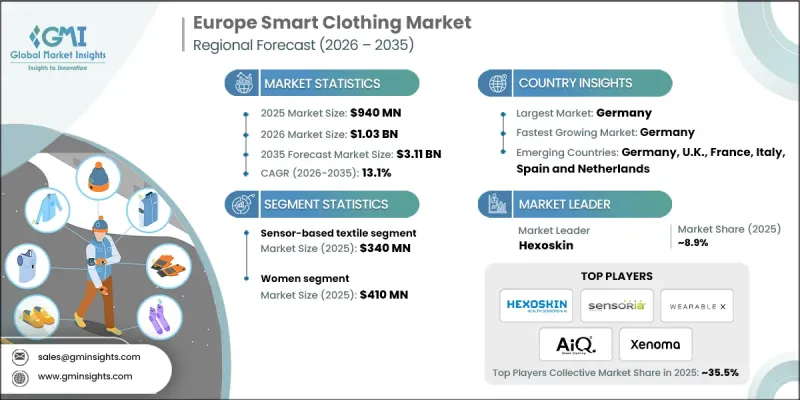
The region is becoming a central hub for advancements in textile-embedded electronics and intelligent data-driven fabric systems. This market now encompasses far more than basic activity-tracking items, evolving into a diverse range of connected apparel capable of sensing, analyzing, and reacting to real-time information. These technologies are increasingly important in fields such as healthcare, athletic performance, and workplace well-being. Growth is supported by shifting demographics, rising interest in wellness, and substantial public and private investment in digital transformation. Key European economies, including the UK, France, and Germany, are accelerating adoption through strong tech capabilities and consistent consumer interest in next-generation wearable fabrics. The appeal of these garments lies in their ability to gather continuous, comfortable, and noninvasive data, offering capabilities beyond conventional wearables. However, long-term success depends on resolving challenges tied to data protection, battery efficiency, and the need for streamlined supply-chain coordination across various industries. Europe's aging population is also intensifying the demand for advanced health-monitoring solutions, placing additional strain on existing care systems.
| Market Scope | |
|---|---|
| Start Year | 2025 |
| Forecast Year | 2026-2035 |
| Start Value | $940 Million |
| Forecast Value | $3.11 Billion |
| CAGR | 13.1% |
The sensor-integrated apparel segment generated USD 340 million in 2025 and is forecasted to grow at a CAGR of 10.8% between 2026 and 2035. Its dominance stems from its technological readiness and flexibility to support medical monitoring, fitness tracking, and safety-driven applications. These products often include embedded biometric components that record vital information such as body temperature, respiratory activity, and heart performance-features that match the region's rising shift toward remote supervision and preventative medical care. European health systems continue prioritizing digital health tools, and garments equipped with sensors offer a seamless, long-duration monitoring method aligned with these objectives.
The women's category generated USD 410 million in 2025, holding 11.8% share. This leadership is driven by strong engagement with wellness-oriented and style-focused products, areas where smart fabrics naturally connect. Adoption patterns across Europe show high usage of wearable health-tracking devices among women, supporting the need for apparel designed around tailored biometric insights. Increasing interest in technology for women's health has further encouraged demand for connected garments engineered to address gender-specific comfort and monitoring requirements.
Germany Smart Clothing Market held 18.2% share and will grow at a CAGR of 12.5% through 2035. Europe's overall adoption is reinforced by initiatives geared toward sustainability, digital advancement, and modernization of the textile ecosystem. Regional policies promoting circular production, enhanced durability, and digital product credentials contribute to a favorable environment for smart clothing technologies. These efforts support innovation in connected fabrics and encourage broader use across medical, athletic, industrial, and protection-focused applications.
Prominent companies active in the Europe Smart Clothing Market include AiQ Smart Clothing Inc., Athos, CuteCircuit, Hexoskin, Intelligent Textiles Limited, Levi's, Mitsufuji Corporation, Myant Health, Inc., Myontec, Sensoria, Siren, TORAY INDUSTRIES, INC., Vulpes Electronics GmbH, Wearable X, and Xenoma. Key strategies used by companies to strengthen their position in the Europe Smart Clothing Market include accelerating product development through advanced textile engineering and integrating more accurate biometric systems to enhance reliability. Many organizations are investing heavily in R&D to refine fabric-embedded electronics while forming alliances with healthcare, athletic, and industrial partners to broaden use-case adoption. Brands are expanding their portfolios with garments that meet durability and recyclability goals to align with Europe's sustainability priorities. Firms are also improving data-security frameworks and creating standardized communication platforms to ensure compatibility across devices.
Table of Contents
Chapter 1 Methodology & Scope
- 1.1 Market scope and definition
- 1.2 Research design
- 1.2.1 Research approach
- 1.2.2 Data collection methods
- 1.3 Data mining sources
- 1.3.1 Europe
- 1.3.2 Regional/Country
- 1.4 Base estimates and calculations
- 1.4.1 Base year calculation
- 1.4.2 Key trends for market estimation
- 1.5 Primary research and validation
- 1.5.1 Primary sources
- 1.6 Forecast model
- 1.7 Research assumptions and limitations
Chapter 2 Executive Summary
- 2.1 Industry 3600 synopsis
- 2.2 Key market trends
- 2.2.1 Technology type trends
- 2.2.2 Price range trends
- 2.2.3 Consumer group trends
- 2.2.4 Application trends
- 2.2.5 End use trends
- 2.2.6 Distribution channel trends
- 2.2.7 Country trends
- 2.3 CXO perspective: Strategic imperatives
- 2.3.1 Key decision points for industry executives
- 2.3.2 Critical success factors for market players
- 2.4 Future outlook and strategic recommendations
- 2.5 Strategic recommendations
- 2.5.1 Supply chain diversification strategy
- 2.5.2 Product portfolio enhancement
- 2.5.3 Partnership and alliance opportunities
- 2.5.4 Cost management and pricing strategy
- 2.6 Decision framework
- 2.6.1 Investment priority matrix
- 2.6.2 Risk-adjusted ROI analysis
Chapter 3 Industry Insights
- 3.1 Industry ecosystem analysis
- 3.1.1 Supplier Landscape
- 3.1.2 Profit Margin
- 3.1.3 Value addition at each stage
- 3.1.4 Factor affecting the value chain
- 3.1.5 Disruptions
- 3.2 Industry Impact forces
- 3.2.1 Growth drivers
- 3.2.2 Industry pitfalls & challenges
- 3.2.3 Opportunities
- 3.3 Growth potential analysis
- 3.4 Pricing analysis, 2025
- 3.4.1 By Region
- 3.5 Future market trends
- 3.6 Risk assessment and mitigation
- 3.6.1 Regulatory compliance risks
- 3.6.2 Capacity constraint impact analysis
- 3.6.3 Technology transition risks
- 3.6.4 Pricing volatility and cost escalation risks
- 3.7 Consumer buying behavior analysis
- 3.7.1 Demographic trends
- 3.7.2 Factors affecting buying decisions
- 3.7.3 Consumer product adoption
- 3.7.4 Preferred distribution channel
- 3.7.5 Preferred price range
- 3.8 Porter's analysis
- 3.9 PESTEL analysis
Chapter 4 Competitive Landscape, 2025
- 4.1 Introduction
- 4.2 Company market share analysis
- 4.2.1 By Country
- 4.3 Company matrix analysis
- 4.4 Competitive analysis of major market players
- 4.5 Competitive positioning matrix
- 4.6 Key developments
- 4.6.1 Mergers & acquisitions
- 4.6.2 Partnerships & collaborations
- 4.6.3 New Product Launches
- 4.6.4 Expansion Plans
Chapter 5 Market Estimates & Forecast, By Technology Type, 2022 - 2035 (USD Billion) (Million Units)
- 5.1 Key trends
- 5.2 Sensor-based textile
- 5.3 Conductive thread textile
- 5.4 Photonic smart textile
- 5.5 IoT-connected textile
- 5.6 Others
Chapter 6 Market Estimates & Forecast, By Price Range, 2022 - 2035 (USD Billion) (Million Units)
- 6.1 Key trends
- 6.2 Low (Below USD 50)
- 6.3 Medium (USD 50 - USD 200)
- 6.4 High (Above USD 200)
Chapter 7 Market Estimates & Forecast, By Consumer Group, 2022 - 2035 (USD Billion) (Million Units)
- 7.1 Key trends
- 7.2 Men
- 7.3 Women
- 7.4 Kids
Chapter 8 Market Estimates & Forecast, By Application, 2022 - 2035 (USD Billion) (Million Units)
- 8.1 Key trends
- 8.2 Healthcare & medical monitoring
- 8.3 Sports & fitness performance
- 8.4 Industrial safety & workplace
- 8.5 Consumer lifestyle & fashion
Chapter 9 Market Estimates & Forecast, By End Use, 2022 - 2035 (USD Billion) (Million Units)
- 9.1 Key trends
- 9.2 Healthcare professionals & patients
- 9.3 Military & defense personnel
- 9.4 Professional athlete and fitness enthusiasts
- 9.5 Industrial workers
- 9.6 Others (General consumer, etc.)
Chapter 10 Market Estimates & Forecast, By Distribution Channel, 2022 - 2035 , (USD Billion) (Million Units)
- 10.1 Key trends
- 10.2 Online
- 10.2.1 E-commerce website
- 10.2.2 Brand website
- 10.3 Offline
- 10.3.1 Specialty stores
- 10.3.2 Fitness retail centers
- 10.3.3 Pop-up stores
- 10.3.4 Others
Chapter 11 Market Estimates & Forecast, By Region, 2022 - 2035 , (USD Billion) (Million Units)
- 11.1 Key trends
- 11.2 Germany
- 11.3 U.K.
- 11.4 France
- 11.5 Italy
- 11.6 Spain
- 11.7 Netherlands
- 11.8 Rest of Europe
Chapter 12 Company Profiles (Business Overview, Financial Data, Product Landscape, Strategic Outlook, SWOT Analysis)
- 12.1 AiQ Smart Clothing Inc.
- 12.2 Athos
- 12.3 CuteCircuit
- 12.4 Hexoskin
- 12.5 Intelligent Textiles Limited
- 12.6 Levi’s
- 12.7 Mitsufuji Corporation
- 12.8 Myant Health, Inc.
- 12.9 Myontec
- 12.10 Sensoria
- 12.11 Siren
- 12.12 TORAY INDUSTRIES, INC.
- 12.13 Vulpes Electronics GmbH
- 12.14 Wearable X
- 12.15 Xenoma

