
PUBLISHER: Global Market Insights Inc. | PRODUCT CODE: 1892754

PUBLISHER: Global Market Insights Inc. | PRODUCT CODE: 1892754
RF Front End Module Market Opportunity, Growth Drivers, Industry Trend Analysis, and Forecast 2026 - 2035
The Global RF Front End Module Market was valued at USD 28.7 billion in 2025 and is estimated to grow at a CAGR of 11.9% to reach USD 87.7 billion by 2035.
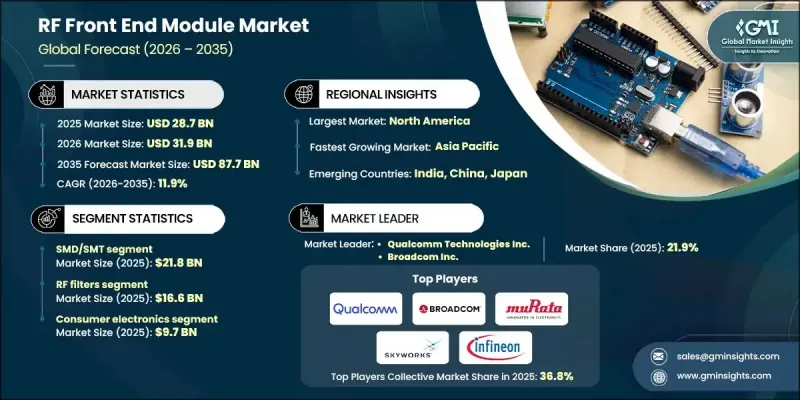
Growth is shaped by the ongoing rollout of 5G networks, rapid enhancements in wireless technologies, and rising adoption of connected devices across consumer, industrial, and automotive sectors. Increasing use of IoT, advancements in Wi-Fi 6/6E and upcoming Wi-Fi 7, and stronger demand for automotive radar and V2X communication systems continue to elevate the need for high-performance RF front-end modules. At the same time, sustainability and energy-efficient hardware design are becoming stronger priorities as industry stakeholders look for ways to reduce power consumption in next-generation wireless infrastructure. Initiatives focused on developing RF modules with significantly lower energy requirements are reinforcing this shift. Automation, AI-enabled production systems, and intelligent testing methods are also optimizing manufacturing processes, supporting higher reliability and improved consistency across FEM components. With these combined forces driving demand, the market continues to experience rapid technological shifts and strong momentum across major application areas.
| Market Scope | |
|---|---|
| Start Year | 2025 |
| Forecast Year | 2026-2035 |
| Start Value | $28.7 Billion |
| Forecast Value | $87.7 Billion |
| CAGR | 11.9% |
The SMD/SMT segment generated USD 21.8 billion in 2024. Demand is rising due to the need for compact, affordable, and high-performance components that maximize device space while enhancing efficiency across consumer electronics, automotive systems, and industrial applications. Manufacturers are encouraged to prioritize miniaturization, integration, and stringent quality standards.
The RF filters segment was valued at USD 16.6 billion in 2025 and remained the largest category. Growing reliance on reliable signal filtration within 5G, IoT, and wireless communication ecosystems continues to fuel development. Producers of RF filters are expected to create advanced designs that enhance signal clarity, minimize interference, and align with evolving connectivity standards.
United States RF Front End Module Market generated USD 7.3 billion in 2025. Growth is supported by expanding consumer electronics demand, federal investment in IoT infrastructure, and the increasing requirement for high-speed communication technologies within defense applications. Companies operating in the region are encouraged to strengthen their portfolios with advanced RF modules that support 5G expansion, IoT integration, and secure communication platforms.
Key players active in the Global RF Front End Module Market include Analog Devices Inc., Broadcom Inc., Infineon Technologies AG, L3Harris Technologies Inc., MACOM Technology Solutions, Murata Manufacturing Co. Ltd, NXP Semiconductors NV, Qorvo Inc., Qualcomm Technologies Inc., Renesas Electronics Corporation, Skyworks Solutions Inc., Microchip Technology Inc., OnMicro, Nisshinbo Micro Devices Inc., and Texas Instruments Incorporated. Leading companies in the Global RF Front End Module Market are advancing their competitive position by investing in high-efficiency designs, developing low-power architectures, and expanding product portfolios that support emerging wireless standards. Many manufacturers are strengthening their R&D efforts to enhance signal performance, broaden frequency support, and optimize integration for compact devices. Partnerships with telecom providers, semiconductor firms, and system integrators enable companies to accelerate innovation and align with the rapid pace of 5G and IoT deployments.
Table of Contents
Chapter 1 Methodology and scope
- 1.1 Market scope and definition
- 1.2 Research design
- 1.2.1 Research approach
- 1.2.2 Data collection methods
- 1.3 Data mining sources
- 1.3.1 Global
- 1.3.2 Regional/Country
- 1.4 Base estimates and calculations
- 1.4.1 Base year calculation
- 1.4.2 Key trends for market estimation
- 1.5 Primary research and validation
- 1.5.1 Primary sources
- 1.6 Forecast model
- 1.7 Research assumptions and limitations
Chapter 2 Executive summary
- 2.1 Industry 360° synopsis
- 2.2 Key market trends
- 2.2.1 Component trend
- 2.2.2 Mounting style trends
- 2.2.3 Connectivity trends
- 2.2.4 Cellular technology trends
- 2.2.5 Frequency trends
- 2.2.6 Application trends
- 2.2.7 End Use industry trends
- 2.2.8 Regional trends
- 2.3 TAM Analysis, 2025-2034 (USD Billion)
- 2.4 CXO perspectives: Strategic imperatives
- 2.4.1 Executive decision points
- 2.4.2 critical success factors
- 2.5 Future outlook and strategic recommendations
Chapter 3 Industry insights
- 3.1 Industry ecosystem analysis
- 3.1.1 Supplier landscape
- 3.1.2 Profit margin
- 3.1.3 Cost structure
- 3.1.4 Value addition at each stage
- 3.1.5 Factor affecting the value chain
- 3.1.6 Disruptions
- 3.2 Industry ecosystem analysis
- 3.3 Industry impact forces
- 3.3.1 Growth drivers
- 3.3.1.1 Growing demand for 5G and advanced wireless communication
- 3.3.1.2 Increasing adoption of IoT and connected devices
- 3.3.1.3 Rising smartphone and consumer electronics penetration
- 3.3.1.4 Expansion of Wi-Fi 6/6E and upcoming Wi-Fi 7 standards
- 3.3.1.5 Increasing demand in automotive radar and V2X communication
- 3.3.2 Pitfalls and challenges
- 3.3.2.1 Security concerns with wireless audio transmission
- 3.3.2.2 Interference issues in crowded wireless environments
- 3.3.3 Market opportunities
- 3.3.3.1 Expanding connected devices and applications
- 3.3.3.2 Advancements in wireless communication standards
- 3.3.1 Growth drivers
- 3.4 Growth potential analysis
- 3.5 Regulatory landscape
- 3.5.1 North America
- 3.5.2 Europe
- 3.5.3 Asia Pacific
- 3.5.4 Latin America
- 3.5.5 Middle East & Africa
- 3.6 Porter's analysis
- 3.7 PESTEL analysis
- 3.8 Technology and innovation landscape
- 3.8.1 Current technological trends
- 3.8.2 Emerging technologies
- 3.9 Emerging business models
- 3.10 Compliance requirements
- 3.11 Sustainability measures
- 3.12 Consumer sentiment analysis
- 3.13 Patent and IP analysis
- 3.14 Geopolitical and trade dynamics
Chapter 4 Competitive Landscape, 2024
- 4.1 Introduction
- 4.2 Company market share analysis
- 4.2.1 By region
- 4.2.1.1 North America
- 4.2.1.2 Europe
- 4.2.1.3 Asia Pacific
- 4.2.1.4 Latin America
- 4.2.1.5 Middle East & Africa
- 4.2.2 Market concentration analysis
- 4.2.1 By region
- 4.3 Competitive benchmarking of key players
- 4.3.1 Financial performance comparison
- 4.3.1.1 Revenue
- 4.3.1.2 Profit margin
- 4.3.1.3 R&D
- 4.3.2 Product portfolio comparison
- 4.3.2.1 Product range breadth
- 4.3.2.2 Technology
- 4.3.2.3 Innovation
- 4.3.3 Geographic presence comparison
- 4.3.3.1 Global footprint analysis
- 4.3.3.2 Service network coverage
- 4.3.3.3 Market penetration by region
- 4.3.4 Competitive positioning matrix
- 4.3.4.1 Leaders
- 4.3.4.2 Challengers
- 4.3.4.3 Followers
- 4.3.4.4 Niche players
- 4.3.5 Strategic outlook matrix
- 4.3.1 Financial performance comparison
- 4.4 Key developments, 2021-2024
- 4.4.1 Mergers and acquisitions
- 4.4.2 Partnerships and collaborations
- 4.4.3 Technological advancements
- 4.4.4 Expansion and investment strategies
- 4.4.5 Sustainability initiatives
- 4.4.6 Digital transformation initiatives
- 4.5 Emerging/ startup competitors landscape
Chapter 5 Market Estimates and Forecast, By Component, 2022 - 2035 (USD Billion)
- 5.1 Key trends
- 5.2 RF switches
- 5.3 Low noise amplifiers
- 5.4 Power amplifiers
- 5.5 RF filters
- 5.6 Others
Chapter 6 Market Estimates and Forecast, By Mounting Style, 2022 - 2035 (USD Billion)
- 6.1 Key trends
- 6.2 Through-hole
- 6.3 SMD/SMT
Chapter 7 Market Estimates and Forecast, By Connectivity, 2022 - 2035 (USD Billion)
- 7.1 Key trends
- 7.2 Wi-Fi
- 7.2.1 Wi-Fi 5
- 7.2.2 Wi-Fi 6/6E
- 7.2.3 Others
- 7.3 Bluetooth
- 7.4 Zigbee
- 7.5 Others
Chapter 8 Market Estimates and Forecast, By Cellular Technology, 2022 - 2035 (USD Billion)
- 8.1 Key trends
- 8.2 3G
- 8.3 4G
- 8.4 5G
- 8.5 Others
Chapter 9 Market Estimates and Forecast, By Frequency, 2022 - 2035 (USD Billion)
- 9.1 Key trends
- 9.2 Less than 2.5 GHz
- 9.3 2.5 to 3.5 GHz
- 9.4 Above 3.5 GHz to 5 GHz
- 9.5 Others
Chapter 10 Market Estimates and Forecast, By Application, 2022 - 2035 (USD Billion)
- 10.1 Key trends
- 10.2 Smartphones
- 10.3 PC
- 10.4 Tablets
- 10.5 Wearables
- 10.6 Industrial IoT
- 10.7 Mobile broadband
- 10.8 Others
Chapter 11 Market Estimates and Forecast, By End Use Industry, 2022 - 2035 (USD Billion)
- 11.1 Key trends
- 11.2 Consumer electronics
- 11.3 Automotive
- 11.4 Military & defense
- 11.5 Medical
- 11.6 Others
Chapter 12 Market Estimates and Forecast, By Region, 2022 - 2035 (USD Billion)
- 12.1 Key trends
- 12.2 North America
- 12.2.1 U.S.
- 12.2.2 Canada
- 12.3 Europe
- 12.3.1 Germany
- 12.3.2 UK
- 12.3.3 France
- 12.3.4 Spain
- 12.3.5 Italy
- 12.3.6 Netherlands
- 12.4 Asia Pacific
- 12.4.1 China
- 12.4.2 India
- 12.4.3 Japan
- 12.4.4 Australia
- 12.4.5 South Korea
- 12.5 Latin America
- 12.5.1 Brazil
- 12.5.2 Mexico
- 12.5.3 Argentina
- 12.6 Middle East and Africa
- 12.6.1 Saudi Arabia
- 12.6.2 South Africa
- 12.6.3 UAE
Chapter 13 Company profiles
- 13.1 Global Key Players
- 13.1.1 Analog Devices, Inc.
- 13.1.2 Broadcom Inc.
- 13.1.3 Qualcomm Technologies Inc.
- 13.1.4 Infineon Technologies AG
- 13.2 Regional Key Players
- 13.2.1 North America
- 13.2.1.1 L3Harris Technologies, Inc.
- 13.2.1.2 Qorvo Inc.
- 13.2.2 Europe
- 13.2.2.1 NXP Semiconductors NV
- 13.2.2.2 Renesas Electronics Corporation
- 13.2.3 Asia-Pacific
- 13.2.3.1 Murata Manufacturing Co. Ltd
- 13.2.3.2 Skyworks Solutions Inc.
- 13.2.1 North America
- 13.3 Disruptors / Niche Players
- 13.3.1 MACOM Technology Solutions
- 13.3.2 Microchip Technology Inc.
- 13.3.3 OnMicro
- 13.3.4 Nisshinbo Micro Devices Inc.
- 13.3.5 Texas Instruments Incorporated

