PUBLISHER: Global Market Insights Inc. | PRODUCT CODE: 1892763

PUBLISHER: Global Market Insights Inc. | PRODUCT CODE: 1892763
Phytosterols Market Opportunity, Growth Drivers, Industry Trend Analysis, and Forecast 2026 - 2035
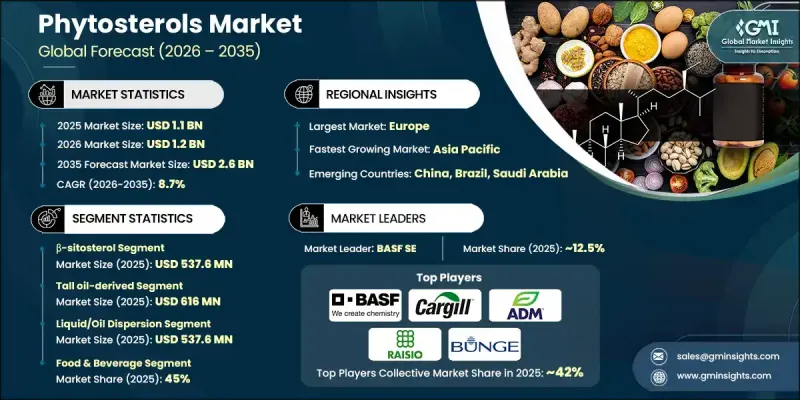
The Global Phytosterols Market was valued at USD 1.1 billion in 2025 and is estimated to grow at a CAGR of 8.7% to reach USD 2.6 billion by 2035.
Market growth is supported by rising demand for plant-based bioactive ingredients that support cardiovascular health and preventive nutrition. Phytosterols are naturally occurring plant compounds that share a structural resemblance with cholesterol and are widely recognized for their ability to limit cholesterol absorption in the digestive system. Increasing consumer focus on heart health, combined with the growing penetration of functional foods, dietary supplements, and pharmaceutical formulations, continues to strengthen market demand. Ongoing progress in extraction, purification, and formulation technologies has significantly improved product purity, stability, and absorption efficiency. Advanced processing methods have enabled broader incorporation of phytosterols into a wide range of food and wellness products while maintaining regulatory compliance and consistent quality. Improved formulation techniques have also helped overcome solubility challenges, supporting wider adoption across food, nutraceutical, and pharmaceutical supply chains. Together, these developments are positioning phytosterols as a high-value ingredient aligned with long-term health and wellness trends.
| Market Scope | |
|---|---|
| Start Year | 2025 |
| Forecast Year | 2026-2035 |
| Start Value | $1.1 Billion |
| Forecast Value | $2.6 Billion |
| CAGR | 8.7% |
The B-sitosterol segment generated USD 537.6 million in 2025. Its strong market position is supported by widespread availability from plant sources, favorable economics for large-scale production, and well-established cholesterol-lowering performance. Its broad acceptance across food, pharmaceutical, and nutraceutical applications continues to reinforce steady demand.
The tall oil-derived phytosterols segment reached USD 616 million in 2025. Their leadership is driven by cost efficiency, reliable raw material availability, and integration with established industrial processing infrastructure, supporting consistent production of high-purity sterol ingredients.
U.S. Phytosterols Market reached USD 245.2 million in 2025. Strong consumer awareness of cardiovascular health, a mature functional food sector, and advanced supplement manufacturing capabilities continue to support sustained demand for high-quality phytosterol ingredients that meet stringent regulatory standards.
Key companies operating in the Global Phytosterols Market include Cargill, Incorporated, BASF SE, Archer Daniels Midland, Wilmar International Ltd., Bunge Limited, Raisio Oyj, DuPont de Nemours / IFF, Kensing LLC, DRT (Les Derives Resiniques et Terpeniques), Vitae Naturals, Arboris LLC, Advanced Organic Materials (AOM) S.A., COFCO Biotechnology Co., Ltd., Ashland Global Holdings Inc., and Gustav Parmentier GmbH. Companies in the Global Phytosterols Market are strengthening their competitive position through investments in advanced extraction technologies, capacity expansion, and product purity enhancement. Strategic focus is placed on developing high-bioavailability formulations that align with functional food and nutraceutical trends. Partnerships with food manufacturers and supplement brands support long-term demand visibility and application-driven innovation.
Table of Contents
Chapter 1 Methodology & Scope
- 1.1 Market scope and definition
- 1.2 Research design
- 1.2.1 Research approach
- 1.2.2 Data collection methods
- 1.3 Data mining sources
- 1.3.1 Global
- 1.3.2 Regional/Country
- 1.4 Base estimates and calculations
- 1.4.1 Base year calculation
- 1.4.2 Key trends for market estimation
- 1.5 Primary research and validation
- 1.5.1 Primary sources
- 1.6 Forecast model
- 1.7 Research assumptions and limitations
Chapter 2 Executive Summary
- 2.1 Industry 360° synopsis
- 2.2 Key market trends
- 2.2.1 Sterol Grade
- 2.2.2 Source
- 2.2.3 Physical form
- 2.2.4 Application
- 2.2.5 Regional
- 2.3 TAM Analysis, 2025-2035
- 2.4 CXO perspectives: Strategic imperatives
- 2.4.1 Executive decision points
- 2.4.2 Critical success factors
- 2.5 Future outlook and strategic recommendations
Chapter 3 Industry Insights
- 3.1 Industry ecosystem analysis
- 3.1.1 Supplier landscape
- 3.1.2 Profit margin
- 3.1.3 Value addition at each stage
- 3.1.4 Factor affecting the value chain
- 3.1.5 Disruptions
- 3.2 Industry impact forces
- 3.2.1 Growth drivers
- 3.2.2 Industry pitfalls and challenges
- 3.2.3 Market opportunities
- 3.3 Growth potential analysis
- 3.4 Regulatory landscape
- 3.4.1 North America
- 3.4.2 Europe
- 3.4.3 Asia Pacific
- 3.4.4 Latin America
- 3.4.5 Middle East & Africa
- 3.5 Porter's analysis
- 3.6 PESTEL analysis
- 3.7 Technology and innovation landscape
- 3.7.1 Current technological trends
- 3.7.2 Emerging technologies
- 3.8 Price trends
- 3.8.1 By region
- 3.8.2 By sterol type
- 3.9 Future market trends
- 3.10 Technology and innovation landscape
- 3.10.1 Current technological trends
- 3.10.2 Emerging technologies
- 3.11 Patent landscape
- 3.12 Trade statistics (HS code)( Note: the trade statistics will be provided for key countries only)
- 3.12.1 Major importing countries
- 3.12.2 Major exporting countries
- 3.13 Sustainability and environmental aspects
- 3.13.1 Sustainable practices
- 3.13.2 Waste reduction strategies
- 3.13.3 Energy efficiency in production
- 3.13.4 Eco-friendly initiatives
- 3.14 Carbon footprint consideration
Chapter 4 Competitive Landscape, 2025
- 4.1 Introduction
- 4.2 Company market share analysis
- 4.2.1 By region
- 4.2.1.1 North America
- 4.2.1.2 Europe
- 4.2.1.3 Asia Pacific
- 4.2.1.4 LATAM
- 4.2.1.5 MEA
- 4.2.1 By region
- 4.3 Company matrix analysis
- 4.4 Competitive analysis of major market players
- 4.5 Competitive positioning matrix
- 4.6 Key developments
- 4.6.1 Mergers & acquisitions
- 4.6.2 Partnerships & collaborations
- 4.6.3 New product launches
- 4.6.4 Expansion plans
Chapter 5 Market Estimates and Forecast, By Sterol Type, 2022-2035 (USD Billion) (Kilo Tons)
- 5.1 Key trends
- 5.2 Β-sitosterol
- 5.3 Campesterol
- 5.4 Stigmasterol
- 5.5 Β-sitostanol
- 5.6 Campestanol
- 5.7 Brassicasterol
- 5.8 Fucosterol
- 5.9 Others
Chapter 6 Market Estimates and Forecast, By Source, 2022-2035 (USD Billion) (Kilo Tons)
- 6.1 Key trends
- 6.2 Tall oil-derived
- 6.3 Soybean-derived
- 6.4 Sunflower-derived
- 6.5 Rapeseed/canola-derived
- 6.6 Rice bran-derived
- 6.7 Other plant sources
Chapter 7 Market Estimates and Forecast, By Physical Form, 2022-2035 (USD Billion) (Kilo Tons)
- 7.1 Key trends
- 7.2 Liquid / oil dispersion
- 7.3 Powder / crystalline
- 7.4 Microencapsulated
- 7.5 Emulsion
- 7.6 Micronized / nano-sized
Chapter 8 Market Estimates and Forecast, By Application, 2022-2035 (USD Billion) (Kilo Tons)
- 8.1 Key trends
- 8.2 Food & beverage
- 8.2.1 Spreads & margarines
- 8.2.2 Dairy products
- 8.2.3 Beverages
- 8.2.4 Bakery products
- 8.2.5 Snack bars & confectionery
- 8.2.6 Others
- 8.3 Pharmaceuticals
- 8.3.1 Cholesterol management
- 8.3.2 Atherosclerosis prevention
- 8.3.3 BPH treatment
- 8.3.4 Anti-inflammatory therapies
- 8.3.5 Cancer prevention & adjunct therapy
- 8.3.6 Metabolic syndrome management
- 8.4 Nutraceuticals & dietary supplements
- 8.5 Cosmetics & personal care
- 8.5.1 Moisturizers & creams
- 8.5.2 Anti-aging formulations
- 8.5.3 Skin care
- 8.5.4 Hair care products
- 8.5.5 Lip care
- 8.5.6 Sun care
- 8.5.7 Others
- 8.6 Animal nutrition & veterinary
Chapter 9 Market Estimates and Forecast, By Region, 2022-2035 (USD Billion) (Kilo Tons)
- 9.1 Key trends
- 9.2 North America
- 9.2.1 U.S.
- 9.2.2 Canada
- 9.3 Europe
- 9.3.1 Germany
- 9.3.2 UK
- 9.3.3 France
- 9.3.4 Spain
- 9.3.5 Italy
- 9.3.6 Rest of Europe
- 9.4 Asia Pacific
- 9.4.1 China
- 9.4.2 India
- 9.4.3 Japan
- 9.4.4 Australia
- 9.4.5 South Korea
- 9.4.6 Rest of Asia Pacific
- 9.5 Latin America
- 9.5.1 Brazil
- 9.5.2 Mexico
- 9.5.3 Argentina
- 9.5.4 Rest of Latin America
- 9.6 Middle East and Africa
- 9.6.1 Saudi Arabia
- 9.6.2 South Africa
- 9.6.3 UAE
- 9.6.4 Rest of Middle East and Africa
Chapter 10 Company Profiles
- 10.1 ExxonMobil Corporation
- 10.2 Royal Dutch Shell plc
- 10.3 Chevron Corporation
- 10.4 Petro-Canada/Suncor Energy
- 10.5 Sonneborn LLC
- 10.6 H&R Group (Hansen & Rosenthal KG)
- 10.7 FUCHS Petrolub SE
- 10.8 APAR Industries Limited
- 10.9 Savita Oil Technologies Ltd.
- 10.10 Panama Petrochem Ltd.
- 10.11 Raj Petro Specialities Pvt. Ltd.
- 10.12 Lodha Petro
- 10.13 SEOJIN Chemical Co., Ltd.
- 10.14 JX Nippon Oil & Energy Corporation

