PUBLISHER: Global Market Insights Inc. | PRODUCT CODE: 1892777

PUBLISHER: Global Market Insights Inc. | PRODUCT CODE: 1892777
Dropshipping Market Opportunity, Growth Drivers, Industry Trend Analysis, and Forecast 2026 - 2035
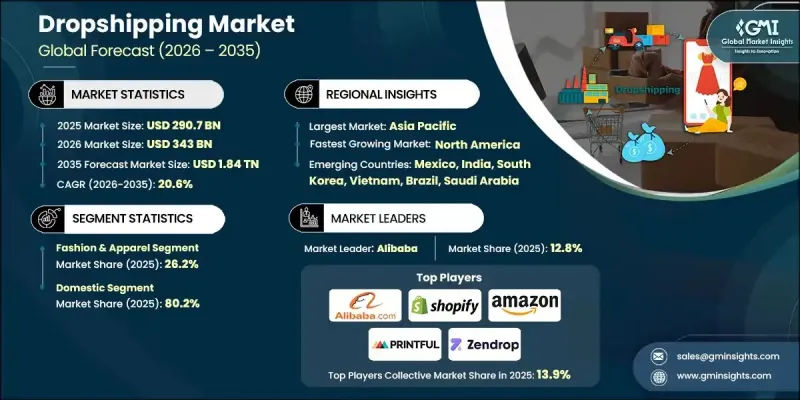
The Global Dropshipping Market was valued at USD 290.7 billion in 2025 and is estimated to grow at a CAGR of 20.6% to reach USD 1.84 trillion by 2035.
The market's rapid growth is fueled by the accessibility of cost-effective social media advertising, which allows small and medium-sized enterprises to promote products to highly targeted audiences at minimal expense. Platforms provide tools to optimize ad performance, track engagement, and refine strategies in real time, increasing visibility and conversion rates. Over 27% of retailers now use dropshipping for order fulfillment, as it eliminates the need to maintain inventory while offering flexibility to update product catalogs and diversify offerings. The model's profitability, with potential profit margins of 10-15%, attracts new entrants by reducing financial risk and enabling rapid expansion. E-commerce platforms and independent online stores benefit from dropshipping by improving cash flow and offering products only when customers place orders.
| Market Scope | |
|---|---|
| Start Year | 2025 |
| Forecast Year | 2026-2035 |
| Start Value | $290.7 Billion |
| Forecast Value | $1.84 Trillion |
| CAGR | 20.6% |
The fashion & apparel segment held a 26.2% share in 2025, driven by the visual appeal and variety that fashion products offer online. Electronics also contribute significantly due to global standards and frequent product upgrades. Other rising categories include Home & Kitchen, Beauty & Personal Care, Health & Wellness, Toys & Baby, and Sporting Goods, all of which are benefiting from growing e-commerce adoption.
The domestic segment held an 80.2% share in 2025, as local fulfillment ensures faster delivery, easier returns, and simple payment processes. However, cross-border dropshipping is accelerating, supported by improved logistics and broader access to international products, making global operations increasingly attractive for merchants.
U.S. Dropshipping Market reached USD 48.2 billion in 2025. Growth is supported by advanced digital infrastructure, high e-commerce adoption, widespread internet and smartphone use, and a secure digital payment ecosystem. The U.S. market also benefits from strong logistics networks and a business-friendly environment, enabling small businesses to launch dropshipping ventures quickly while leveraging established e-commerce platforms.
Key players in the Global Dropshipping Market include Amazon, Spocket, Shopify, Printful, DSers, Zendrop, SaleHoo, Alibaba, AutoDS, and CJ Dropshipping. Companies in the Dropshipping Market are adopting multiple strategies to strengthen their foothold. They are expanding product catalogs and supplier networks to offer a wider variety of items and reduce stockout risks. Strategic partnerships with e-commerce platforms and logistics providers improve delivery speed, tracking, and overall service quality. Investing in digital marketing, especially targeted social media advertising, enhances visibility and conversion rates. Automation tools for order processing, inventory tracking, and customer support are being implemented to improve operational efficiency. Businesses are also leveraging analytics and AI to forecast demand, optimize pricing, and tailor offerings to regional markets.
Table of Contents
Chapter 1 Methodology
- 1.1 Market scope and definition
- 1.2 Research design
- 1.2.1 Research approach
- 1.2.2 Data collection methods
- 1.3 Data mining sources
- 1.3.1 Global
- 1.3.2 Regional/Country
- 1.4 Base estimates and calculations
- 1.4.1 Base year calculation
- 1.4.2 Key trends for market estimation
- 1.5 Primary research and validation
- 1.5.1 Primary sources
- 1.6 Forecast
- 1.7 Research assumptions and limitations
Chapter 2 Executive Summary
- 2.1 Industry 3600 synopsis
- 2.2 Key market trends
- 2.2.1 Regional
- 2.2.2 Product
- 2.2.3 Destination
- 2.2.4 Business model
- 2.2.5 Sales channel
- 2.3 TAM analysis, 2026-2035
- 2.4 CXO perspectives: Strategic imperatives
- 2.4.1 Executive decision points
- 2.4.2 Critical success factors
- 2.5 Future outlook and recommendations
Chapter 3 Industry Insights
- 3.1 Industry ecosystem analysis
- 3.1.1 Supplier landscape
- 3.1.2 Profit margin
- 3.1.3 Cost structure
- 3.1.4 Value addition at each stage
- 3.1.5 Factor affecting the value chain
- 3.1.6 Disruptions
- 3.2 Industry impact forces
- 3.2.1 Growth drivers
- 3.2.1.1 Low barrier to entry for entrepreneurs
- 3.2.1.2 Growth of global e-commerce
- 3.2.1.3 Rise of social commerce & mobile shopping
- 3.2.1.4 Expansion of cross-border E-commerce
- 3.2.2 Industry pitfalls and challenges
- 3.2.2.1 Long shipping times from overseas suppliers
- 3.2.2.2 Supplier reliability issues
- 3.2.3 Market opportunities
- 3.2.3.1 Niche & micro-niche market targeting
- 3.2.3.2 Domestic/regional supplier networks
- 3.2.3.3 B2B dropshipping growth
- 3.2.3.4 Influencer-driven commerce integration
- 3.2.1 Growth drivers
- 3.3 Growth potential analysis
- 3.4 Regulatory landscape
- 3.4.1 North America
- 3.4.2 Europe
- 3.4.3 Asia Pacific
- 3.4.4 Latin America
- 3.4.5 Middle East & Africa
- 3.5 Porter's analysis
- 3.6 PESTEL analysis
- 3.7 Technology and innovation landscape
- 3.7.1 Current technological trends
- 3.7.2 Emerging technologies
- 3.7.3 Technology roadmaps & evolution
- 3.7.4 Technology adoption lifecycle analysis
- 3.8 Price trends
- 3.8.1 By region
- 3.8.2 By product
- 3.9 Patent analysis
- 3.10 Industry ecosystem & value chain analysis
- 3.10.1 Supplier/wholesaler layer
- 3.10.2 Platform/technology layer
- 3.10.3 Merchant/retailer layer
- 3.10.4 Logistics/fulfillment layer
- 3.10.5 End-consumer layer
- 3.11 Customer demographics & behavior analysis
- 3.11.1 Age distribution
- 3.11.2 Income levels & spending patterns
- 3.11.3 Geographic distribution of dropshipping customers
- 3.11.4 Shopping frequency & average order value
- 3.12 Marketing channels & customer acquisition strategies
- 3.12.1 Paid advertising landscape
- 3.12.2 Facebook & Instagram ads
- 3.12.3 Google ads
- 3.12.4 Organic marketing strategies
- 3.13 Regional business model variations & trends
- 3.13.1 North America dropshipping dynamics
- 3.13.2 Europe dropshipping characteristics
- 3.13.3 Asia-Pacific dropshipping trends
- 3.13.4 Latin America dropshipping challenges & opportunities
- 3.13.5 Middle East & Africa emerging patterns
- 3.14 Payment methods & fintech integration
- 3.14.1 Credit & debit cards
- 3.14.2 Digital wallets
- 3.14.3 Buy now pay later (BNPL) solutions
- 3.14.4 Cash on delivery (COD) in emerging markets
- 3.15 Quality control & customer service models
- 3.15.1 Quality assurance challenges in dropshipping
- 3.15.2 Inspection services & third-party auditors
- 3.15.3 Customer service infrastructure
- 3.15.4 Returns & refunds management
- 3.15.5 Dispute resolution & chargeback management
- 3.16 Branding, packaging & customer experience
- 3.16.1 Private labeling & custom branding trends
- 3.16.2 Custom packaging solutions
- 3.16.3 Product photography & visual merchandising
- 3.16.4 Store design & user experience (UX) optimization
- 3.16.5 Brand storytelling & differentiation strategies
- 3.17 Seasonal trends & demand patterns
- 3.17.1 Holiday season impact
- 3.17.2 Back-to-school season
- 3.17.3 Summer shopping patterns
- 3.17.4 Category-specific seasonality
- 3.17.5 Regional festival & cultural events
- 3.18 Tariff & trade policy analysis
- 3.18.1. 2025 U.S. tariff changes & de minimis elimination
- 3.18.2 Impact on cost structure
- 3.18.3 HS code classification challenges
- 3.18.4 Customs clearance procedures & delays
- 3.18.5 Regional trade agreements impact
- 3.19 Supply chain & logistics analysis
- 3.19.1 Global supplier networks
- 3.19.2 Warehouse & fulfillment infrastructure
- 3.19.3 Last-mile delivery challenges
- 3.19.4 Express delivery services growth
- 3.19.5 Reverse logistics & returns management
- 3.20 Mobile commerce & device trends
- 3.20.1 Mobile vs desktop shopping patterns
- 3.20.2 Mobile app vs mobile web performance
- 3.20.3 Progressive web apps (PWAs) adoption
- 3.21 Best case scenarios
Chapter 4 Competitive Landscape, 2025
- 4.1 Introduction
- 4.2 Company market share analysis
- 4.2.1 North America
- 4.2.2 Europe
- 4.2.3 Asia Pacific
- 4.2.4 LATAM
- 4.2.5 MEA
- 4.3 Competitive analysis of major market players
- 4.4 Competitive positioning matrix
- 4.5 Strategic outlook matrix
- 4.6 Key developments
- 4.6.1 Mergers & acquisitions
- 4.6.2 Partnerships & collaborations
- 4.6.3 New product launches
- 4.6.4 Expansion plans and funding
- 4.7 Vendor selection criteria
Chapter 5 Market Estimates & Forecast, By Product, 2022 - 2035 ($Mn, Number of Orders)
- 5.1 Key trends
- 5.2 Electronics
- 5.3 Fashion & apparel
- 5.3.1 Precious metal & jewelry
- 5.3.2 Clothes
- 5.3.3 Footwear
- 5.3.4 Others
- 5.4 Home & kitchen
- 5.5 Beauty & personal care
- 5.6 Health & wellness
- 5.7 Toys & baby products
- 5.8 Sporting goods
- 5.9 Others
- 5.9.1 Food & beverages
- 5.9.2 Automotive & car accessories
- 5.9.3 Furniture & home furnishings
- 5.9.4 Hobby & DIY
- 5.9.5 Media
Chapter 6 Market Estimates & Forecast, By Destination, 2022 - 2035 ($Mn, Number of Orders)
- 6.1 Key trends
- 6.2 Domestic
- 6.3 International
Chapter 7 Market Estimates & Forecast, By Business Model, 2022 - 2035 ($Mn, Number of Orders)
- 7.1 Key trends
- 7.2 B2C
- 7.3 B2B
- 7.3.1 SMEs
- 7.3.2 Large enterprises
- 7.4 C2C
Chapter 8 Market Estimates & Forecast, By Sales Channel, 2022 - 2035 ($Mn, Number of Orders)
- 8.1 Key trends
- 8.2 Online marketplaces
- 8.3 Branded e-commerce stores
- 8.4 Social commerce platforms
Chapter 9 Market Estimates & Forecast, By Region, 2022 - 2035 ($Mn, Number of Orders)
- 9.1 Key trends
- 9.2 North America
- 9.2.1 US
- 9.2.2 Canada
- 9.3 Europe
- 9.3.1 Germany
- 9.3.2 UK
- 9.3.3 France
- 9.3.4 Italy
- 9.3.5 Spain
- 9.3.6 Russia
- 9.3.7 Nordics
- 9.3.8 Benelux
- 9.4 Asia Pacific
- 9.4.1 China
- 9.4.2 India
- 9.4.3 Japan
- 9.4.4 South Korea
- 9.4.5 ANZ
- 9.4.6 Singapore
- 9.4.7 Malaysia
- 9.4.8 Indonesia
- 9.4.9 Vietnam
- 9.4.10 Thailand
- 9.5 Latin America
- 9.5.1 Brazil
- 9.5.2 Mexico
- 9.5.3 Argentina
- 9.5.4 Colombia
- 9.6 MEA
- 9.6.1 South Africa
- 9.6.2 Saudi Arabia
- 9.6.3 UAE
Chapter 10 Company Profiles
- 10.1 Global companies
- 10.1.1 Shopify
- 10.1.2 Amazon
- 10.1.3 eBay
- 10.1.4 Alibaba
- 10.1.5 BigCommerce
- 10.1.6 WooCommerce
- 10.1.7 Etsy
- 10.1.8 Walmart
- 10.2 Regional companies
- 10.2.1 SaleHoo
- 10.2.2 Doba
- 10.2.3. Wholesale2B
- 10.2.4 DropCommerce
- 10.2.5 Trendsi
- 10.3 Emerging companies
- 10.3.1 Spocket
- 10.3.2 CJdropshipping
- 10.3.3 DSers
- 10.3.4 Modalyst
- 10.3.5 Zendrop
- 10.3.6 AutoDS
- 10.3.7 Syncee
- 10.3.8 Printful
- 10.3.9 Printify
- 10.3.10 Gelato
- 10.3.11 SPOD

