
PUBLISHER: Global Market Insights Inc. | PRODUCT CODE: 1892784

PUBLISHER: Global Market Insights Inc. | PRODUCT CODE: 1892784
Eyelash Serum Market Opportunity, Growth Drivers, Industry Trend Analysis, and Forecast 2025 - 2034
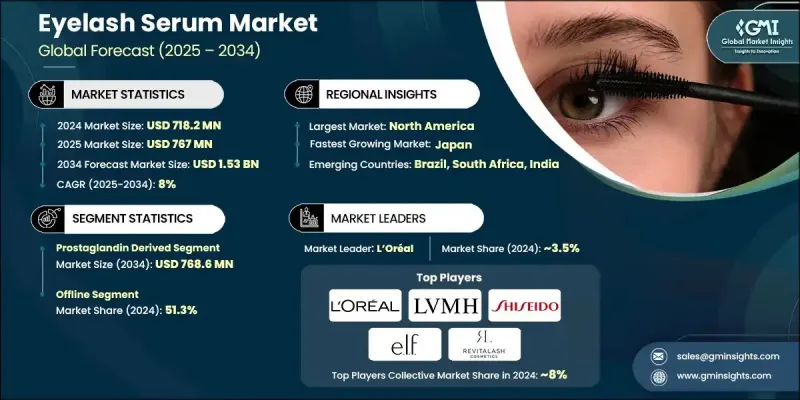
The Global Eyelash Serum Market was valued at USD 718.2 million in 2024 and is estimated to grow at a CAGR of 8% to reach USD 1.53 billion by 2034.
Demand is growing as consumers move away from high-maintenance lash enhancement methods and look for easier solutions that deliver natural-looking length without extensions or artificial lashes. Eyelash serums appeal to individuals who want noticeable results without procedures or long-term commitments, offering a safer and more convenient option. Many buyers also gravitate toward serums because they are considered appropriate for routine use when applied correctly, encouraging shoppers who value gentle beauty solutions to choose them instead of alternatives. The rising popularity of these products reflects a broader shift in beauty habits, where people increasingly focus on self-care and prefer items that support their natural features. At the same time, clean beauty preferences are reshaping purchase decisions, with customers prioritizing formulas that avoid potentially harmful ingredients and align with ethical and environmentally conscious values.
| Market Scope | |
|---|---|
| Start Year | 2024 |
| Forecast Year | 2025-2034 |
| Start Value | $718.2 Million |
| Forecast Value | $1.53 Billion |
| CAGR | 8% |
The prostaglandin-derived segment generated USD 314.2 million in 2024 and is projected to reach USD 768.6 million by 2034. This ingredient class maintains its dominance because it delivers more noticeable and faster lash improvements than formulations based on peptides or vitamins. Prostaglandin derivatives are highly effective due to their ability to extend the anagen phase of the lash growth cycle, resulting in visibly longer, thicker, and darker eyelashes.
The offline channel generated USD 368.1 million in 2024, holding a 51.3% share. Consumers continue to rely on physical stores when purchasing products applied near the eyes, as they want reassurance about product authenticity and safety. Shoppers often prefer examining expiration dates, confirming ingredient information, and speaking with trained advisors before committing to a purchase, which reinforces the strength of this distribution channel.
U.S. Eyelash Serum Market generated USD 185.9 million in 2024 and is expected to grow at a CAGR of 7.2% from 2025 to 2034. Strong spending power and a well-established beauty culture contribute to the country's leading role within the region. Consumer investment in personal care continues climbing steadily, supported by higher annual expenditures across households. Rising interest in specialty beauty categories, along with ongoing enthusiasm for cosmetic enhancement without invasive procedures, has further increased demand for lash-focused products.
Key companies active in the Global Eyelash Serum Market include Biolyn, DHC, and E.l.f. Cosmetics, Grande Cosmetics, JB Cosmetics, L'Oreal, LVMH, Mavala, Neora, Pacifica Beauty, RevitaLash, Shiseido, Skin Research Laboratories, Too Faced, and Uklash. Companies in the Global Eyelash Serum Market are strengthening their competitive position by developing cleaner, safer, and more transparent ingredient profiles to meet rising consumer expectations. Many brands are reformulating products to highlight dermatologist-tested and irritation-free claims, widening their appeal to sensitive-skin users. Investments in clinical testing and scientific validation help manufacturers build trust and differentiate results-driven formulas. Digital engagement strategies, including influencer partnerships and social media campaigns, are expanding brand visibility and driving direct-to-consumer sales.
Table of Contents
Chapter 1 Methodology & Scope
- 1.1 Market scope and definition
- 1.2 Research design
- 1.2.1 Research approach
- 1.2.2 Data collection methods
- 1.3 Data mining sources
- 1.3.1 Global
- 1.3.2 Regional/Country
- 1.4 Base estimates and calculations
- 1.4.1 Base year calculation
- 1.4.2 Key trends for market estimation
- 1.5 Primary research and validation
- 1.5.1 Primary sources
- 1.6 Forecast model
- 1.7 Research assumptions and limitations
Chapter 2 Executive Summary
- 2.1 Industry 360° synopsis
- 2.2 Key market trends
- 2.2.1 Regional trends
- 2.2.2 Product type trends
- 2.2.3 End Use trends
- 2.2.4 Price trends
- 2.2.5 Distribution channel trends
- 2.3 CXO perspective: Strategic imperatives
- 2.3.1 Key decision points for industry executives
- 2.3.2 Critical success factors for market players
- 2.4 Future outlook and strategic recommendations
- 2.5 Strategic recommendations
- 2.5.1 Supply chain diversification strategy
- 2.5.2 Product portfolio enhancement
- 2.5.3 Partnership and alliance opportunities
- 2.5.4 Cost management and pricing strategy
- 2.6 Decision framework
- 2.6.1 Investment priority matrix
- 2.6.2 ROI analysis
Chapter 3 Industry Insights
- 3.1 Industry ecosystem analysis
- 3.1.1 Supplier landscape
- 3.1.2 Profit margin
- 3.1.3 Value addition at each stage
- 3.1.4 Factor affecting the value chain
- 3.2 Industry impact forces
- 3.2.1 Growth drivers
- 3.2.2 Industry pitfalls & challenges
- 3.2.3 Opportunities
- 3.3 Growth potential analysis
- 3.4 Future market trends
- 3.5 Price trends
- 3.5.1 By Region
- 3.5.2 By Product type
- 3.6 Regulatory framework
- 3.7 Consumer buying behavior analysis
- 3.7.1 Demographic trends
- 3.7.2 Factors affecting buying decisions
- 3.7.3 Consumer product adoption
- 3.7.4 Preferred distribution channel
- 3.7.5 Preferred price range
- 3.8 Porter's five forces analysis
- 3.9 PESTEL analysis
Chapter 4 Competitive Landscape, 2024
- 4.1 Introduction
- 4.2 Company market share analysis
- 4.2.1 By Region
- 4.3 Company matrix analysis
- 4.4 Competitive analysis of major market players
- 4.5 Competitive positioning matrix
- 4.6 Product portfolio benchmarking
- 4.7 Key developments
- 4.7.1 Mergers & acquisitions
- 4.7.2 Partnerships & collaborations
- 4.7.3 New Product Launches
- 4.7.4 Expansion Plans
Chapter 5 Market Estimates & Forecast, By Product Type, 2021 - 2034 (USD Million) (Thousand Units)
- 5.1 Key trends
- 5.2 Prostaglandin derived
- 5.3 Peptide based
- 5.4 Vitamin based
Chapter 6 Market Estimates & Forecast, By End Use, 2021 - 2034 (USD Million) (Thousand Units)
- 6.1 Key trends
- 6.2 Women
- 6.3 Men
Chapter 7 Market Estimates & Forecast, By Price, 2021 - 2034 (USD Million) (Thousand Units)
- 7.1 Key trends
- 7.2 Low
- 7.3 Medium
- 7.4 High
Chapter 8 Market Estimates & Forecast, By Distribution Channel, 2021 - 2034, (USD Million) (Thousand Units)
- 8.1 Key trends
- 8.2 Online
- 8.2.1 E-Commerce website
- 8.2.2 Company owned website
- 8.3 Offline
- 8.3.1 Department stores
- 8.3.2 Pharmaceutical stores
- 8.3.3 Beauty salons
Chapter 9 Market Estimates & Forecast, By Region, 2021 - 2034, (USD Million) (Thousand Units)
- 9.1 Key trends
- 9.2 North America
- 9.2.1 U.S.
- 9.2.2 Canada
- 9.3 Europe
- 9.3.1 Germany
- 9.3.2 U.K.
- 9.3.3 France
- 9.3.4 Italy
- 9.3.5 Spain
- 9.4 Asia Pacific
- 9.4.1 China
- 9.4.2 India
- 9.4.3 Japan
- 9.4.4 South Korea
- 9.4.5 Australia
- 9.5 Latin America
- 9.5.1 Brazil
- 9.5.2 Mexico
- 9.5.3 Argentina
- 9.6 MEA
- 9.6.1 UAE
- 9.6.2 Saudi Arabia
- 9.6.3 South Africa
Chapter 10 Company Profiles (Business Overview, Financial Data, Product Landscape, Strategic Outlook, SWOT Analysis)
- 10.1 Biolyn
- 10.2 DHC
- 10.3 E.l.f. Cosmetics
- 10.4 Grande Cosmetics
- 10.5 JB Cosmetics
- 10.6 L’Oreal
- 10.7 LVMH
- 10.8 Mavala
- 10.9 Neora
- 10.10 Pacifica Beauty
- 10.11 RevitaLash
- 10.12 Shiseido
- 10.13 Skin Research Laboratories
- 10.14 Too Faced
- 10.15 Uklash

