PUBLISHER: Global Market Insights Inc. | PRODUCT CODE: 1892802

PUBLISHER: Global Market Insights Inc. | PRODUCT CODE: 1892802
Luxury Footwear Market Opportunity, Growth Drivers, Industry Trend Analysis, and Forecast 2025 - 2034
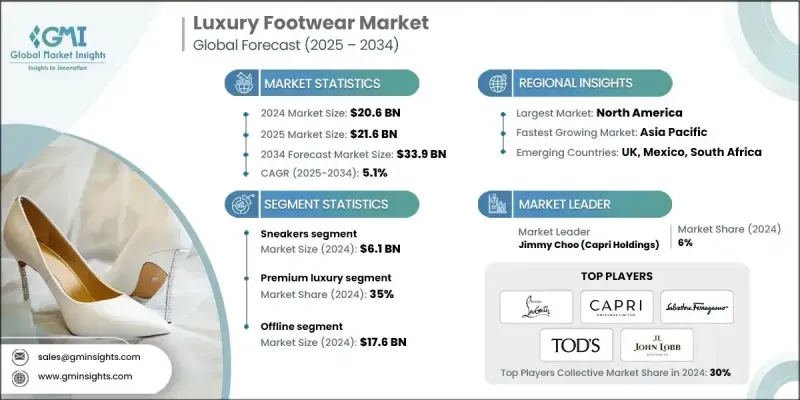
The Global Luxury Footwear Market was valued at USD 20.6 billion in 2024 and is estimated to grow at a CAGR of 5.1% to reach USD 33.9 billion by 2034.
Luxury shoes have evolved from simple functional items to symbols of personal identity, exclusivity, and social standing. Consumers increasingly gravitate toward footwear that reflects craftsmanship, brand heritage, and a premium positioning. As demand for high-end fashion deepens, premiumization continues to elevate the market by emphasizing limited releases, artisan-made designs, and collaborations that reinforce rarity and brand desirability. These factors strengthen the emotional connection between luxury labels and their audience, who value individuality and the prestige tied to longstanding brand traditions. Lifestyle changes are also shaping buying behavior as luxury footwear becomes part of daily fashion choices, blending comfort with sophisticated style for both casual and formal settings. The expansion of luxury athleisure highlights how fashion-forward, performance-inspired designs are driving new opportunities, underscoring the merging boundaries between functionality, high fashion, and everyday wear.
| Market Scope | |
|---|---|
| Start Year | 2024 |
| Forecast Year | 2025-2034 |
| Start Value | $20.6 Billion |
| Forecast Value | $33.9 Billion |
| CAGR | 5.1% |
The sneakers segment generated USD 6.1 billion in 2024. These styles have evolved into defining fashion statements that showcase personal taste and status. Their mix of comfort and visual appeal allows brands to deliver distinct designs that attract collectors and trend-focused consumers. Limited drops, unique styling, and partnerships with influential names help luxury sneaker lines maintain high demand.
The premium luxury tier represented 35% share in 2024. This segment continues to grow due to the importance consumers place on authenticity and brand heritage. Luxury houses cultivate emotional engagement by highlighting the craftsmanship, design narrative, and traditions behind each product. Through curated campaigns, flagship store experiences, and selective partnerships, these brands reinforce their legacy while offering modern interpretations that appeal to contemporary fashion preferences.
U.S. Luxury Footwear Market held 73.7% share in 2024. Demand in the country is supported by strong fashion influence, high purchasing power, and consumer preference for products that merge innovation, comfort, and exclusivity. Sneakers continue to dominate the style landscape, while sustainability-oriented designs and customization are emerging as key differentiators within the U.S. luxury footwear sector.
Key companies active in the Global Luxury Footwear Market include Berluti (LVMH), Bottega Veneta (Kering), Brunello Cucinelli, Christian Louboutin, Crockett & Jones, Edward Green, J.M. Weston, Jimmy Choo (Capri Holdings), John Lobb (Hermes), Manolo Blahnik, Paraboot, Prada, Salvatore Ferragamo, Santoni, and Tod's Group. Companies in the Global Luxury Footwear Market are strengthening their competitive edge by expanding their artisanal craftsmanship, enhancing personalization options, and incorporating sustainable materials that appeal to modern luxury buyers. Brands are investing in exclusive product lines, heritage-driven storytelling, and collaborations that elevate desirability and reinforce status value. Many are prioritizing omnichannel strategies that blend immersive retail experiences with digitally enhanced touchpoints to increase customer engagement. Limited-edition releases and capsule collections help maintain scarcity while driving higher margins.
Table of Contents
Chapter 1 Methodology and Scope
- 1.1 Market scope and definition
- 1.2 Research design
- 1.2.1 Research approach
- 1.2.2 Data collection methods
- 1.3 Data mining sources
- 1.3.1 Global
- 1.3.2 Regional/Country
- 1.4 Base estimates and calculations
- 1.4.1 Base year calculation
- 1.4.2 Key trends for market estimation
- 1.5 Primary research and validation
- 1.5.1 Primary sources
- 1.6 Forecast model
- 1.7 Research assumptions and limitations
Chapter 2 Executive Summary
- 2.1 Industry 360° synopsis
- 2.2 Key market trends
- 2.2.1 Regional
- 2.2.2 Product type
- 2.2.3 Price
- 2.2.4 Consumer group
- 2.2.5 Distribution channel
- 2.3 CXO perspectives: Strategic imperatives
- 2.3.1 Key decision points for industry executives
- 2.3.2 Critical success factors for market players
- 2.4 Future outlook and strategic recommendations
Chapter 3 Industry Insights
- 3.1 Industry ecosystem analysis
- 3.1.1 Supplier landscape
- 3.1.2 Profit margin
- 3.1.3 Value addition at each stage
- 3.1.4 Factor affecting the value chain
- 3.2 Industry impact forces
- 3.2.1 Growth drivers
- 3.2.1.1 Premiumization and Lifestyle Trends
- 3.2.1.2 Increasing fashion consciousness
- 3.2.1.3 Rise in footwear customizations and personalization
- 3.2.1.4 Celebrity endorsements and brand collaborations
- 3.2.2 Industry pitfalls & challenges
- 3.2.2.1 High price sensitivity in emerging markets
- 3.2.2.2 Rapid fashion cycles
- 3.2.3 Opportunities
- 3.2.3.1 Sustainable luxury footwear
- 3.2.3.2 Luxury athleisure segment
- 3.2.1 Growth drivers
- 3.3 Growth potential analysis
- 3.4 Future market trends
- 3.5 Technology and innovation landscape
- 3.5.1 Current technological trends
- 3.5.2 Emerging technologies
- 3.6 Price trends
- 3.6.1 By region
- 3.6.2 By product type
- 3.7 Regulatory landscape
- 3.7.1 Standards and compliance requirements
- 3.7.2 Regional regulatory frameworks
- 3.7.3 Certification standards
- 3.8 Porter's analysis
- 3.9 PESTEL analysis
- 3.10 Consumer behavior analysis
- 3.10.1 Purchasing patterns
- 3.10.2 Preference analysis
- 3.10.3 Regional variations in consumer behavior
- 3.10.4 Impact of e-commerce on buying decisions
Chapter 4 Competitive Landscape, 2024
- 4.1 Introduction
- 4.2 Company market share analysis
- 4.2.1 By region
- 4.2.1.1 North America
- 4.2.1.2 Europe
- 4.2.1.3 Asia Pacific
- 4.2.1.4 Latin America
- 4.2.1.5 Middle East and Africa
- 4.2.1 By region
- 4.3 Company matrix analysis
- 4.4 Competitive analysis of major market players
- 4.5 Competitive positioning matrix
- 4.6 Key developments
- 4.6.1 Mergers & acquisitions
- 4.6.2 Partnerships & collaborations
- 4.6.3 New product launches
- 4.6.4 Expansion plans
Chapter 5 Market Estimates and Forecast, By Product Type, 2021 - 2034 (USD Billion) (Thousand Units)
- 5.1 Key trends
- 5.2 Boots
- 5.3 Flats
- 5.4 High heel sandals
- 5.5 Loafers
- 5.6 Sleepers
- 5.7 Sneakers
- 5.8 Others
Chapter 6 Market Estimates and Forecast, By Price, 2021 - 2034 (USD Billion) (Thousand Units)
- 6.1 Key trends
- 6.2 Entry-level luxury (0-0)
- 6.3 Mid-tier luxury (0-,500)
- 6.4 Premium luxury (,500-,000)
- 6.5 Ultra-luxury (Above $3,000)
Chapter 7 Market Estimates and Forecast, By Consumer Group, 2021 - 2034 (USD Billion) (Thousand Units)
- 7.1 Key trends
- 7.2 Men
- 7.3 Women
- 7.4 Children
Chapter 8 Market Estimates and Forecast, By Distribution Channel, 2021 - 2034 (USD Billion) (Thousand Units)
- 8.1 Key trends
- 8.2 Online
- 8.2.1 E-commerce
- 8.2.2 Brand websites
- 8.3 Offline
- 8.3.1 Luxury boutiques
- 8.3.2 Department stores
- 8.3.3 Multi-brand retail stores
- 8.3.4 Others
Chapter 9 Market Estimates and Forecast, By Region, 2021 - 2034 (USD Billion) (Thousand Units)
- 9.1 Key trends
- 9.2 North America
- 9.2.1 U.S.
- 9.2.2 Canada
- 9.3 Europe
- 9.3.1 Germany
- 9.3.2 UK
- 9.3.3 France
- 9.3.4 Italy
- 9.3.5 Spain
- 9.4 Asia Pacific
- 9.4.1 China
- 9.4.2 Japan
- 9.4.3 India
- 9.4.4 Australia
- 9.4.5 South Korea
- 9.5 Latin America
- 9.5.1 Brazil
- 9.5.2 Mexico
- 9.5.3 Argentina
- 9.6 Middle East and Africa
- 9.6.1 South Africa
- 9.6.2 Saudi Arabia
- 9.6.3 UAE
Chapter 10 Company Profiles
- 10.1 Berluti (LVMH)
- 10.2 Bottega Veneta (Kering)
- 10.3 Brunello Cucinelli
- 10.4 Christian Louboutin
- 10.5 Crockett & Jones
- 10.6 Edward Green
- 10.7 J.M. Weston
- 10.8 Jimmy Choo (Capri Holdings)
- 10.9 John Lobb (Hermes)
- 10.10 Manolo Blahnik
- 10.11 Paraboot
- 10.12 Prada
- 10.13 Salvatore Ferragamo
- 10.14 Santoni
- 10.15 Tod's Group

