PUBLISHER: Global Market Insights Inc. | PRODUCT CODE: 1892822

PUBLISHER: Global Market Insights Inc. | PRODUCT CODE: 1892822
Residential Boiler Market Opportunity, Growth Drivers, Industry Trend Analysis, and Forecast 2026 - 2035
The Global Residential Boiler Market was valued at USD 83.9 billion in 2025 and is estimated to grow at a CAGR of 6.8% to reach USD 165.5 billion by 2035.
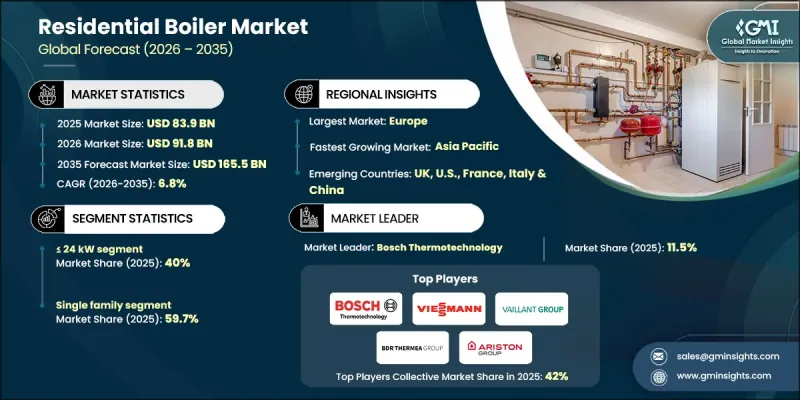
Market growth is fueled by extreme weather conditions, rising urbanization, and the increasing integration of smart home technologies. Homeowners are seeking efficient space heating solutions to maintain comfort during extended cold seasons, while ongoing infrastructure upgrades further drive demand. Residential boilers provide centralized heating and hot water throughout homes, delivering consistent indoor temperatures and a reliable water supply. Their energy efficiency, durability, and user-friendly operation are key factors boosting adoption. Advanced models now incorporate automated temperature control, safety mechanisms, and smart grid compatibility, enabling optimized energy consumption. Government subsidies, environmental incentives, and compact boiler designs for apartments are also playing a pivotal role in stimulating market growth. Rising awareness of energy conservation and low-emission technologies is shaping future demand for modern, high-performance residential boilers.
| Market Scope | |
|---|---|
| Start Year | 2025 |
| Forecast Year | 2026-2035 |
| Start Value | $83.9 Billion |
| Forecast Value | $165.5 Billion |
| CAGR | 6.8% |
The <= 24 kW segment accounted for a 40% share in 2025 and is expected to grow at a CAGR of 6.5% through 2035. Growth in this segment is supported by demand for compact, energy-efficient heating solutions suitable for small homes and apartments. Urbanization, cost-effective installation, and adherence to energy-efficiency standards are further accelerating adoption. These boilers remain popular due to their reliable performance, compact form factor, and affordability.
The single-family home segment held a 59.7% share in 2025 and is expected to reach USD 95 billion by 2035. Homeowners increasingly prefer efficient, dependable boilers that provide both heating and hot water. Easy installation, space-saving designs, and energy-efficient performance continue to drive adoption, while advancements in smart control systems and low-emission technologies are influencing buyer preferences. Rising urban development, environmental awareness, and emphasis on sustainable living further support growth in this segment.
North America Residential Boiler Market held 80% share, generating USD 2.4 billion in 2025. Growth in this market is propelled by strict government regulations targeting carbon emission reduction, rising disposable incomes, and increasing consumer demand for advanced, energy-efficient heating systems. High living standards and strong awareness of smart heating technologies contribute to steady industry momentum.
Key players in the Global Residential Boiler Market include ACV International, A.O. Smith, Ariston Holding, BDR Thermea Group, Bradford White Corporation, Bosch Thermotechnology Corp., Carrier, Ferroli, Hoval, Laars Boilers, Lennox International, Lochinvar, Navien, NTI Boilers, Noritz America Corp., PB Heat, Rinnai America Corporation, Smith Boilers, Thermona, U.S. Boiler Company, Viessmann, Vaillant Group, WM Technologies, and Wolf. Companies in the Global Residential Boiler Market are strengthening their foothold through multiple strategies. They focus on product innovation, introducing energy-efficient, compact, and smart-grid-compatible boilers tailored to urban homes. Expansion into emerging markets, strategic acquisitions, and collaborations allows firms to broaden distribution networks and capture new customer segments. Investments in research and development aim to enhance product reliability, low-emission performance, and integration with home automation systems.
Table of Contents
Chapter 1 Methodology & Scope
- 1.1 Research design
Research approach
- 1.1.1 Data collection methods
- 1.2 Base estimates and calculations
- 1.2.1 Base year calculation
- 1.2.2 Market estimates & forecast parameters
- 1.3 Forecast
- 1.3.1 Key trends for market estimates
- 1.3.2 Quantified market impact analysis
- 1.3.2.1 Mathematical impact of growth parameters on forecast
- 1.3.3 Scenario analysis framework
- 1.4 Primary research and validation
- 1.4.1 Some of the primary sources (but not limited to)
- 1.5 Data mining sources
- 1.5.1 Paid Sources
- 1.5.2 Sources, by region
- 1.6 Research trail & scoring components
- 1.6.1 Research trail components
- 1.6.2 Scoring components
- 1.7 Research transparency addendum
- 1.7.1 Source attribution framework
- 1.7.2 Quality assurance metrics
- 1.7.3 Our commitment to trust
- 1.8 Market definitions
Chapter 2 Executive Summary
- 2.1 Industry synopsis, 2022 - 2035
- 2.1.1 Business trends
- 2.1.2 Fuel trends
- 2.1.3 Technology trends
- 2.1.4 Application trends
- 2.1.5 Installation trends
- 2.1.6 Capacity trends
- 2.1.7 Regional trends
Chapter 3 Industry Insights
- 3.1 Industry ecosystem analysis
- 3.1.1 Raw material availability & sourcing analysis
- 3.1.2 Manufacturing capacity assessment
- 3.1.3 Supply chain resilience & risk factors
- 3.1.4 Distribution network analysis
- 3.2 Regulatory landscape
- 3.3 Industry impact forces
- 3.3.1 Growth drivers
- 3.3.2 Industry pitfalls & challenges
- 3.4 Growth potential analysis
- 3.5 Porter's analysis
- 3.5.1 Bargaining power of suppliers
- 3.5.2 Bargaining power of buyers
- 3.5.3 Threat of new entrants
- 3.5.4 Threat of substitutes
- 3.6 PESTEL analysis
- 3.6.1 Political factors
- 3.6.2 Economic factors
- 3.6.3 Social factors
- 3.6.4 Technological factors
- 3.6.5 Legal factors
- 3.6.6 Environmental factors
- 3.7 Cost structure analysis of residential boilers
- 3.8 Price trend analysis (USD/Unit)
- 3.8.1 By region
- 3.8.2 By capacity
- 3.9 Market opportunities & evolving trends
- 3.10 Investment insights & future outlook
- 3.11 Digitalization & industry 4.0 adoption
- 3.12 Sustainability practices & regulatory compliance
Chapter 4 Competitive Landscape, 2025
- 4.1 Introduction
- 4.2 Company market share analysis, by region, 2025
- 4.2.1 North America
- 4.2.2 Europe
- 4.2.3 Asia Pacific
- 4.2.4 Middle East & Africa
- 4.2.5 Latin America
- 4.3 Strategic dashboard
- 4.4 Strategic initiatives
- 4.4.1 Key partnerships & collaborations
- 4.4.2 Major M&A activities
- 4.4.3 Product innovations & launches
- 4.4.4 Market expansion strategies
- 4.5 Competitive benchmarking
- 4.6 Innovation & sustainability landscape
Chapter 5 Market Size and Forecast, By Fuel, 2022 - 2035 (USD Million & '000 Units)
- 5.1 Key trends
- 5.2 Natural gas
- 5.3 Oil
- 5.4 Electric
- 5.5 Others
Chapter 6 Market Size and Forecast, By Technology, 2022 - 2035 (USD Million & '000 Units)
- 6.1 Key trends
- 6.2 Condensing
- 6.2.1 Natural gas
- 6.2.2 Oil
- 6.2.3 Electric
- 6.2.4 Others
- 6.3 Non-condensing
- 6.3.1 Natural gas
- 6.3.2 Oil
- 6.3.3 Electric
- 6.3.4 Others
Chapter 7 Market Size and Forecast, By Application, 2022 - 2035 (USD Million & '000 Units)
- 7.1 Key trends
- 7.2 Single family
- 7.3 Multi family
Chapter 8 Market Size and Forecast, By Installation, 2022 - 2035 (USD Million & '000 Units)
- 8.1 Key trends
- 8.2 Wall-mounted
- 8.3 Floor-standing
Chapter 9 Market Size and Forecast, By Capacity, 2022 - 2035 (USD Million & '000 Units)
- 9.1 Key trends
- 9.2 ≤ 24 kW
- 9.3 > 24 kW - 35 kW
- 9.4 > 35 kW - 100 kW
- 9.5 > 100 kW
Chapter 10 Market Size and Forecast, By Region, 2022 - 2035 (USD Million & '000 Units)
- 10.1 Key trends
- 10.2 North America
- 10.2.1 U.S.
- 10.2.2 Canada
- 10.3 Europe
- 10.3.1 Denmark
- 10.3.2 Finland
- 10.3.3 Norway
- 10.3.4 Sweden
- 10.3.5 UK
- 10.3.6 Russia
- 10.3.7 Romania
- 10.3.8 Poland
- 10.3.9 Austria
- 10.3.10 Belgium
- 10.3.11 France
- 10.3.12 Germany
- 10.3.13 Netherlands
- 10.3.14 Switzerland
- 10.3.15 Greece
- 10.3.16 Italy
- 10.3.17 Portugal
- 10.3.18 Spain
- 10.4 Asia Pacific
- 10.4.1 China
- 10.4.2 Japan
- 10.4.3 South Korea
- 10.4.4 Australia
- 10.5 Middle East & Africa
- 10.5.1 Saudi Arabia
- 10.5.2 UAE
- 10.5.3 Qatar
- 10.5.4 South Africa
- 10.6 Latin America
- 10.6.1 Brazil
- 10.6.2 Argentina
- 10.6.3 Mexico
Chapter 11 Company Profiles
- 11.1 ACV International
- 11.2 Ariston Holding
- 11.3 A.O. Smith
- 11.4 BDR Thermea Group
- 11.5 Bradford White Corporation
- 11.6 Bosch Thermotechnology Corp.
- 11.7 Carrier
- 11.8 Ferroli
- 11.9 Hoval
- 11.10 Laars Boilers
- 11.11 Lennox International
- 11.12 Lochinvar
- 11.13 Navien
- 11.14 NTI Boilers
- 11.15 Noritz America Corp.
- 11.16 PB Heat
- 11.17 Rinnai America Corporation
- 11.18 Smith Boilers
- 11.19 Thermona
- 11.20 U.S. Boiler Company
- 11.21 Viessmann
- 11.22 Vaillant Group
- 11.23 WM Technologies
- 11.24 Wolf

