
PUBLISHER: Global Market Insights Inc. | PRODUCT CODE: 1892832

PUBLISHER: Global Market Insights Inc. | PRODUCT CODE: 1892832
Harvester Market Opportunity, Growth Drivers, Industry Trend Analysis, and Forecast 2026 - 2035
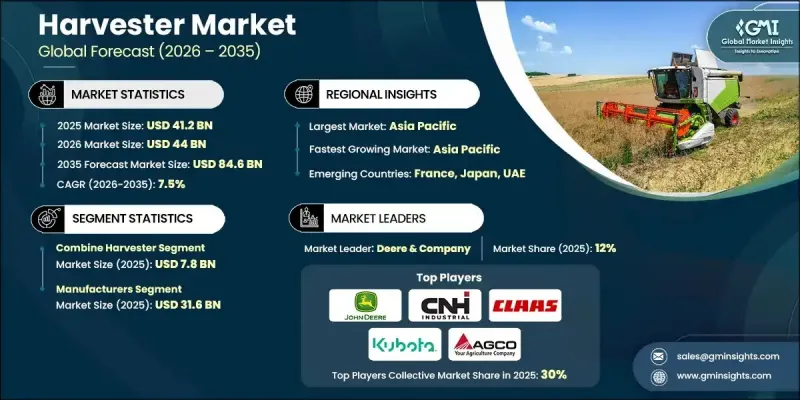
The Global Harvester Market was valued at USD 41.2 billion in 2025 and is estimated to grow at a CAGR of 7.5% to reach USD 84.6 billion by 2035.
The increasing focus on sustainable farming practices is driving the adoption of eco-friendly harvesters with energy-efficient engines and low-emission technologies. Continuous technological advancements, including precision agriculture tools and smart harvesting systems, are enhancing productivity, fuel efficiency, and operational effectiveness. Manufacturers are actively launching new models to meet the evolving needs of modern agriculture, which is being reshaped by rising global food demand. Large-scale commercial farms and contract farming providers are investing in high-capacity machines to ensure rapid and efficient harvesting, reducing losses caused by unpredictable weather and maintaining the quality of staple crops. This combination of innovation, technological integration, and growing demand for fresh produce is propelling market expansion globally.
| Market Scope | |
|---|---|
| Start Year | 2025 |
| Forecast Year | 2026-2035 |
| Start Value | $41.2 Billion |
| Forecast Value | $84.6 Billion |
| CAGR | 7.5% |
In 2025, the combine harvesters segment generated USD 7.8 billion. Combine harvesters remain the most valuable and essential machinery for commercial grain production, capable of reaping, threshing, and winnowing crops in a single operation. Their efficiency and speed allow large farms to complete harvests promptly, minimizing weather-related risks and maintaining optimal grain quality.
The manufacturers segment reached USD 31.6 billion in 2025. Manufacturers maintain strong control over pricing, after-sales support, and the integration of proprietary precision farming technologies, fostering brand loyalty, providing financing options, and offering specialized operator training for complex, high-horsepower machines.
Asia Pacific Harvester Market held a 36.9% share in 2025. The region's growth is fueled by rapid mechanization, government subsidies for small machinery, and the need for efficient harvesting of key staple crops. Countries like China, India, and Japan are investing in modernized farming equipment, including track-based combinations, compact power tillers, and advanced electric machinery, supported by government initiatives aimed at farm modernization.
Key players in the Global Harvester Market include Komatsu, Clark Material Handling Company, Crown Equipment, Mitsubishi Logisnext, Anhui Heli, Toyota Industries, Jungheinrich AG, KION Group AG, Doosan Corporation Industrial Vehicle, Hangcha Group, Hyster-Yale Materials Handling, Manitou Group, BYD Company, and Combilift. Companies in the Global Harvester Market are strengthening their position through continuous innovation, launching energy-efficient and technologically advanced machines that meet modern agriculture demands. Strategic R&D investments enable the development of precision farming solutions, smart harvesting systems, and electric-powered machinery. Firms are expanding their global distribution networks, providing financing solutions, after-sales support, and operator training programs to enhance customer loyalty. Collaborations with governments and agricultural agencies help promote mechanization and the adoption of eco-friendly harvesters.
Table of Contents
Chapter 1 Methodology and Scope
- 1.1 Market scope and definition
- 1.2 Research design
- 1.2.1 Research approach
- 1.2.2 Data collection methods
- 1.3 Data mining sources
- 1.3.1 Global
- 1.3.2 Regional/Country
- 1.4 Base estimates and calculations
- 1.4.1 Base year calculation
- 1.4.2 Key trends for market estimation
- 1.5 Primary research and validation
- 1.5.1 Primary sources
- 1.6 Forecast model
- 1.7 Research assumptions and limitations
Chapter 2 Executive Summary
- 2.1 Industry 3600 synopsis
- 2.2 Key market trends
- 2.2.1 Regional
- 2.2.2 Type
- 2.2.3 Sales channel
- 2.3 CXO perspectives: Strategic imperatives
- 2.3.1 Key decision points for industry executives
- 2.3.2 Critical success factors for market players
- 2.4 Future outlook and strategic recommendations
Chapter 3 Industry Insights
- 3.1 Industry ecosystem analysis
- 3.1.1 Supplier landscape
- 3.1.2 Profit margin
- 3.1.3 Value addition at each stage
- 3.1.4 Factor affecting the value chain
- 3.2 Industry impact forces
- 3.2.1 Growth drivers
- 3.2.1.1 E-commerce expansion & warehouse automation
- 3.2.1.2 Global population growth & food demand
- 3.2.1.3 Rising labor costs and shortages
- 3.2.1.4 Advancements in precision agriculture (Ag 4.0)
- 3.2.2 Industry pitfalls & challenges
- 3.2.2.1 High initial investment cost
- 3.2.2.2 Lack of skilled operators/technicians
- 3.2.3 Opportunities
- 3.2.3.1 Expansion of leasing & rental models
- 3.2.3.2 Development of specialty/electric harvesters
- 3.2.1 Growth drivers
- 3.3 Growth potential analysis
- 3.4 Future market trends
- 3.5 Technology and innovation landscape
- 3.5.1 Current technological trends
- 3.5.2 Emerging technologies
- 3.6 Price trends
- 3.6.1 By region
- 3.6.2 By type
- 3.7 Regulatory landscape
- 3.7.1 Standards and compliance requirements
- 3.7.2 Regional regulatory frameworks
- 3.7.3 Certification standards
- 3.8 Porter's analysis
- 3.9 PESTEL analysis
Chapter 4 Competitive Landscape, 2025
- 4.1 Introduction
- 4.2 Company market share analysis
- 4.2.1 By region
- 4.2.1.1 North America
- 4.2.1.2 Europe
- 4.2.1.3 Asia Pacific
- 4.2.1.4 Latin America
- 4.2.1.5 Middle East and Africa
- 4.2.1 By region
- 4.3 Company matrix analysis
- 4.4 Competitive analysis of major market players
- 4.5 Competitive positioning matrix
- 4.6 Key developments
- 4.6.1 Mergers & acquisitions
- 4.6.2 Partnerships & collaborations
- 4.6.3 New product launches
- 4.6.4 Expansion plans
Chapter 5 Market Estimates and Forecast, By Type, 2022 - 2035 (USD Billion) (Thousand Units)
- 5.1 Key trends
- 5.2 Combine harvester
- 5.3 Forage harvester
- 5.4 Trailed silage harvester
- 5.5 Self-propelled forage harvester
- 5.6 Trailed forage harvester
- 5.7 Mounted forage harvester
- 5.8 Mounted silage harvester
- 5.9 Surgarbeet harvester
- 5.10 Potato harvester
- 5.11 Wine grape harvester
- 5.12 Forage mowers
- 5.13 Municipal mowers
Chapter 6 Market Estimates and Forecast, By Sales Channel, 2022 - 2035 (USD Billion) (Thousand Units)
- 6.1 Key trends
- 6.2 Manufacturers
- 6.3 Distributors
Chapter 7 Market Estimates and Forecast, By Region, 2022 - 2035 (USD Billion) (Thousand Units)
- 7.1 Key trends
- 7.2 North America
- 7.2.1 U.S.
- 7.2.2 Canada
- 7.3 Europe
- 7.3.1 Germany
- 7.3.2 UK
- 7.3.3 France
- 7.3.4 Italy
- 7.3.5 Spain
- 7.4 Asia Pacific
- 7.4.1 China
- 7.4.2 Japan
- 7.4.3 India
- 7.4.4 Australia
- 7.4.5 South Korea
- 7.5 Latin America
- 7.5.1 Brazil
- 7.5.2 Mexico
- 7.5.3 Argentina
- 7.6 Middle East and Africa
- 7.6.1 South Africa
- 7.6.2 Saudi Arabia
- 7.6.3 UAE
Chapter 8 Company Profiles
- 8.1 Anhui Heli
- 8.2 BYD Company
- 8.3 Clark Material Handling Company
- 8.4 Combilift
- 8.5 Crown Equipment
- 8.6 Doosan Corporation Industrial Vehicle
- 8.7 Hangcha Group
- 8.8 Hyster-Yale Materials Handling
- 8.9 Hyundai Heavy Industries
- 8.10 Jungheinrich AG
- 8.11 KION Group AG
- 8.12 Komatsu
- 8.13 Manitou Group
- 8.14 Mitsubishi Logisnext
- 8.15 Toyota Industries

