
PUBLISHER: Global Market Insights Inc. | PRODUCT CODE: 1892835

PUBLISHER: Global Market Insights Inc. | PRODUCT CODE: 1892835
Aramid Fiber Market Opportunity, Growth Drivers, Industry Trend Analysis, and Forecast 2026 - 2035
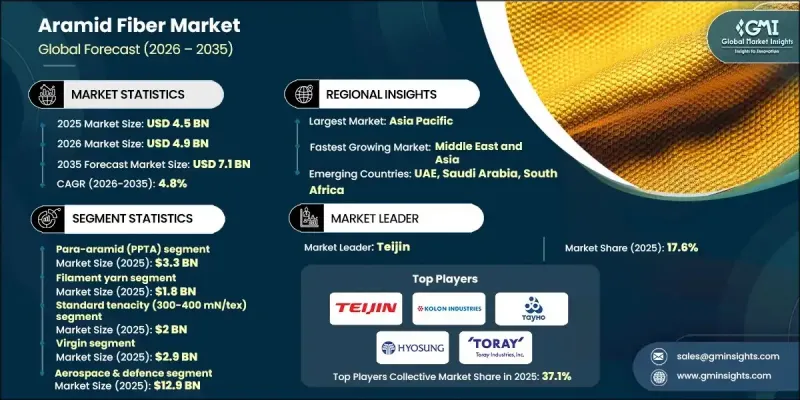
The Global Aramid Fiber Market was valued at USD 4.5 billion in 2025 and is estimated to grow at a CAGR of 4.8% to reach USD 7.1 billion by 2035.
Aramid fibers are high-performance synthetic fibers known for their exceptional strength, thermal stability, and resistance to abrasion and heat. These fibers are widely used in aerospace, military applications, personal protective equipment, and industrial manufacturing, where durability and safety are critical. Aramid fibers are divided into para-aramid (PPTA) and meta-aramid (PMIA), each offering unique properties tailored to specific industrial needs. Recent advancements in polymer chemistry and fiber spinning technologies have enhanced fiber tenacity while reducing elongation, resulting in stronger and more versatile materials. Additionally, innovations in recycling have allowed the production of eco-friendly aramid fibers, addressing sustainability concerns. Emerging technologies such as nanocomposites and hybrid materials are further expanding applications in lightweight armor, aerospace, and high-performance industrial products, making aramid fibers an essential material in advanced manufacturing sectors globally.
| Market Scope | |
|---|---|
| Start Year | 2025 |
| Forecast Year | 2026-2035 |
| Start Value | $4.5 Billion |
| Forecast Value | $7.1 Billion |
| CAGR | 4.8% |
The para-aramid (PPTA) segment generated USD 3.3 billion in 2025, driven by demand for its lightweight, high-strength properties in protective gear, automotive components, and industrial reinforcements. The continuous improvements in fiber processing and composite integration are increasing its applicability across multiple industries.
The filament yarn segment reached USD 1.8 billion in 2025. Its continuous strength and uniformity make it ideal for ropes, cables, and technical textiles, while staple fibers are widely used in nonwoven fabrics and protective wear, offering flexibility and ease of manufacture. The growing focus on lightweight, high-performance textiles continues to sustain demand across these forms.
U.S. Aramid Fiber Market accounted for USD 850 million in 2025, supported by strong defense spending, advanced aerospace manufacturing, and high demand for materials used in military gear and industrial safety applications. North America remains a key market due to consistent investment in high-performance fiber applications.
Key players in the Global Aramid Fiber Market include Teijin Aramid B.V., Toray Industries Inc., Kolon Industries Inc., Huvis Corporation, Aramid HPM S.L., SRO Aramid, Hyosung Advanced Materials, X-FIPER New Material Co. Ltd., Jiangsu Shino New Materials Technology Co. Ltd., Beijing Landingji Engineering Tech Co. Ltd., Guangdong Charming Chemical Co. Ltd., Henan Longsheng New Material Technology Co. Ltd., Jiaxing Newtex Composites Co. Ltd., Kermel, Ningxia Eppen Biotech Co. Ltd., Sinopec Yizheng Chemical Fibre Co. Ltd., China National Bluestar (Group) Co. Ltd., and Taekwang Industrial Co. Ltd. Companies in the Aramid Fiber Market are strengthening their presence by investing in research and development to enhance fiber performance, durability, and thermal stability. Strategic partnerships with defense, aerospace, and industrial clients enable adoption in high-value applications. Firms are also expanding production capacities, optimizing manufacturing processes, and integrating recycling technologies to address sustainability.
Table of Contents
Chapter 1 Methodology & Scope
- 1.1 Market scope and definition
- 1.2 Research design
- 1.2.1 Research approach
- 1.2.2 Data collection methods
- 1.3 Data mining sources
- 1.3.1 Global
- 1.3.2 Regional/Country
- 1.4 Base estimates and calculations
- 1.4.1 Base year calculation
- 1.4.2 Key trends for market estimation
- 1.5 Primary research and validation
- 1.5.1 Primary sources
- 1.6 Forecast model
- 1.7 Research assumptions and limitations
Chapter 2 Executive Summary
- 2.1 Industry 360° synopsis
- 2.2 Key market trends
- 2.2.1 Product Type
- 2.2.2 Physical Form
- 2.2.3 Performance grade
- 2.2.4 Source
- 2.2.5 End use Industry
- 2.2.6 Regional
- 2.3 TAM Analysis, 2025-2035
- 2.4 CXO perspectives: Strategic imperatives
- 2.4.1 Executive decision points
- 2.4.2 Critical success factors
- 2.5 Future outlook and strategic recommendations
Chapter 3 Industry Insights
- 3.1 Industry ecosystem analysis
- 3.1.1 Supplier landscape
- 3.1.2 Profit margin
- 3.1.3 Value addition at each stage
- 3.1.4 Factor affecting the value chain
- 3.1.5 Disruptions
- 3.2 Industry impact forces
- 3.2.1 Growth drivers
- 3.2.1.1 Increasing demand in aerospace & defence
- 3.2.1.2 Rising need for personal protective equipment
- 3.2.1.3 Technological advancements
- 3.2.2 Industry pitfalls and challenges
- 3.2.2.1 High production costs
- 3.2.2.2 Competition from alternative fibers
- 3.2.3 Market opportunities
- 3.2.3.1 Expansion into renewable energy
- 3.2.3.2 Advanced composite materials
- 3.2.3.3 Automotive lightweighting trends
- 3.2.1 Growth drivers
- 3.3 Growth potential analysis
- 3.4 Regulatory landscape
- 3.4.1 North America
- 3.4.2 Europe
- 3.4.3 Asia Pacific
- 3.4.4 Latin America
- 3.4.5 Middle East & Africa
- 3.5 Porter's analysis
- 3.6 PESTEL analysis
- 3.7 Technology and innovation landscape
- 3.7.1 Current technological trends
- 3.7.2 Emerging technologies
- 3.8 Price trends
- 3.8.1 By region
- 3.8.2 By product type
- 3.9 Future market trends
- 3.10 Technology and innovation landscape
- 3.10.1 Current technological trends
- 3.10.2 Emerging technologies
- 3.11 Patent landscape
- 3.12 Trade statistics (HS code)( Note: the trade statistics will be provided for key countries only)
- 3.12.1 Major importing countries
- 3.12.2 Major exporting countries
- 3.13 Sustainability and environmental aspects
- 3.13.1 Sustainable practices
- 3.13.2 Waste reduction strategies
- 3.13.3 Energy efficiency in production
- 3.13.4 Eco-friendly initiatives
- 3.14 Carbon footprint consideration
Chapter 4 Competitive Landscape, 2025
- 4.1 Introduction
- 4.2 Company market share analysis
- 4.2.1 By region
- 4.2.1.1 North America
- 4.2.1.2 Europe
- 4.2.1.3 Asia Pacific
- 4.2.1.4 LATAM
- 4.2.1.5 MEA
- 4.2.1 By region
- 4.3 Company matrix analysis
- 4.4 Competitive analysis of major market players
- 4.5 Competitive positioning matrix
- 4.6 Key developments
- 4.6.1 Mergers & acquisitions
- 4.6.2 Partnerships & collaborations
- 4.6.3 New product launches
- 4.6.4 Expansion plans
Chapter 5 Market Estimates and Forecast, By Product Type, 2022-2035 (USD Billion) (Kilo Tons)
- 5.1 Key trends
- 5.2 Para-aramid (PPTA)
- 5.3 Meta-aramid (PMIA)
- 5.4 Copolyimide
Chapter 6 Market Estimates and Forecast, By Physical Form, 2022-2035 (USD Billion) (Kilo Tons)
- 6.1 Key trends
- 6.2 Filament yarn
- 6.3 Staple fiber
- 6.4 Spun yarn
- 6.5 Blended fibers
Chapter 7 Market Estimates and Forecast, By Performance Grade, 2022-2035 (USD Billion) (Kilo Tons)
- 7.1 Key trends
- 7.2 Standard tenacity (300-400 mN/tex)
- 7.3 High tenacity (400-500+ mN/tex)
Chapter 8 Market Estimates and Forecast, By Source, 2022-2035 (USD Billion) (Kilo Tons)
- 8.1 Key trends
- 8.2 Virgin aramid fiber
- 8.3 Recycled aramid fiber
Chapter 9 Market Estimates and Forecast, By End Use Industry, 2022-2035 (USD Billion) (Kilo Tons)
- 9.1 Key trends
- 9.2 Aerospace & defense
- 9.3 Automotive
- 9.4 Oil & gas
- 9.5 Renewable energy
- 9.6 Telecommunications
- 9.7 Construction
- 9.8 Marine & shipbuilding
- 9.9 Personal protection equipment
- 9.10 Industrial manufacturing
- 9.11 Others
Chapter 10 Market Estimates and Forecast, By Region, 2022-2035 (USD Billion) (Kilo Tons)
- 10.1 Key trends
- 10.2 North America
- 10.2.1 U.S.
- 10.2.2 Canada
- 10.2.3 Mexico
- 10.3 Europe
- 10.3.1 Germany
- 10.3.2 UK
- 10.3.3 France
- 10.3.4 Spain
- 10.3.5 Italy
- 10.3.6 Rest of Europe
- 10.4 Asia Pacific
- 10.4.1 China
- 10.4.2 India
- 10.4.3 Japan
- 10.4.4 Australia
- 10.4.5 South Korea
- 10.4.6 Rest of Asia Pacific
- 10.5 Latin America
- 10.5.1 Brazil
- 10.5.2 Mexico
- 10.5.3 Argentina
- 10.5.4 Rest of Latin America
- 10.6 Middle East and Africa
- 10.6.1 Saudi Arabia
- 10.6.2 South Africa
- 10.6.3 UAE
- 10.6.4 Rest of Middle East and Africa
Chapter 11 Company Profiles
- 11.1 Aramid HPM S.L
- 11.2 Beijing Landingji Engineering Tech Co. Ltd.
- 11.3 China National Bluestar (Group) Co. Ltd.
- 11.4 Guangdong Charming Chemical Co. Ltd.
- 11.5 Henan Longsheng New Material Technology Co. Ltd.
- 11.6 Huvis Corporation
- 11.7 Hyosung Advanced Materials
- 11.8 Jiangsu Shino New Materials Technology Co. Ltd.
- 11.9 Jiaxing Newtex Composites Co. Ltd.
- 11.10 Kermel
- 11.11 Kolon Industries Inc.
- 11.12 Ningxia Eppen Biotech Co. Ltd.
- 11.13 SRO Aramid
- 11.14 Sinopec Yizheng Chemical Fibre Co. Ltd.
- 11.15 Taekwang Industrial Co. Ltd.
- 11.16 Teijin Aramid B.V.
- 11.17 Toray Industries Inc.
- 11.18 X-FIPER New Material Co. Ltd.
- 11.19 Yantai Tayho Advanced Materials Co. Ltd.

