
PUBLISHER: Global Market Insights Inc. | PRODUCT CODE: 1892840

PUBLISHER: Global Market Insights Inc. | PRODUCT CODE: 1892840
Freight Trucking Market Opportunity, Growth Drivers, Industry Trend Analysis, and Forecast 2026 - 2035
The Global Freight Trucking Market was valued at USD 2.67 trillion in 2025 and is estimated to grow at a CAGR of 4.1% to reach USD 3.98 trillion by 2035.
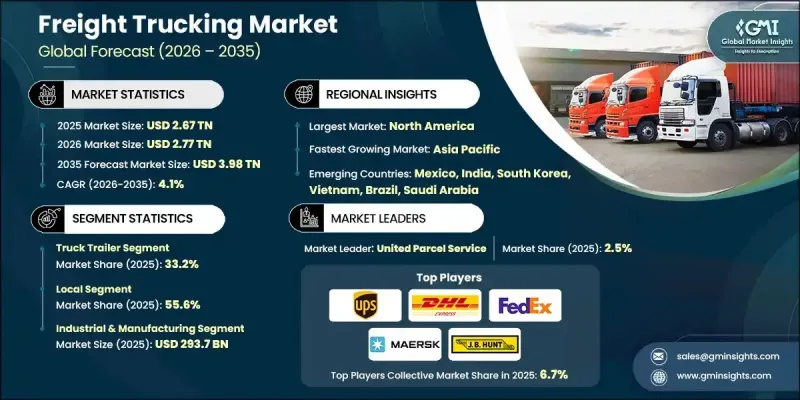
Roadways remain the backbone of global logistics, with trucks accounting for more than 60% of worldwide freight movement. Industries such as pharmaceuticals, food and beverages, and chemicals rely heavily on trucking to preserve product quality, freshness, and safety. Expanding domestic and international freight services through trucks has become a preferred solution for businesses seeking reliable and efficient transportation. The rising number of logistics startups each year highlights investor confidence in capturing market share early, providing both domestic and cross-border freight solutions. Government initiatives in multiple regions, including the construction of dedicated lanes and incentives for LNG or electric trucks, are boosting efficiency and promoting the adoption of sustainable trucking practices, shaping the future of the industry.
| Market Scope | |
|---|---|
| Start Year | 2025 |
| Forecast Year | 2026-2035 |
| Start Value | $2.67 Trillion |
| Forecast Value | $3.98 Trillion |
| CAGR | 4.1% |
The truck trailer segment held a 33.2% share in 2025. Truck trailers are primarily utilized for transporting non-perishable goods, making them essential in retail, consumer goods, and e-commerce sectors. Globally, over ten million truck trailers are registered, underscoring their critical role in industrial and commercial freight operations.
The retail and e-commerce segment is projected to grow at a CAGR of 5.9% between 2026 and 2035. Increasing online shopping, expanding last-mile delivery networks, and growing consumer expectations for same-day or next-day delivery are driving demand. The omnichannel retail trend, frequent small-parcel shipments, and the need for rapid logistics solutions are pushing trucking to the forefront as a key driver of market expansion.
U.S. Freight Trucking Market was valued at USD 830.3 billion in 2025. The market growth is supported by strong domestic manufacturing, high consumer-driven freight volumes, and an extensive interstate network. Trucks remain the primary mode for transporting goods, reflecting changing logistics patterns and economic factors that favor road transportation.
Major players in the Global Freight Trucking Market include DHL Express, United Parcel Service, J.B. Hunt Transport, FedEx, A.P. Moller - Maersk, Nippon Express, Schneider National, XPO Logistics, C.H. Robinson, and Kuehne + Nagel. Companies in the Freight Trucking Market are strengthening their market position through several strategic approaches. They are investing in fleet modernization, adopting electric and LNG trucks to meet sustainability targets, and expanding regional and international networks. Firms are also leveraging technology such as route optimization software, real-time tracking, and data analytics to improve operational efficiency. Strategic partnerships and acquisitions enhance market penetration and service coverage. Additionally, companies focus on specialized freight solutions for sectors like pharmaceuticals, retail, and e-commerce, while developing robust last-mile delivery capabilities to meet rising consumer expectations and maintain competitive advantage.
Table of Contents
Chapter 1 Methodology
- 1.1 Market scope and definition
- 1.2 Research design
- 1.2.1 Research approach
- 1.2.2 Data collection methods
- 1.3 Data mining sources
- 1.3.1 Global
- 1.3.2 Regional/Country
- 1.4 Base estimates and calculations
- 1.4.1 Base year calculation
- 1.4.2 Key trends for market estimation
- 1.5 Primary research and validation
- 1.5.1 Primary sources
- 1.6 Forecast
- 1.7 Research assumptions and limitations
Chapter 2 Executive Summary
- 2.1 Industry 360° synopsis
- 2.2 Key market trends
- 2.2.1 Regional
- 2.2.2 Truck
- 2.2.3 Distance
- 2.2.4 Service Model
- 2.2.5 Truck Size
- 2.2.6 Cargo
- 2.2.7 Enterprise Size
- 2.2.8 Industry
- 2.3 TAM analysis, 2026-2035
- 2.4 CXO perspectives: Strategic imperatives
- 2.4.1 Executive decision points
- 2.4.2 Critical success factors
- 2.5 Future outlook and recommendations
Chapter 3 Industry Insights
- 3.1 Industry ecosystem analysis
- 3.1.1 Supplier landscape
- 3.1.2 Profit margin
- 3.1.3 Cost structure
- 3.1.4 Value addition at each stage
- 3.1.5 Factor affecting the value chain
- 3.1.6 Disruptions
- 3.2 Industry impact forces
- 3.2.1 Growth drivers
- 3.2.1.1 Global e-commerce and omnichannel retail growth
- 3.2.1.2 Global trade deals and partnership expansion
- 3.2.1.3 Infrastructure investment
- 3.2.1.4 Fleet renewal and stricter emissions standards
- 3.2.2 Industry pitfalls and challenges
- 3.2.2.1 Regulatory fragmentation across countries/regions
- 3.2.2.2 Road congestion and deteriorating urban access
- 3.2.3 Market opportunities
- 3.2.3.1 Electrification & zero-emission truck adoption
- 3.2.3.2 Automated Driving Systems in Freight Trucks
- 3.2.3.3 Rapid expansion of digital freight platforms
- 3.2.3.4 Value-added logistics
- 3.2.1 Growth drivers
- 3.3 Growth potential analysis
- 3.4 Regulatory landscape
- 3.4.1 North America
- 3.4.1.1 U.S. corporate average fuel economy (CAFE) standards
- 3.4.1.2 Canadian heavy-duty vehicle greenhouse gas emissions regulations
- 3.4.2 Europe
- 3.4.2.1 German federal road freight transport act (GuKG)
- 3.4.2.2 French mobility orientation law (LOM) for road freight
- 3.4.2.3 UK heavy goods vehicle (HGV) road user levy regulations
- 3.4.2.4 Spanish road transport regulation (ROTT)
- 3.4.3 Asia Pacific
- 3.4.3.1 China VI emission standards for heavy-duty trucks
- 3.4.3.2 Japan motor vehicle exhaust emissions standards
- 3.4.3.3 Bharat stage emission standards for commercial vehicles in India
- 3.4.4 Latin America
- 3.4.4.1 Brazil PROCONVE P8 emission standards for heavy trucks
- 3.4.4.2 Argentine national road freight transport regulations
- 3.4.4.3 Mexican NOM-044 heavy-duty diesel emission standards
- 3.4.5 Middle East & Africa
- 3.4.5.1 UAE federal transport authority commercial transport regulations
- 3.4.5.2 South African national road traffic act (NRTA) for freight vehicles
- 3.4.5.3 Saudi Arabian SASO fuel economy & emission standards
- 3.4.1 North America
- 3.5 Porter's analysis
- 3.6 PESTEL analysis
- 3.7 Technology and innovation landscape
- 3.7.1 Current technological trends
- 3.7.2 Emerging technologies
- 3.8 Price trends
- 3.8.1 By region
- 3.8.2 By product
- 3.9 Cost breakdown analysis
- 3.10 Sustainability and environmental impact
- 3.10.1 Environmental impact assessment
- 3.10.2 Social Impact & community benefits
- 3.10.3 Governance & corporate responsibility
- 3.10.4 Sustainable finance & investment trends
- 3.11 Cross-Border Trade & International Freight Movements
- 3.11.1 Growth of major cross-border trade corridors
- 3.11.2 Customs procedures & border delays
- 3.11.3 Bilateral agreements
- 3.11.4 International trucking permits & transit restrictions
- 3.12 Road infrastructure & freight corridor assessment
- 3.12.1 Condition of national highways and expressways
- 3.12.2 Expansion of dedicated freight corridors and logistics corridors
- 3.12.3 Truck parking, rest areas & safety infrastructure for drivers
- 3.12.4 Tolling systems, road user charges & cost implications for carriers
- 3.12.5 Infrastructure investments, public-private partnerships
- 3.13 Future outlook & opportunities
Chapter 4 Competitive Landscape, 2025
- 4.1 Introduction
- 4.2 Company market share analysis
- 4.2.1 North America
- 4.2.2 Europe
- 4.2.3 Asia Pacific
- 4.2.4 LATAM
- 4.2.5 MEA
- 4.3 Competitive analysis of major market players
- 4.4 Competitive positioning matrix
- 4.5 Strategic outlook matrix
- 4.6 Key developments
- 4.6.1 Mergers & acquisitions
- 4.6.2 Partnerships & collaborations
- 4.6.3 New product launches
- 4.6.4 Expansion plans and funding
Chapter 5 Market Estimates & Forecast, By Truck, 2022 - 2035 ($Bn, fleet size)
- 5.1 Key trends
- 5.2 Lorry tank
- 5.3 Truck trailer
- 5.4 Refrigerated truck
- 5.5 Flatbed truck
- 5.6 Others
Chapter 6 Market Estimates & Forecast, By Distance, 2022 - 2035 ($Bn, fleet size)
- 6.1 Key trends
- 6.2 Local
- 6.3 Long haul
Chapter 7 Market Estimates & Forecast, By Service Model, 2022 - 2035 ($Bn, fleet size)
- 7.1 Key trends
- 7.2 Full Truckload (FTL)
- 7.3 Less Than Truckload (LTL)
Chapter 8 Market Estimates & Forecast, By Truck Size, 2022 - 2035 ($Bn, fleet size)
- 8.1 Key trends
- 8.2 Light-duty trucks (LDTs)
- 8.3 Medium-duty trucks (MDTs)
- 8.4 Heavy-duty trucks (HDTs)
Chapter 9 Market Estimates & Forecast, By Enterprise Size, 2022 - 2035 ($Bn, fleet size)
- 9.1 Key trends
- 9.2 SMEs
- 9.3 Large Enterprises
Chapter 10 Market Estimates & Forecast, By Cargo, 2022 - 2035 ($Bn, fleet size)
- 10.1 Key trends
- 10.2 Dry Goods
- 10.3 Perishables
- 10.4 Hazardous materials
- 10.5 Others
Chapter 11 Market Estimates & Forecast, By Industry, 2022 - 2035 ($Bn, fleet size)
- 11.1 Key trends
- 11.2 Food & beverages
- 11.3 Retail & e-commerce
- 11.4 Industrial & manufacturing
- 11.5 Energy and mining
- 11.6 Oil & gas
- 11.7 Pharmaceutical & healthcare
- 11.8 Chemical
- 11.9 Others
Chapter 12 Market Estimates & Forecast, By Region, 2022 - 2035 ($Bn, fleet size)
- 12.1 Key trends
- 12.2 North America
- 12.2.1 US
- 12.2.2 Canada
- 12.3 Europe
- 12.3.1 Germany
- 12.3.2 UK
- 12.3.3 France
- 12.3.4 Italy
- 12.3.5 Spain
- 12.3.6 Russia
- 12.3.7 Nordics
- 12.3.8 Benelux
- 12.4 Asia Pacific
- 12.4.1 China
- 12.4.2 India
- 12.4.3 Japan
- 12.4.4 South Korea
- 12.4.5 ANZ
- 12.4.6 Singapore
- 12.4.7 Malaysia
- 12.4.8 Indonesia
- 12.4.9 Vietnam
- 12.4.10 Thailand
- 12.5 Latin America
- 12.5.1 Brazil
- 12.5.2 Mexico
- 12.5.3 Argentina
- 12.5.4 Colombia
- 12.6 MEA
- 12.6.1 South Africa
- 12.6.2 Saudi Arabia
- 12.6.3 UAE
Chapter 13 Company Profiles
- 13.1 Global companies
- 13.1.1 United Parcel Service
- 13.1.2 FedEx
- 13.1.3 DHL
- 13.1.4 A.P. Moller - Maersk
- 13.1.5 XPO Logistics
- 13.1.6 DB Schenker
- 13.1.7 Kuehne + Nagel
- 13.1.8 Nippon Express
- 13.1.9 Ryder System
- 13.1.10 C.H. Robinson
- 13.2 Regional companies
- 13.2.1 J.B. Hunt Transport
- 13.2.2 Schneider National
- 13.2.3 Knight-Swift Transportation
- 13.2.4 Old Dominion Freight Line
- 13.2.5 Werner Enterprises
- 13.2.6 Yamato Transport
- 13.2.7 DSV Road
- 13.2.8 GEFCO
- 13.2.9 Sagawa Express
- 13.2.10 CJ Logistics
- 13.3 Emerging companies
- 13.3.1 Convoy
- 13.3.2 Full Truck Alliance
- 13.3.3 CargoX
- 13.3.4 BlackBuck
- 13.3.5 Sennder

