
PUBLISHER: Global Market Insights Inc. | PRODUCT CODE: 1892853

PUBLISHER: Global Market Insights Inc. | PRODUCT CODE: 1892853
Robotic Paint Booth Market Opportunity, Growth Drivers, Industry Trend Analysis, and Forecast 2026 - 2035
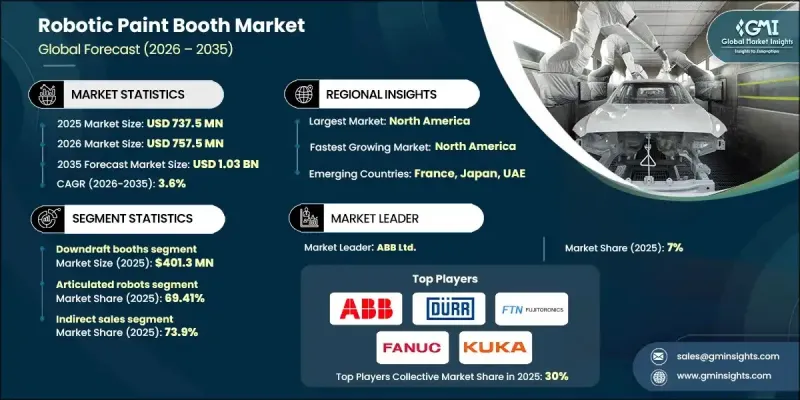
The Global Robotic Paint Booth Market was valued at USD 737.5 million in 2025 and is estimated to grow at a CAGR of 3.6% to reach USD 1.03 billion by 2035.
Rising demand for customized products and the shift toward high-throughput, flexible manufacturing have pushed production facilities to prioritize accuracy, consistent coating quality, and cycle-time optimization. As manufacturers continue expanding and upgrading their operations to handle broader color palettes, specialized finishes, and shorter production timelines, the need for automated painting systems is rapidly increasing. Robotic paint booths are becoming essential for maintaining uniform coating performance and managing growing production complexity. Automation in painting environments is accelerating with the use of intelligent conveyor systems, integrated vision technology, and advanced feedback controls to monitor and adjust coating parameters in real time. These innovations help companies improve transfer efficiency, reduce material waste, and enhance worker safety by limiting direct exposure to volatile organic compounds. The ongoing push toward smart manufacturing is reinforcing the adoption of robotic platforms that ensure repeatability, precision, and compliance with environmental requirements.
| Market Scope | |
|---|---|
| Start Year | 2025 |
| Forecast Year | 2026-2035 |
| Start Value | $737.5 Million |
| Forecast Value | $1.03 Billion |
| CAGR | 3.6% |
The downdraft booths segment generated USD 401.3 million in 2025, remaining the leading configuration due to their vertical airflow design that minimizes overspray and contamination. Their controlled air movement, combined with filtered ceilings and specialized exhaust systems, supports consistent finish quality by maintaining stable airflow patterns throughout the coating cycle.
The articulated robots segment accounted for 69.41% share in 2025, maintaining its position as the dominant robotic type. These robots offer high flexibility with multiple axes of movement and are engineered for precise, repeatable tasks across detailed and irregular surfaces. Their servo-driven mechanisms and specialized controllers allow them to perform demanding coating operations for extended periods while sustaining optimal performance.
U.S. Robotic Paint Booth Market held 83% share in 2025, generating USD 225.8 million. Strong interest in enhanced finishing capabilities, combined with demand for sophisticated coating technologies in sectors such as automotive, aerospace, and general manufacturing, continues to accelerate growth. Adoption of multi-axis robotic painting systems is expanding as organizations prioritize material savings, ESG compliance, and reduced emissions linked to strict VOC regulations.
Key participants in the Global Robotic Paint Booth Market include ABB Ltd., Durr Group, Eisenmann SE, KUKA AG, Kawasaki Heavy Industry Co. Ltd., Fanuc Corporation, Yaskawa Electric Corporation, GIFFIN, Staubli International AG, TKS Industrial Company, Blowtherm, SAIMA Meccanica S.p.A., Effort Intelligence Equipment Co. Ltd., Robotic Paint Group Ltd., and Fujitoronics-RSA. Companies in the Robotic Paint Booth Market rely on a mix of innovation, partnerships, and customer-focused strategies to expand their competitive presence. Many firms are advancing their robotic platforms with smarter control systems, energy-efficient components, and enhanced integration capabilities to support next-generation automated plants. Collaboration with coating material suppliers, automation integrators, and OEM manufacturers helps streamline system compatibility and accelerate deployment. Businesses are also expanding global service networks to provide rapid maintenance, training, and lifecycle support, ensuring reliable long-term performance for end users. Additionally, companies are strengthening their portfolios with customizable booth designs and modular robotic systems that address varied production needs. Investments in R&D, along with digital tools for predictive monitoring and process optimization, further reinforce their market foothold.
Table of Contents
Chapter 1 Methodology and Scope
- 1.1 Market scope and definition
- 1.2 Research design
- 1.2.1 Research approach
- 1.2.2 Data collection methods
- 1.3 Data mining sources
- 1.3.1 Global
- 1.3.2 Regional/Country
- 1.4 Base estimates and calculations
- 1.4.1 Base year calculation
- 1.4.2 Key trends for market estimation
- 1.5 Primary research and validation
- 1.5.1 Primary sources
- 1.6 Forecast model
- 1.7 Research assumptions and limitations
Chapter 2 Executive Summary
- 2.1 Industry 3600 synopsis
- 2.2 Key market trends
- 2.2.1 Regional
- 2.2.2 Product
- 2.2.3 Robot type
- 2.2.4 Operation
- 2.2.5 Application
- 2.2.6 Distribution channel
- 2.2.7 CXO perspectives: Strategic imperatives
- 2.2.8 Key decision points for industry executives
- 2.2.9 Critical success factors for market players
- 2.3 Future outlook and strategic recommendations
Chapter 3 Industry Insights
- 3.1 Industry ecosystem analysis
- 3.1.1 Supplier landscape
- 3.1.2 Profit margin
- 3.1.3 Value addition at each stage
- 3.1.4 Factor affecting the value chain
- 3.2 Industry impact forces
- 3.2.1 Growth drivers
- 3.2.1.1 Expansion of customization & EV manufacturing
- 3.2.1.2 Adoption of Industry 4.0 & digital twins
- 3.2.1.3 Global push for VOC reduction & ESG compliance
- 3.2.2 Industry pitfalls & challenges
- 3.2.2.1 High upfront capital investment
- 3.2.2.2 Complexity of system integration & programming
- 3.2.3 Opportunities
- 3.2.3.1 High-efficiency & sustainable application technology
- 3.2.3.2 AI-driven path planning & vision systems growth potential analysis
- 3.2.1 Growth drivers
- 3.3 Future market trends
- 3.4 Technology and innovation landscape
- 3.4.1 Current technological trends
- 3.4.2 Emerging technologies
- 3.5 Price trends
- 3.5.1 By region
- 3.5.2 By type
- 3.6 Regulatory landscape
- 3.6.1 Standards and compliance requirements
- 3.6.2 Regional regulatory frameworks
- 3.6.3 Certification standards
- 3.7 Porter's analysis
- 3.8 PESTEL analysis
Chapter 4 Competitive Landscape, 2024
- 4.1 Introduction
- 4.2 Company market share analysis
- 4.2.1 By region
- 4.2.1.1 North America
- 4.2.1.2 Europe
- 4.2.1.3 Asia Pacific
- 4.2.1.4 Latin America
- 4.2.1.5 Middle East and Africa
- 4.2.1 By region
- 4.3 Company matrix analysis
- 4.4 Competitive analysis of major market players
- 4.5 Competitive positioning matrix
- 4.6 Key developments
- 4.6.1 Mergers & acquisitions
- 4.6.2 Partnerships & collaborations
- 4.6.3 New product launches
- 4.6.4 Expansion plans
Chapter 5 Market Estimates and Forecast, By Product, 2022 - 2035 (USD Million) (Thousand Units)
- 5.1 Key trends
- 5.2 Downdraft booth
- 5.3 Sidedraft booth
- 5.4 Crossdraft booth
- 5.5 Others
Chapter 6 Market Estimates and Forecast, By Robot Type, 2022 - 2035 (USD Million) (Thousand Units)
- 6.1 Key trends
- 6.2 Articulated robots
- 6.3 Cartesian robots
Chapter 7 Market Estimates and Forecast, By Operation, 2022 - 2035 (USD Million) (Thousand Units)
- 7.1 Key trends
- 7.2 Automatic paint booth
- 7.3 Semi-automatic paint booth
Chapter 8 Market Estimates and Forecast, By Application, 2022 - 2035 (USD Million) (Thousand Units)
- 8.1 Key trends
- 8.2 Automotive
- 8.3 Aerospace & defense
- 8.4 Furniture
- 8.5 Electronics
- 8.6 Others
Chapter 9 Market Estimates and Forecast, By Distribution Channel, 2022 - 2035 (USD Million) (Thousand Units)
- 9.1 Key trends
- 9.2 Direct sales
- 9.3 Indirect sales
Chapter 10 Market Estimates and Forecast, By Region, 2022 - 2035 (USD Million) (Thousand Units)
- 10.1 Key trends
- 10.2 North America
- 10.2.1 U.S.
- 10.2.2 Canada
- 10.3 Europe
- 10.3.1 Germany
- 10.3.2 UK
- 10.3.3 France
- 10.3.4 Italy
- 10.3.5 Spain
- 10.4 Asia Pacific
- 10.4.1 China
- 10.4.2 Japan
- 10.4.3 India
- 10.4.4 Australia
- 10.4.5 South Korea
- 10.5 Latin America
- 10.5.1 Brazil
- 10.5.2 Mexico
- 10.5.3 Argentina
- 10.6 Middle East and Africa
- 10.6.1 South Africa
- 10.6.2 Saudi Arabia
- 10.6.3 UAE
Chapter 11 Company Profiles
- 11.1 ABB Ltd.
- 11.2 Blowtherm
- 11.3 Durr Group
- 11.4 Effort Intelligence Equipment Co. Ltd.
- 11.5 Eisenmann SE
- 11.6 Fanuc Corporation
- 11.7 Fujitoronics-RSA
- 11.8 GIFFIN
- 11.9 Kawasaki Heavy Industry Co. Ltd.
- 11.10 KUKA AG
- 11.11 Robotic Paint Group Ltd.
- 11.12 SAIMA Meccanica S.p.A.
- 11.13 Staubli International AG
- 11.14 TKS Industrial Company
- 11.15 Yaskawa Electric Corporation

