PUBLISHER: Global Market Insights Inc. | PRODUCT CODE: 1892893

PUBLISHER: Global Market Insights Inc. | PRODUCT CODE: 1892893
Fumed Silica Market Opportunity, Growth Drivers, Industry Trend Analysis, and Forecast 2026 - 2035
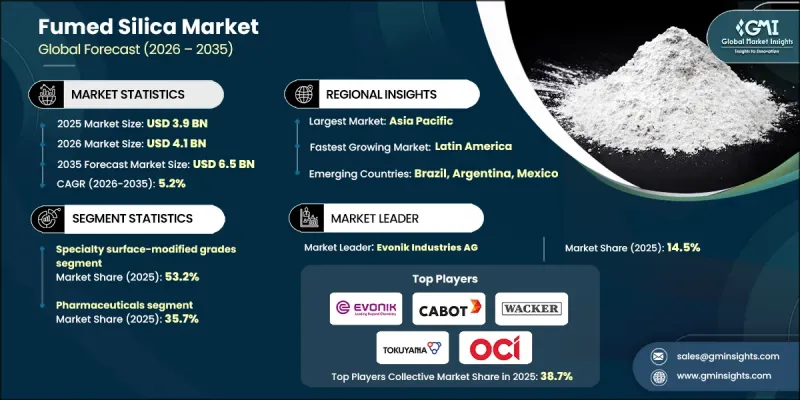
The Global Fumed Silica Market was valued at USD 3.9 billion in 2025 and is estimated to grow at a CAGR of 5.2% to reach USD 6.5 billion by 2035.
Market expansion is supported by the versatile performance characteristics of fumed silica across a wide range of industrial applications. Its chemical stability, high surface area, and strong thickening behavior make it a critical functional additive in multiple value chains. High-purity grades are widely adopted in healthcare-related manufacturing due to their role in improving formulation stability, flow behavior, and shelf life. The personal care sector relies on these materials to enhance texture, consistency, absorption, and durability across both premium and large-scale formulations. Industrial demand is further reinforced by coatings, adhesives, and resin systems where fumed silica improves viscosity control, mechanical performance, and resistance to environmental stress. Growing emphasis on material efficiency, product longevity, and formulation precision continues to support demand. As industries increasingly prioritize performance optimization and regulatory compliance, fumed silica remains an essential additive. Continuous advancements in processing technology and surface engineering are expanding application potential, while sustainability-focused manufacturing practices are strengthening long-term market prospects across both mature and emerging economies. Fumed silica is extensively used as a reinforcing and rheology-control agent in industrial formulations. Its ability to enhance structural strength, stability, and resistance properties supports growing adoption in advanced material systems and resin-based applications.
| Market Scope | |
|---|---|
| Start Year | 2025 |
| Forecast Year | 2026-2035 |
| Start Value | $3.9 Billion |
| Forecast Value | $6.5 Billion |
| CAGR | 5.2% |
The specialty surface-modified grades segment accounted for a 53.2% share in 2025 and is forecast to grow at a CAGR of 5.5% through 2035. Demand for these grades is driven by the need for tailored performance attributes such as improved dispersion, compatibility, and thermal resilience. Industries increasingly favor customized material solutions, encouraging ongoing investment in surface modification technologies and research-driven product development.
The pharmaceutical segment held a 35.7% share in 2025 and is expected to grow at a CAGR of 4.6% between 2026 and 2035. Growth is supported by rising healthcare demand, increased formulation complexity, and stricter quality standards that favor high-purity excipients and flow-enhancing materials.
North America Fumed Silica Market held a 29.7% share in 2025. Regional growth is supported by steady expansion across construction, automotive, electronics, and advanced manufacturing sectors. Strong regulatory frameworks, technology adoption, and sustainability initiatives continue to encourage demand for high-performance and surface-modified grades.
Key companies operating in the Global Fumed Silica Market include Evonik Industries AG, Cabot Corporation, Wacker Chemie AG, Solvay Group, Tokuyama Corporation, W.R. Grace & Co., OCI Company Ltd, PPG Industries, Dongyue Group, Zhejiang Wynca Chemical Industry Group, Kemitura, Anmol Chemicals Group, Henan Xunyu Chemical Co., Ltd, and Fushimi Pharmaceutical Co., Ltd. Companies in the Global Fumed Silica Market are strengthening their competitive position through focused investment in product innovation, capacity expansion, and advanced surface engineering technologies. Manufacturers prioritize the development of customized grades that meet precise application requirements across regulated and high-performance industries. Strategic partnerships with downstream users support co-development and long-term supply agreements. Geographic expansion into high-growth regions improves market reach and resilience.
Table of Contents
Chapter 1 Methodology & Scope
- 1.1 Market scope and definition
- 1.2 Research design
- 1.2.1 Research approach
- 1.2.2 Data collection methods
- 1.3 Data mining sources
- 1.3.1 Global
- 1.3.2 Regional/Country
- 1.4 Base estimates and calculations
- 1.4.1 Base year calculation
- 1.4.2 Key trends for market estimation
- 1.5 Primary research and validation
- 1.5.1 Primary sources
- 1.6 Forecast model
- 1.7 Research assumptions and limitations
Chapter 2 Executive Summary
- 2.1 Industry 3600 synopsis
- 2.2 Key market trends
- 2.2.1 Regional
- 2.2.2 Product
- 2.2.3 Application
- 2.3 TAM Analysis, 2026-2035
- 2.4 CXO perspectives: Strategic imperatives
- 2.4.1 Executive decision points
- 2.4.2 Critical success factors
- 2.5 Future Outlook and Strategic Recommendations
Chapter 3 Industry Insights
- 3.1 Industry ecosystem analysis
- 3.1.1 Supplier landscape
- 3.1.2 Profit margin
- 3.1.3 Value addition at each stage
- 3.1.4 Factor affecting the value chain
- 3.1.5 Disruptions
- 3.2 Industry impact forces
- 3.2.1 Growth drivers
- 3.2.2 Industry pitfalls and challenges
- 3.2.3 Market opportunities
- 3.3 Growth potential analysis
- 3.4 Regulatory landscape
- 3.4.1 North America
- 3.4.2 Europe
- 3.4.3 Asia Pacific
- 3.4.4 Latin America
- 3.4.5 Middle East & Africa
- 3.5 Porter's analysis
- 3.6 PESTEL analysis
- 3.7 Price trends
- 3.7.1 By region
- 3.7.2 By Product type
- 3.8 Future market trends
- 3.9 Technology and Innovation landscape
- 3.9.1 Current technological trends
- 3.9.2 Emerging technologies
- 3.10 Patent Landscape
- 3.11 Trade statistics (HS code) (Note: the trade statistics will be provided for key countries only)
- 3.11.1 Major importing countries
- 3.11.2 Major exporting countries
- 3.12 Sustainability and environmental aspects
- 3.12.1 Sustainable practices
- 3.12.2 Waste reduction strategies
- 3.12.3 Energy efficiency in production
- 3.12.4 Eco-friendly initiatives
- 3.13 Carbon footprint consideration
Chapter 4 Competitive Landscape, 2025
- 4.1 Introduction
- 4.2 Company market share analysis
- 4.2.1 By region
- 4.2.1.1 North America
- 4.2.1.2 Europe
- 4.2.1.3 Asia Pacific
- 4.2.1.4 LATAM
- 4.2.1.5 MEA
- 4.2.1 By region
- 4.3 Company matrix analysis
- 4.4 Competitive analysis of major market players
- 4.5 Competitive positioning matrix
- 4.6 Key developments
- 4.6.1 Mergers & acquisitions
- 4.6.2 Partnerships & collaborations
- 4.6.3 New Product Launches
- 4.6.4 Expansion Plans
Chapter 5 Market Estimates and Forecast, By Product, 2022-2035 (USD Billion) (Kilo Tons)
- 5.1 Key trends
- 5.2 Hydrophilic fumed silica
- 5.2.1 Standard hydrophilic grades
- 5.2.2 High surface area grades (>300 m²/g)
- 5.3 Hydrophobic fumed silica
- 5.3.1 Silane-treated grades
- 5.3.2 Siloxane-treated grades
- 5.4 Specialty surface-modified grades
- 5.4.1 Amino-functionalized grades
- 5.4.2 Methacrylate-functionalized grades
Chapter 6 Market Estimates and Forecast, By Application, 2022-2035 (USD Billion) (Kilo Tons)
- 6.1 Key trends
- 6.2 Pharmaceuticals
- 6.2.1 Prescription drugs (high-purity grades)
- 6.2.2 Over-the-counter medications
- 6.2.3 Nutraceuticals and supplements
- 6.3 Beauty & personal care
- 6.3.1 Premium cosmetics (hydrophobic grades)
- 6.3.2 Mass market personal care
- 6.3.3 Oral care products
- 6.4 Paints & coatings
- 6.5 Unsaturated polyester resins (UPR)
- 6.6 Adhesives & sealants
- 6.7 Food & beverage
Chapter 7 Market Estimates and Forecast, By Region, 2022-2035 (USD Billion) (Kilo Tons)
- 7.1 Key trends
- 7.2 North America
- 7.2.1 U.S.
- 7.2.2 Canada
- 7.3 Europe
- 7.3.1 Germany
- 7.3.2 UK
- 7.3.3 France
- 7.3.4 Spain
- 7.3.5 Italy
- 7.3.6 Rest of Europe
- 7.4 Asia Pacific
- 7.4.1 China
- 7.4.2 India
- 7.4.3 Japan
- 7.4.4 Australia
- 7.4.5 South Korea
- 7.4.6 Rest of Asia Pacific
- 7.5 Latin America
- 7.5.1 Brazil
- 7.5.2 Mexico
- 7.5.3 Argentina
- 7.5.4 Rest of Latin America
- 7.6 Middle East and Africa
- 7.6.1 Saudi Arabia
- 7.6.2 South Africa
- 7.6.3 UAE
- 7.6.4 Rest of Middle East and Africa
Chapter 8 Company Profiles
- 8.1 Anmol Chemicals Group
- 8.2 Cabot Corporation
- 8.3 Dongyue Group
- 8.4 Evonik Industries AG
- 8.5 Fushimi Pharmaceutical Co., Ltd
- 8.6 Henan Xunyu Chemical Co., Ltd
- 8.7 Kemitura
- 8.8 OCI Company Ltd
- 8.9 PPG Industries
- 8.10 Solvay Group
- 8.11 Tokuyama Corporation
- 8.12 W.R. Grace & Co
- 8.13 Wacker Chemie AG
- 8.14 Zhejiang Wynca Chemical Industry Group

