PUBLISHER: Global Market Insights Inc. | PRODUCT CODE: 1913284

PUBLISHER: Global Market Insights Inc. | PRODUCT CODE: 1913284
Food Preparation Appliances Market Opportunity, Growth Drivers, Industry Trend Analysis, and Forecast 2026 - 2035
The Global Food Preparation Appliances Market was valued at USD 23.9 billion in 2025 and is estimated to grow at a CAGR of 4.5% to reach USD 37.1 billion by 2035.
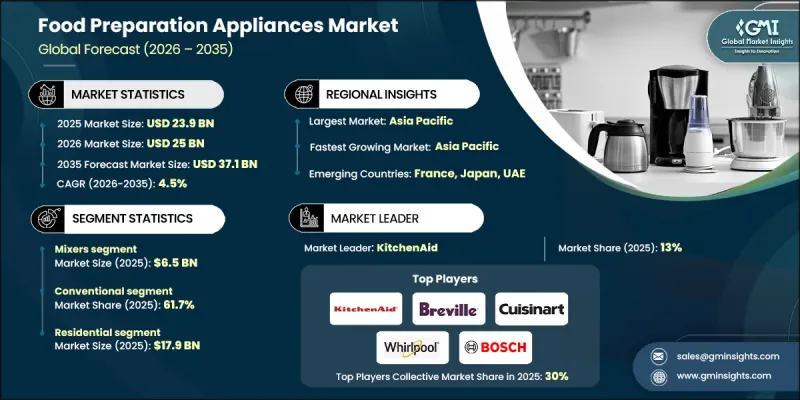
Consumers across urban and semi-urban regions manage demanding schedules and seek solutions that reduce the effort and time required for daily meal preparation. Food preparation appliances address this need by simplifying kitchen tasks and enabling faster execution of complex cooking processes while maintaining consistent output quality. The growing reliance on automated kitchen solutions reflects a broader lifestyle shift toward productivity-focused living. Technological advancements further enhance demand, as digitally enabled appliances support remote operation, scheduling, and seamless integration into connected households. The adoption of intelligent features aligns with the expanding smart home ecosystem and reinforces consumer expectations for ease of use. Convenience-driven innovation remains a central growth catalyst, and time efficiency continues to shape purchasing behavior across global markets, positioning food preparation appliances as essential components of contemporary households.
| Market Scope | |
|---|---|
| Start Year | 2025 |
| Forecast Year | 2026-2035 |
| Start Value | $23.9 Billion |
| Forecast Value | $37.1 Billion |
| CAGR | 4.5% |
Appliances equipped with automated functions, intuitive controls, and connectivity features redefine user interaction by allowing operation through mobile platforms and voice-enabled systems. This technological integration strengthens consumer engagement and supports the broader adoption of smart living environments. The focus on user-friendly design continues to elevate perceived value and drives sustained market momentum.
The mixers segment held a significant share in 2025 owing to their broad functionality and consistent performance across household and professional settings. These appliances support a wide range of food preparation needs, making them indispensable for individuals with varying culinary skill levels. Their ability to deliver reliable results across simple and advanced recipes sustains their popularity and positions them as core kitchen investments.
In 2025, the residential segment accounts for USD 17.9 billion, representing the largest share of the overall market. Rising expectations for convenience and lifestyle enhancement fuel strong household demand for food preparation appliances. Urban consumers increasingly rely on these solutions to streamline daily routines, improve efficiency, and achieve uniform preparation outcomes. The emphasis on ease of use and dependable performance continues to accelerate residential adoption and reinforces long-term growth prospects within this segment.
Germany Food Preparation Appliances Market held a 22.7% share in 2025 and is forecast to grow at a CAGR of 4.4% throughout 2035. The regional market reflects high saturation and intense competition, driven by consumer demand for premium design, energy efficiency, and sustainable manufacturing. Environmental responsibility strongly influences purchasing decisions, encouraging the adoption of appliances produced with eco-conscious materials and optimized energy consumption. Cultural appreciation for home-based cooking and an increasing focus on wellness further sustain demand across the region.
Key participants operating in the Global Food Preparation Appliances Market include Samsung Electronics, Philips, Whirlpool, Robert Bosch, KitchenAid, Panasonic, Black+Decker, Breville, Tefal, Kenwood, Morphy Richards, Cuisinart, Bajaj Electricals, Havells India, and V-Guard Industries. Companies in the Global Food Preparation Appliances Market strengthen their market position through continuous product innovation, strategic portfolio expansion, and investment in smart technology integration. Manufacturers focus on enhancing energy efficiency, durability, and user-centric design to align with evolving consumer preferences. Many brands prioritize sustainability by adopting environmentally responsible materials and improving manufacturing processes. Strategic partnerships, regional expansion, and strong after-sales support help improve brand visibility and customer retention.
Table of Contents
Chapter 1 Methodology and Scope
- 1.1 Market scope and definition
- 1.2 Research design
- 1.2.1 Research approach
- 1.2.2 Data collection methods
- 1.3 Data mining sources
- 1.3.1 Global
- 1.3.2 Regional/Country
- 1.4 Base estimates and calculations
- 1.4.1 Base year calculation
- 1.4.2 Key trends for market estimation
- 1.5 Primary research and validation
- 1.5.1 Primary sources
- 1.6 Forecast model
- 1.7 Research assumptions and limitations
Chapter 2 Executive Summary
- 2.1 Industry 3600 synopsis
- 2.2 Key market trends
- 2.2.1 Regional
- 2.2.2 Product type
- 2.2.3 Function
- 2.2.4 Price
- 2.2.5 End user
- 2.2.6 Distribution channel
- 2.3 CXO perspectives: Strategic imperatives
- 2.3.1 Key decision points for industry executives
- 2.3.2 Critical success factors for market players
- 2.4 Future outlook and strategic recommendations
Chapter 3 Industry Insights
- 3.1 Industry ecosystem analysis
- 3.1.1 Supplier landscape
- 3.1.2 Profit margin
- 3.1.3 Value addition at each stage
- 3.1.4 Factor affecting the value chain
- 3.2 Industry impact forces
- 3.2.1 Growth drivers
- 3.2.1.1 Convenience & time-saving
- 3.2.1.2 Urbanization & disposable income
- 3.2.1.3 Smart & IoT integration
- 3.2.2 Industry pitfalls & challenges
- 3.2.2.1 Complexity in system integration
- 3.2.2.2 Supply chain disruptions
- 3.2.3 Opportunities
- 3.2.3.1 Smart appliance ecosystem expansion
- 3.2.3.2 Multi-function and compact products
- 3.2.1 Growth drivers
- 3.3 Growth potential analysis
- 3.4 Future market trends
- 3.5 Technology and innovation landscape
- 3.5.1 Current technological trends
- 3.5.2 Emerging technologies
- 3.6 Price trends
- 3.6.1 By Region
- 3.6.2 By Product type
- 3.7 Regulatory landscape
- 3.7.1 Standards and compliance requirements
- 3.7.2 Regional regulatory frameworks
- 3.7.3 Certification standards
- 3.8 Porter's analysis
- 3.9 PESTEL analysis
- 3.10 Consumer behavior analysis
- 3.10.1 Purchasing patterns
- 3.10.2 Preference analysis
- 3.10.3 Regional variations in consumer behavior
- 3.10.4 Impact of e-commerce on buying decisions
Chapter 4 Competitive Landscape, 2025
- 4.1 Introduction
- 4.2 Company market share analysis
- 4.2.1 By region
- 4.2.1.1 North America
- 4.2.1.2 Europe
- 4.2.1.3 Asia Pacific
- 4.2.1.4 Latin America
- 4.2.1.5 Middle East and Africa
- 4.2.1 By region
- 4.3 Company matrix analysis
- 4.4 Competitive analysis of major market players
- 4.5 Competitive positioning matrix
- 4.6 Key developments
- 4.6.1 Mergers & acquisitions
- 4.6.2 Partnerships & collaborations
- 4.6.3 New product launches
- 4.6.4 Expansion plans
Chapter 5 Market Estimates and Forecast, By Product Type, 2022 - 2035 (USD Billion) (Thousand Units)
- 5.1 Key trends
- 5.2 Fryers
- 5.2.1 Air fryers
- 5.2.2 Deep fryers
- 5.2.3 Others
- 5.3 Grinders
- 5.4 Mixers
- 5.5 Juicers
- 5.6 Food Processors
- 5.7 Others (Food Dehydrators etc.)
Chapter 6 Market Estimates and Forecast, By Function, 2022 - 2035 (USD Billion) (Thousand Units)
- 6.1 Key trends
- 6.2 Conventional
- 6.3 Smart
- 6.3.1 Wi-Fi
- 6.3.2 Bluetooth
- 6.3.3 Others (Zigbee technology, etc.)
Chapter 7 Market Estimates and Forecast, By Price, 2022 - 2035 (USD Billion) (Thousand Units)
- 7.1 Key trends
- 7.2 Low
- 7.3 Medium
- 7.4 High
Chapter 8 Market Estimates and Forecast, By End User, 2022 - 2035 (USD Billion) (Thousand Units)
- 8.1 Key trends
- 8.2 Residential
- 8.3 Commercial
Chapter 9 Market Estimates and Forecast, By Distribution Channel, 2022 - 2035 (USD Billion) (Thousand Units)
- 9.1 Key trends
- 9.2 Online
- 9.2.1 E-commerce
- 9.2.2 Company websites
- 9.3 Offline
- 9.3.1 Specialty stores
- 9.3.2 Individual stores
- 9.3.3 Others
Chapter 10 Market Estimates and Forecast, By Region, 2022 - 2035 (USD Billion) (Thousand Units)
- 10.1 Key trends
- 10.2 North America
- 10.2.1 U.S.
- 10.2.2 Canada
- 10.3 Europe
- 10.3.1 Germany
- 10.3.2 UK
- 10.3.3 France
- 10.3.4 Italy
- 10.3.5 Spain
- 10.4 Asia Pacific
- 10.4.1 China
- 10.4.2 Japan
- 10.4.3 India
- 10.4.4 Australia
- 10.4.5 South Korea
- 10.5 Latin America
- 10.5.1 Brazil
- 10.5.2 Mexico
- 10.5.3 Argentina
- 10.6 Middle East and Africa
- 10.6.1 South Africa
- 10.6.2 Saudi Arabia
- 10.6.3 UAE
Chapter 11 Company Profiles
- 11.1 Bajaj Electricals
- 11.2 Black+Decker
- 11.3 Breville
- 11.4 Cuisinart
- 11.5 Havells India
- 11.6 Kenwood
- 11.7 KitchenAid
- 11.8 Morphy Richards
- 11.9 Panasonic
- 11.10 Philips
- 11.11 Robert Bosch
- 11.12 Samsung Electronics
- 11.13 Tefal
- 11.14 V-Guard Industries
- 11.15 Whirlpool

