
PUBLISHER: Global Market Insights Inc. | PRODUCT CODE: 1913291

PUBLISHER: Global Market Insights Inc. | PRODUCT CODE: 1913291
GCC Industrial Gas Market Opportunity, Growth Drivers, Industry Trend Analysis, and Forecast 2026 - 2035
The Global GCC Industrial Gas Market was valued at USD 2.6 billion in 2025 and is estimated to grow at a CAGR of 6.2% to reach USD 4.8 billion by 2035.
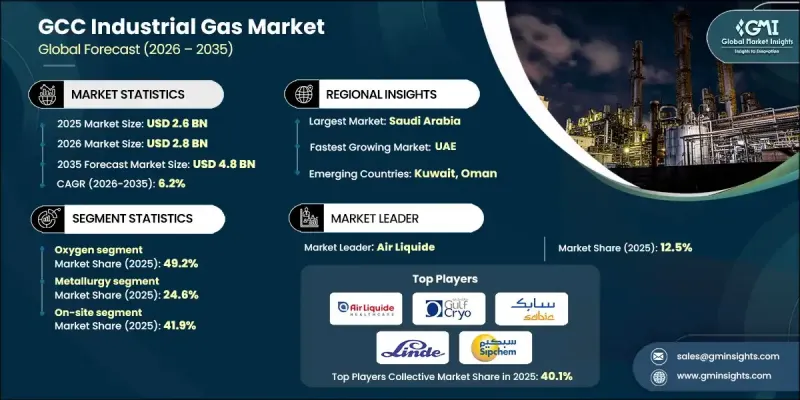
The market continues to demonstrate strong growth momentum, supported by large-scale infrastructure investments, rapid industrialization, renewable energy deployment, and policy frameworks encouraging energy efficiency and domestic production across GCC economies. Industrial gases such as oxygen, nitrogen, hydrogen, argon, carbon dioxide, helium, krypton, and xenon play an essential role in supporting core industries, including metals, chemicals, power generation, manufacturing, and healthcare across the region. The market is undergoing structural evolution as producers increasingly adopt advanced and energy-efficient production systems to manage rising input costs and sustainability requirements. Demand for application-specific and high-purity gas solutions is rising, particularly for electronics manufacturing and medical use, reflecting the shift toward value-added offerings. At the same time, integration of renewable energy and smart operating systems into gas production facilities is becoming more prominent, with green hydrogen emerging as a high-growth opportunity. Long-term regional ambitions to establish leadership in low-carbon energy supply chains further reinforce the strategic importance of industrial gases in the GCC's industrial transformation.
| Market Scope | |
|---|---|
| Start Year | 2025 |
| Forecast Year | 2026-2035 |
| Start Value | $2.6 Billion |
| Forecast Value | $4.8 Billion |
| CAGR | 6.2% |
The oxygen segment accounted for 49.2% share in 2025, maintaining its leading position due to widespread utilization across multiple high-consumption industries. Its strong demand is supported by expanding steel and aluminum production linked to infrastructure development, increasing petrochemical output, power generation efficiency requirements, and sustained growth in healthcare services requiring medical-grade oxygen. The versatility and essential nature of oxygen across industrial and medical applications continue to underpin its dominant market position.
The on-site supply models segment held 41.9% share in 2025. This distribution mode benefits from cost efficiency, supply reliability, and operational control for large-volume end users, particularly in metallurgy, refining, and chemical processing. Dedicated on-site production facilities allow continuous gas availability under long-term contractual arrangements, helping industrial consumers optimize logistics, reduce transportation risks, and achieve stable pricing over extended periods.
Saudi Arabia GCC Industrial Gas Market reached USD 1.3 billion in 2025 and is expected to reach USD 2.4 billion by 2035. Saudi Arabia represents the largest national market within the GCC, supported by its expansive downstream industrial base, large-scale refining capacity, and integrated petrochemical operations. Continued investments in chemicals, metals, energy infrastructure, and carbon management initiatives are driving sustained demand for industrial gases. The country's emphasis on industrial diversification, low-carbon technologies, and advanced manufacturing is further strengthening long-term consumption of oxygen, hydrogen, nitrogen, and carbon dioxide across both traditional and emerging applications, positioning Saudi Arabia as the central growth engine of the regional market.
Key companies operating across the GCC Industrial Gas Market include Linde, Air Products and Chemicals, Inc., Air Liquide, SABIC, Gulf Cryo, SIPCHEM (Sahara International Petrochemical Company), ADNOC Linde, Dubai Industrial Gases, Buzwair Industrial Gases Factories, Brothers Gas Bottling & Distribution Co LLC, Abdullah Hashim Industrial Gases & Equipment (AHG), Gaschem Kuwait, Yateem Oxygen, Nizwa Gas Industries, and other regional suppliers. Companies active in the GCC Industrial Gas Market are strengthening their competitive position through capacity expansion near major industrial hubs and long-term supply agreements with large end users. Investment in energy-efficient production technologies and low-emission gas generation is a key strategic focus. Firms are diversifying portfolios by offering customized, high-purity, and application-specific gas solutions. Strategic partnerships with energy, metals, and healthcare sectors support stable demand.
Table of Contents
Chapter 1 Methodology & Scope
- 1.1 Market scope and definition
- 1.2 Research design
- 1.2.1 Research approach
- 1.2.2 Data collection methods
- 1.3 Data mining sources
- 1.3.1 Regional/Country
- 1.4 Base estimates and calculations
- 1.4.1 Base year calculation
- 1.4.2 Key trends for market estimation
- 1.5 Primary research and validation
- 1.5.1 Primary sources
- 1.6 Forecast model
- 1.7 Research assumptions and limitations
Chapter 2 Executive Summary
- 2.1 Industry 360° synopsis
- 2.2 Key market trends
- 2.2.1 Country
- 2.2.2 Product
- 2.2.3 Supply Mode
- 2.2.4 Application
- 2.3 TAM Analysis, 2025-2034
- 2.4 CXO perspectives: Strategic imperatives
- 2.4.1 Executive decision points
- 2.4.2 Critical success factors
- 2.5 Future Outlook and Strategic Recommendations
Chapter 3 Industry Insights
- 3.1 Industry ecosystem analysis
- 3.1.1 Supplier landscape
- 3.1.2 Profit margin
- 3.1.3 Value addition at each stage
- 3.1.4 Factor affecting the value chain
- 3.1.5 Disruptions
- 3.2 Industry impact forces
- 3.2.1 Growth drivers
- 3.2.2 Industry pitfalls and challenges
- 3.2.3 Market opportunities
- 3.3 Growth potential analysis
- 3.4 Regulatory landscape
- 3.5 Porter's analysis
- 3.6 PESTEL analysis
- 3.7 Price trends
- 3.8 Future market trends
- 3.9 Technology and Innovation landscape
- 3.9.1 Current technological trends
- 3.9.2 Emerging technologies
- 3.10 Patent Landscape
- 3.11 Trade statistics (HS code)
Chapter 4 Competitive Landscape, 2025
- 4.1 Introduction
- 4.2 Company market share analysis
- 4.3 Company matrix analysis
- 4.4 Competitive analysis of major market players
- 4.5 Competitive positioning matrix
- 4.6 Key developments
- 4.6.1 Mergers & acquisitions
- 4.6.2 Partnerships & collaborations
- 4.6.3 New Product Launches
- 4.6.4 Expansion Plans
Chapter 5 Market Estimates and Forecast, By Product, 2022-2035 (USD Billion & Tons)
- 5.1 Key trends
- 5.2 Nitrogen
- 5.3 Oxygen
- 5.4 Carbon Dioxide
- 5.5 Argon
- 5.6 Hydrogen
- 5.7 Helium
- 5.8 Krypton
- 5.9 Xenon
Chapter 6 Market Estimates and Forecast, By Supply Mode, 2022-2035 (USD Billion & Tons)
- 6.1 Key trends
- 6.2 Packaged
- 6.3 Bulk
- 6.4 On-Site
Chapter 7 Market Estimates and Forecast, By Application, 2022-2035 (USD Billion & Tons)
- 7.1 Key trends
- 7.2 Manufacturing
- 7.3 Metallurgy
- 7.4 Energy
- 7.5 Chemicals
- 7.6 Healthcare
- 7.7 Others
Chapter 8 Market Estimates and Forecast, By Region, 2022-2035 (USD Billion & Tons)
- 8.1 Key trends
- 8.2 Saudi Arabia
- 8.3 UAE
- 8.4 Qatar
- 8.5 Oman
- 8.6 Kuwait
- 8.7 Bahrain
Chapter 9 Company Profiles
- 9.1 Gulf Cryo
- 9.2 SABIC (Saudi Basic Industries Corporation)
- 9.3 Linde
- 9.4 SIPCHEM (Sahara International Petrochemical Company)
- 9.5 Brothers Gas Bottling & Distribution Co LLC
- 9.6 Abdullah Hashim Industrial Gases & Equipment (AHG)
- 9.7 Dubai Industrial Gases
- 9.8 Gaschem Kuwait
- 9.9 Air Liquide
- 9.10 Buzwair Industrial Gases Factories
- 9.11 Air Products and Chemicals, Inc.
- 9.12 Yateem Oxygen
- 9.13 ADNOC Linde
- 9.14 Nizwa Gas Industries

