PUBLISHER: Global Market Insights Inc. | PRODUCT CODE: 1913306

PUBLISHER: Global Market Insights Inc. | PRODUCT CODE: 1913306
Management System Certification Market Opportunity, Growth Drivers, Industry Trend Analysis, and Forecast 2026 - 2035
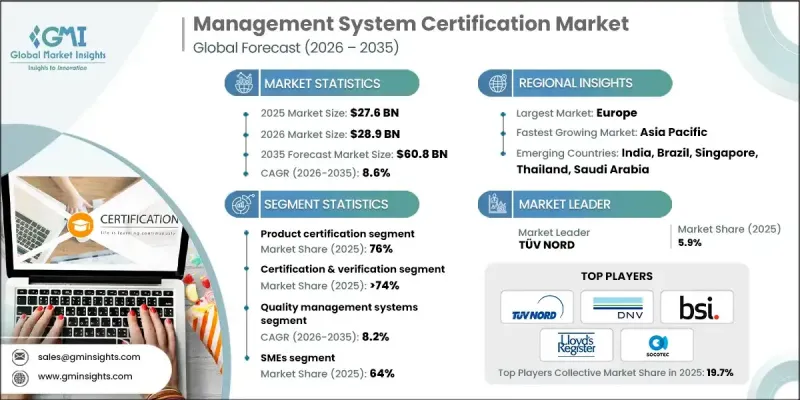
The Global Management System Certification Market was valued at USD 27.6 billion in 2025 and is estimated to grow at a CAGR of 8.6% to reach USD 60.8 billion by 2035.
Growth is fueled by rising regulatory pressures, increasing focus on quality, sustainability, and the need for global compliance. Companies pursue certification not only to meet regulatory mandates but also to enhance credibility, manage risk, and gain a competitive edge in international trade. Organizations operating in regulated industries increasingly require certified management systems from suppliers to assure quality, safety, and reliability. Certification strengthens market access, reduces operational and legal risks, ensures workplace safety, protects data, and maintains customer trust. Rapid digital transformation and rising cyber threats are also driving demand for information security and cybersecurity certifications. Innovations such as blockchain-enabled certification platforms are streamlining the management, verification, and validation of certification data, enabling real-time compliance assurance across global supply chains.
| Market Scope | |
|---|---|
| Start Year | 2025 |
| Forecast Year | 2026-2035 |
| Start Value | $27.6 Billion |
| Forecast Value | $60.8 Billion |
| CAGR | 8.6% |
The product certification segment held a 76% share and is expected to grow at a CAGR of 8.3% from 2026 to 2035. Product certifications are increasingly aligned with sustainability, traceability, performance benchmarks, and digital compliance tools, helping organizations differentiate their offerings while demonstrating measurable value beyond regulatory requirements. Demand is particularly strong in export-oriented and regulated markets that require transparency, safety assurances, and lifecycle impact validation.
The certification & verification segment accounted for 74% share in 2025, valued at around USD 20.5 billion. Third-party certification and verification services remain critical for companies seeking to satisfy regulatory requirements, enhance supply chain credibility, and build customer confidence. Technology-enabled audits, including remote and hybrid approaches, are enhancing the efficiency, scalability, and consistency of verification services while maintaining compliance rigor.
U.S. Management System Certification Market was valued at USD 9.2 billion in 2025. Growth is driven by regulatory oversight, increasing cybersecurity risks, and ESG compliance pressures. Adoption is strong in healthcare, defense, technology, and critical infrastructure sectors, where third-party validation and compliance assurance are essential. Information security and cybersecurity certifications are experiencing rapid uptake as organizations respond to federal regulations, data privacy laws, and escalating cyber threats across enterprise, defense, and cloud-based operations.
Key players in the Global Management System Certification Market include DNV, TUV NORD, Lloyd's Register Group Services, The British Standards Institution, Holding Socotec, DQS, RINA, Drata, and SIS Certifications. Companies in the Management System Certification Market are leveraging multiple strategies to expand their market presence. They are investing in technology-driven audit solutions, including remote and hybrid verification platforms, to increase efficiency and scalability. Expanding service portfolios to include cybersecurity, ESG, and sustainability certifications helps cater to evolving regulatory and corporate governance needs. Strategic partnerships with industry associations, technology providers, and multinational enterprises strengthen client acquisition and retention. Firms are enhancing digital platforms for real-time certificate management, data analytics, and compliance reporting.
Table of Contents
Chapter 1 Methodology
- 1.1 Market scope and definition
- 1.2 Research design
- 1.2.1 Research approach
- 1.2.2 Data collection methods
- 1.3 Data mining sources
- 1.3.1 Global
- 1.3.2 Regional/Country
- 1.4 Base estimates and calculations
- 1.4.1 Base year calculation
- 1.4.2 Key trends for market estimation
- 1.5 Primary research and validation
- 1.5.1 Primary sources
- 1.6 Forecast
- 1.7 Research assumptions and limitations
Chapter 2 Executive Summary
- 2.1 Industry 360° synopsis, 2022 - 2035
- 2.2 Key market trends
- 2.2.1 Regional
- 2.2.2 Certification
- 2.2.3 Service
- 2.2.4 Organization size
- 2.2.5 Application
- 2.2.6 Industry vertical
- 2.3 TAM Analysis, 2026-2035
- 2.4 CXO perspectives: Strategic imperatives
- 2.4.1 Executive decision points
- 2.4.2 Critical success factors
- 2.5 Future outlook & strategic recommendations
Chapter 3 Industry Insights
- 3.1 Industry ecosystem analysis
- 3.1.1 Supplier landscape
- 3.1.2 Profit margin analysis
- 3.1.3 Cost structure
- 3.1.4 Value addition at each stage
- 3.1.5 Factor affecting the value chain
- 3.1.6 Disruptions
- 3.2 Industry impact forces
- 3.2.1.1 Growth drivers
- 3.2.1.2 Regulatory compliance requirements
- 3.2.1.3 Supply chain qualification pressure
- 3.2.1.4 Rising cybersecurity and data protection risks
- 3.2.1.5 Focus on operational efficiency and risk management
- 3.2.1.6 Growing emphasis on ESG and sustainability
- 3.2.2 Industry pitfalls and challenges
- 3.2.2.1 High certification and audit costs
- 3.2.2.2 Complexity of certification processes
- 3.2.3 Market opportunities
- 3.2.3.1 Expansion of SME-focused certification solutions
- 3.2.3.2 Growth of integrated management system certifications
- 3.2.3.3 Rising demand in emerging economies
- 3.2.3.4 Digital and remote auditing models
- 3.3 Growth potential analysis
- 3.4 Regulatory landscape
- 3.4.1 North America
- 3.4.1.1 U.S. - ISO 9001 Quality Management Systems
- 3.4.1.2 Canada - ISO 45001 Occupational Health and Safety
- 3.4.2 Europe
- 3.4.2.1 UK - ISO/IEC 27001 Information Security Management
- 3.4.2.2 Germany - ISO 50001 Energy Management Systems
- 3.4.2.3 France - ISO 45001 Occupational Health and Safety
- 3.4.2.4 Italy - ISO 14001 Environmental Management Systems
- 3.4.2.5 Spain - ISO 22000 Food Safety Management Systems
- 3.4.3 Asia Pacific
- 3.4.3.1 China - ISO/IEC 27001 Information Security Management
- 3.4.3.2 Japan - ISO 14001 Environmental Management Systems
- 3.4.3.3 India - ISO 45001 Occupational Health and Safety
- 3.4.4 Latin America
- 3.4.4.1 Brazil - ISO 14001 Environmental Management Systems
- 3.4.4.2 Mexico - ISO 45001 Occupational Health and Safety
- 3.4.4.3 Argentina - ISO 14001 Environmental Management Systems
- 3.4.5 Middle East & Africa
- 3.4.5.1 UAE - ISO 14001 Environmental Management Systems
- 3.4.5.2 South Africa - ISO 45001 Occupational Health and Safety
- 3.4.5.3 Saudi Arabia - ISO 14001 Environmental Management Systems
- 3.4.1 North America
- 3.5 Porter's analysis
- 3.6 PESTEL analysis
- 3.7 Technology and innovation landscape
- 3.7.1 Current technological trends
- 3.7.2 Emerging technologies
- 3.8 Cost breakdown analysis
- 3.8.1 Development cost structure
- 3.8.2 R&D cost analysis
- 3.8.3 Marketing & sales costs
- 3.9 Patent analysis
- 3.10 Sustainability and environmental aspects
- 3.10.1 Sustainable practices
- 3.10.2 Waste reduction strategies
- 3.10.3 Energy efficiency in production
- 3.10.4 Eco-friendly Initiatives
- 3.11 Future market outlook & opportunities
- 3.12 Accreditation & governance ecosystem
- 3.12.1 Role of accreditation bodies (IAF, ANAB, UKAS, DAkkS, NABCB)
- 3.12.2 Relationship between ISO, accreditation bodies & certification bodies
- 3.12.3 Impact of accreditation policies on market access and pricing
- 3.13 Buyer decision-making & certification selection criteria
- 3.13.1 Price vs brand credibility trade-offs
- 3.13.2 Importance of accreditation recognition
- 3.13.3 Industry-specific certification preferences
- 3.13.4 Switching behavior and multi-certifier usage
- 3.14 Certification lifecycle & revenue model dynamics
- 3.15 Auditor capacity, competency & workforce dynamics
Chapter 4 Competitive Landscape, 2025
- 4.1 Introduction
- 4.2 Company market share analysis
- 4.2.1 North America
- 4.2.2 Europe
- 4.2.3 Asia Pacific
- 4.2.4 LATAM
- 4.2.5 MEA
- 4.3 Competitive analysis of major market players
- 4.4 Competitive positioning matrix
- 4.5 Strategic outlook matrix
- 4.6 Key developments
- 4.6.1 Mergers & acquisitions
- 4.6.2 Partnerships & collaborations
- 4.6.3 New Product Launches
- 4.6.4 Expansion Plans and funding
Chapter 5 Market Estimates & Forecast, By Certification, 2022 - 2035 ($Bn)
- 5.1 Key trends
- 5.2 Product certification
- 5.3 System certification
Chapter 6 Market Estimates & Forecast, By Service, 2022 - 2035 ($Bn)
- 6.1 Key trends
- 6.2 Certification & Verification
- 6.3 Training & Business Assurance
Chapter 7 Market Estimates & Forecast, By Organization size, 2022 - 2035 ($Bn)
- 7.1 Key trends
- 7.2 SMEs
- 7.3 Large Enterprises
Chapter 8 Market Estimates & Forecast, By Application, 2022 - 2035 ($Bn)
- 8.1 Key trends
- 8.2 Quality Management Systems
- 8.3 Occupational Health and Safety
- 8.4 Cyber Security
- 8.5 Information Security
- 8.6 Food Safety
- 8.7 Environmental Management
- 8.8 Others
Chapter 9 Market Estimates & Forecast, By Industry vertical, 2022 - 2035 ($Bn)
- 9.1 Key trends
- 9.2 Aerospace & Defense
- 9.3 Automotive & Transportation
- 9.4 Construction
- 9.5 Consumer Goods & Retail
- 9.6 Energy & Utilities
- 9.7 Healthcare & Life Sciences
- 9.8 Information Technology & Telecommunication
- 9.9 Manufacturing
- 9.10 Others
Chapter 10 Market Estimates & Forecast, By Region, 2022 - 2035 ($Bn)
- 10.1 Key trends
- 10.2 North America
- 10.2.1 US
- 10.2.2 Canada
- 10.3 Europe
- 10.3.1 Germany
- 10.3.2 UK
- 10.3.3 France
- 10.3.4 Italy
- 10.3.5 Spain
- 10.3.6 Russia
- 10.3.7 Nordics
- 10.3.8 Portugal
- 10.3.9 Croatia
- 10.3.10 Benelux
- 10.4 Asia Pacific
- 10.4.1 China
- 10.4.2 India
- 10.4.3 Japan
- 10.4.4 Australia
- 10.4.5 South Korea
- 10.4.6 Singapore
- 10.4.7 Thailand
- 10.4.8 Indonesia
- 10.4.9 Vietnam
- 10.5 Latin America
- 10.5.1 Brazil
- 10.5.2 Mexico
- 10.5.3 Argentina
- 10.5.4 Colombia
- 10.6 MEA
- 10.6.1 South Africa
- 10.6.2 Saudi Arabia
- 10.6.3 UAE
- 10.6.4 Turkey
Chapter 11 Company Profiles
- 11.1 Global Players
- 11.1.1 TUV NORD
- 11.1.2 DNV
- 11.1.3 The British Standards Institution BSI
- 11.1.4 Lloyd's Register Group Services
- 11.1.5 RINA
- 11.1.6 ASTM
- 11.1.7 SGS
- 11.1.8 Bureau Veritas
- 11.1.9 Intertek
- 11.1.10 TUV Rheinland
- 11.1.11 DEKRA
- 11.1.12 UL
- 11.1.13 Applus+
- 11.2 Regional Players
- 11.2.1 Holding Socotec
- 11.2.2 DQS
- 11.2.3 IMQ
- 11.2.4 IRCLASS
- 11.2.5 SIS Certifications
- 11.2.6 LL-C Certification
- 11.2.7 GCL International
- 11.2.8 Aurion International
- 11.2.9 AL BORJ Facility Management
- 11.3 Emerging / Disruptor Players
- 11.3.1 Drata
- 11.3.2 Vanta
- 11.3.3 Bluestar Management Systems
- 11.3.4 Finecert

