PUBLISHER: Global Market Insights Inc. | PRODUCT CODE: 1913316

PUBLISHER: Global Market Insights Inc. | PRODUCT CODE: 1913316
Automotive Infotainment Market Opportunity, Growth Drivers, Industry Trend Analysis, and Forecast 2026 - 2035
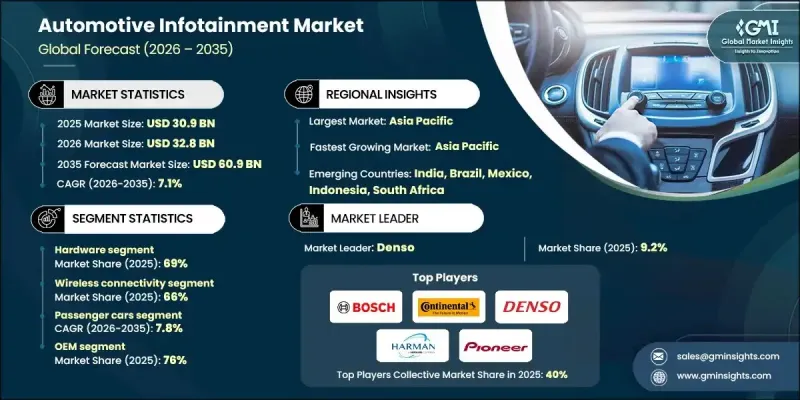
The Global Automotive Infotainment Market was valued at USD 30.9 billion in 2025 and is estimated to grow at a CAGR of 7.1% to reach USD 60.9 billion by 2035.
Growth is linked to the rapid expansion of connected and intelligent vehicles, where infotainment systems are becoming a central element of both passenger and commercial vehicle design. Consumers are increasingly seeking uninterrupted digital interaction inside vehicles, encouraging automakers to prioritize seamless connectivity, real-time data access, and intuitive interfaces that improve driving comfort and overall convenience. Infotainment platforms are now viewed as a key contributor to vehicle connectedness, supporting enhanced user engagement and functionality. Automakers are accelerating the transition toward fully wireless solutions to improve usability and flexibility, allowing drivers to interact with in-vehicle systems without physical connections. This shift is reinforcing the importance of infotainment as a core differentiator and value-enhancing feature across modern vehicle portfolios.
| Market Scope | |
|---|---|
| Start Year | 2025 |
| Forecast Year | 2026-2035 |
| Start Value | $30.9 Billion |
| Forecast Value | $60.9 Billion |
| CAGR | 7.1% |
The hardware segment held 69% share and is forecast to grow at a CAGR of 6.6% between 2026 and 2035. Hardware components form the structural foundation of infotainment systems by enabling connectivity, data exchange, and high-quality audio and visual output. These systems support real-time communication, content access, and interaction between vehicles, users, and manufacturers, reinforcing their importance within the overall infotainment ecosystem.
The wireless connectivity segment held a 66% share and is expected to grow at a CAGR of 7.5% from 2026 to 2035. Wireless solutions are increasingly favored for enabling seamless device integration, cloud-based services, and continuous data access without the need for physical interfaces. This technology supports hands-free operation, media access, and enhanced system functionality, contributing to a more streamlined and connected in-vehicle experience.
US Automotive Infotainment Market reached USD 6.48 billion in 2025. Market growth in the US is supported by strong consumer preference for wireless device integration and advanced digital experiences inside vehicles. The rising presence of connected electric vehicles is further driving the adoption of advanced infotainment platforms that support navigation intelligence, energy optimization, and voice-based interaction.
Key players active in the Global Automotive Infotainment Market include Harman International, Bosch, Continental, Panasonic, Denso, LG Electronics, Pioneer, Alpine Electronics, and Mitsubishi Electric. Companies operating in the Global Automotive Infotainment Market are strengthening their market position through continuous innovation, strategic collaboration, and platform integration. Leading players are investing in scalable system architectures that support future software upgrades and evolving connectivity requirements. Partnerships with automakers are being used to align infotainment solutions with vehicle design and user experience goals. Firms are also focusing on improving system reliability, interface design, and processing performance to enhance customer satisfaction.
Table of Contents
Chapter 1 Methodology
- 1.1 Research approach
- 1.2 Quality commitments
- 1.3 GMI AI policy & data integrity commitment
- 1.4 Research trail & confidence scoring
- 1.4.1 Research trail components
- 1.4.2 Scoring components
- 1.5 Data collection
- 1.5.1 Partial list of primary sources
- 1.6 Data mining sources
- 1.6.1 Paid sources
- 1.7 Base estimates and calculations
- 1.7.1 Base year calculation
- 1.8 Forecast model
- 1.9 Research transparency addendum
Chapter 2 Executive Summary
- 2.1 Industry 3600 synopsis
- 2.2 Key market trends
- 2.2.1 Regional
- 2.2.2 Component
- 2.2.3 Connectivity
- 2.2.4 Vehicle
- 2.2.5 Application
- 2.2.6 Distribution channel
- 2.3 TAM analysis, 2026-2035
- 2.4 CXO perspectives: Strategic imperatives
- 2.4.1 Executive decision points
- 2.4.2 Critical success factors
- 2.5 Future outlook
- 2.6 Strategic recommendations
Chapter 3 Industry Insights
- 3.1 Industry ecosystem analysis
- 3.1.1 Supplier landscape
- 3.1.2 Profit margin
- 3.1.3 Cost structure
- 3.1.4 Value addition at each stage
- 3.1.5 Factor affecting the value chain
- 3.1.6 Disruptions
- 3.2 Industry impact forces
- 3.2.1 Growth drivers
- 3.2.1.1 Rising demand for connected vehicles
- 3.2.1.2 Growth of electric vehicles (EVs)
- 3.2.1.3 Technological advancements
- 3.2.1.4 Consumer preference for multimedia & navigation
- 3.2.2 Industry pitfalls and challenges
- 3.2.2.1 High cost of advanced infotainment systems
- 3.2.2.2 Cybersecurity & data privacy risks
- 3.2.3 Market opportunities
- 3.2.3.1 Aftermarket upgrades & retrofits
- 3.2.3.2 Regional expansion in emerging markets
- 3.2.3.3 Integration with ADAS & safety features
- 3.2.3.4 Subscription-based services & in-car apps
- 3.2.1 Growth drivers
- 3.3 Growth potential analysis
- 3.4 Regulatory landscape
- 3.4.1 North America
- 3.4.1.1 U.S. Department of Transportation (DOT) Standards
- 3.4.1.2 Occupational Safety and Health Administration (OSHA) Guidelines
- 3.4.1.3 U.S. Environmental Protection Agency (EPA)
- 3.4.2 Europe
- 3.4.2.1 EN ISO Container Standards
- 3.4.2.2 European Union Customs and Safety Regulations
- 3.4.2.3 BS EN / CEN Standards
- 3.4.2.4 National Standards (UNE, DIN, etc.)
- 3.4.3 Asia Pacific
- 3.4.3.1 China GB (Guobiao) Standards
- 3.4.3.2 Japan JIS Requirements
- 3.4.3.3 Korea KS Certification
- 3.4.3.4 Indian BIS Standards
- 3.4.3.5 Thai Industrial Standards Institute (TISI)
- 3.4.4 Latin America
- 3.4.4.1 INMETRO (National Institute of Metrology)
- 3.4.4.2 INTI certification (Instituto Nacional de Tecnologia Industrial)
- 3.4.4.3 NOM standards (Norma Official Mexicana)
- 3.4.5 Middle East & Africa
- 3.4.5.1 ESMA / Emirates Conformity Assessment Scheme (ECAS)
- 3.4.5.2 GCC technical regulations
- 3.4.5.3 SABS certification
- 3.4.1 North America
- 3.5 Porter's analysis
- 3.6 PESTEL analysis
- 3.7 Technology and innovation landscape
- 3.7.1 Current technological trends
- 3.7.2 Emerging technologies
- 3.8 Pricing analysis
- 3.8.1.1 Pricing by product
- 3.8.1.2 Pricing by region
- 3.9 Production statistics
- 3.9.1 Production hubs
- 3.9.2 Consumption hubs
- 3.9.3 Export and import
- 3.10 Cost breakdown analysis
- 3.11 Patent analysis
- 3.12 Sustainability and environmental aspects
- 3.12.1 Sustainable practices
- 3.12.2 Waste reduction strategies
- 3.12.3 Energy efficiency in production
- 3.12.4 Eco-friendly initiatives
- 3.12.5 Carbon footprint considerations
- 3.13 Role of infotainment in SDV architectures
- 3.13.1 Centralized vs domain-based E/E architectures
- 3.13.2 Impact on hardware commoditization
- 3.13.3 Implications for OEM-supplier power balance
- 3.14 Comparative assessment of infotainment operating systems
- 3.14.1 OEM control vs Big Tech dependency
- 3.14.2 Platform lock-in risks
- 3.14.3 Regional OS preferences and restrictions
- 3.15 OEM Sourcing Strategy: In-house vs Tier-1 vs Big Tech
- 3.16 Monetization Models & Revenue Streams
- 3.17 User Experience (UX) & Human-Machine Interface (HMI) Benchmarking
Chapter 4 Competitive Landscape, 2025
- 4.1 Introduction
- 4.2 Company market share analysis
- 4.2.1 North America
- 4.2.2 Europe
- 4.2.3 Asia Pacific
- 4.2.4 LATAM
- 4.2.5 MEA
- 4.3 Competitive analysis of major market players
- 4.4 Competitive positioning matrix
- 4.5 Strategic outlook matrix
- 4.6 Key developments
- 4.6.1 Mergers & acquisitions
- 4.6.2 Partnerships & collaborations
- 4.6.3 New product launches
- 4.6.4 Expansion plans and funding
Chapter 5 Market Estimates & Forecast, By Component, 2022 - 2035 ($Mn, Units)
- 5.1 Key trends
- 5.2 Hardware
- 5.2.1 Head units (display screens, touch panels)
- 5.2.2 Audio & speakers
- 5.2.3 Connectivity modules (Bluetooth, Wi-Fi, LTE/5G)
- 5.2.4 Navigation systems (GPS, mapping modules)
- 5.3 Software
- 5.3.1 Operating systems (Android automotive, QNX, Linux-based)
- 5.3.2 Infotainment applications
- 5.3.3 Cloud & connected services
Chapter 6 Market Estimates & Forecast, By Connectivity, 2022 - 2035 ($Mn, Units)
- 6.1 Key trends
- 6.2 Wired connectivity
- 6.3 Wireless connectivity
- 6.3.1 Bluetooth
- 6.3.2 Wi-Fi
- 6.3.3 Cellular (3G/4G/5G)
- 6.3.4 Vehicle-to-Everything (V2X)
Chapter 7 Market Estimates & Forecast, By Vehicle, 2022 - 2035 ($Mn, Units)
- 7.1 Key trends
- 7.2 Passenger cars
- 7.2.1 Hatchback
- 7.2.2 Sedan
- 7.2.3 SUV
- 7.3 Commercial vehicle
- 7.3.1 LCV (Light commercial vehicle)
- 7.3.2 MCV (Medium commercial vehicle)
- 7.3.3 HCV (Heavy commercial vehicle)
Chapter 8 Market Estimates & Forecast, By Application, 2022 - 2035 ($Mn, Units)
- 8.1 Key trends
- 8.2 Navigation & GPS
- 8.3 Multimedia & entertainment (Audio/Video Streaming)
- 8.4 Voice assistance & natural language processing
- 8.5 Telematics & vehicle diagnostics
- 8.6 Safety & ADAS integration
Chapter 9 Market Estimates & Forecast, By Distribution channel, 2022 - 2035 ($Mn, Units)
- 9.1 Key trends
- 9.2 OEM
- 9.3 Aftermarket
Chapter 10 Market Estimates & Forecast, By Region, 2022 - 2035 ($Mn, Units)
- 10.1 Key trends
- 10.2 North America
- 10.2.1 US
- 10.2.2 Canada
- 10.3 Europe
- 10.3.1 Germany
- 10.3.2 UK
- 10.3.3 France
- 10.3.4 Italy
- 10.3.5 Spain
- 10.3.6 Nordics
- 10.3.7 Russia
- 10.3.8 Poland
- 10.3.9 Romania
- 10.4 Asia Pacific
- 10.4.1 China
- 10.4.2 India
- 10.4.3 Japan
- 10.4.4 South Korea
- 10.4.5 ANZ
- 10.4.6 Vietnam
- 10.4.7 Indonesia
- 10.5 Latin America
- 10.5.1 Brazil
- 10.5.2 Mexico
- 10.5.3 Argentina
- 10.6 MEA
- 10.6.1 South Africa
- 10.6.2 Saudi Arabia
- 10.6.3 UAE
Chapter 11 Company Profiles
- 11.1 Global companies
- 11.1.1 Alpine Electronics
- 11.1.2 Bosch
- 11.1.3 Continental
- 11.1.4 Denso
- 11.1.5 Harman International
- 11.1.6 LG Electronics
- 11.1.7 Mitsubishi Electric
- 11.1.8 Panasonic Automotive Systems
- 11.1.9 Pioneer
- 11.1.10 Visteon
- 11.2 Regional players
- 11.2.1 Baidu
- 11.2.2 BYD
- 11.2.3 Clarion
- 11.2.4 Faurecia
- 11.2.5 Geely Auto
- 11.2.6 Huawei
- 11.2.7 Hyundai Mobis
- 11.2.8 JVC Kenwood
- 11.3 Emerging players
- 11.3.1 Apple
- 11.3.2 Google
- 11.3.3 NVIDIA
- 11.3.4 NXP Semiconductors
- 11.3.5 Qualcomm
- 11.3.6 Rokid

