
PUBLISHER: Global Market Insights Inc. | PRODUCT CODE: 1913317

PUBLISHER: Global Market Insights Inc. | PRODUCT CODE: 1913317
Limited Slip Differential Market Opportunity, Growth Drivers, Industry Trend Analysis, and Forecast 2026 - 2035
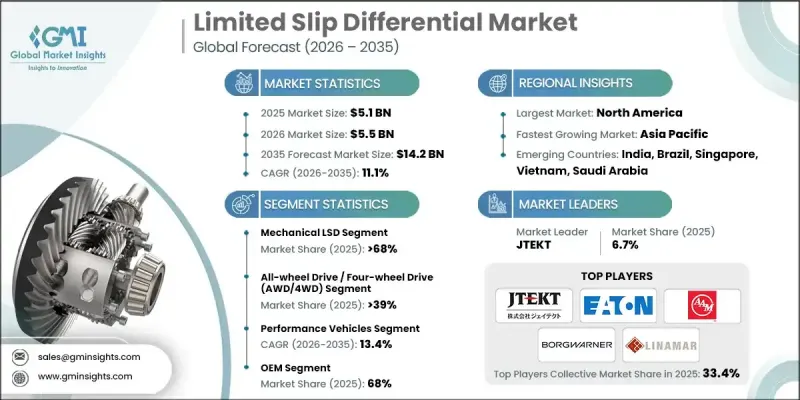
The Global Limited Slip Differential Market was valued at USD 5.1 billion in 2025 and is estimated to grow at a CAGR of 11.1% to reach USD 14.2 billion by 2035.
Rising expectations for vehicle stability, traction management, and consistent handling performance are positioning limited slip differentials as a core drivetrain component. These systems are increasingly used alongside electronic stability solutions to improve overall drivability and safety across a wide range of vehicle categories. Demand is also supported by growing interest in performance-oriented driving characteristics, which has influenced broader consumer preferences beyond specialized applications. Ongoing advancements in design engineering, materials science, and precision manufacturing are enabling more compact and efficient differential systems with higher torque management capability. The growing shift toward electrified powertrains is accelerating the adoption of electronically controlled limited slip differentials, as these systems support optimized torque delivery, improved energy utilization, and enhanced vehicle dynamics. In parallel, rising global demand for utility-focused vehicles is strengthening the need for advanced driveline solutions that support traction consistency and stability. These combined factors continue to drive sustained growth across both mainstream and premium automotive segments worldwide.
| Market Scope | |
|---|---|
| Start Year | 2025 |
| Forecast Year | 2026-2035 |
| Start Value | $5.1 Billion |
| Forecast Value | $14.2 Billion |
| CAGR | 11.1% |
In 2025, the mechanical limited slip differentials segment accounted for 68% share and is projected to reach USD 9.1 billion by 2035. These systems remain widely adopted due to their durability, cost efficiency, and reliable performance without reliance on electronic components. Continuous improvements in internal design and friction materials are enhancing torque transfer efficiency and extending service life, ensuring strong demand across multiple vehicle categories and regional markets.
The performance vehicle segment is expected to grow at a CAGR of 13.4% during 2026-2035. Automakers are increasingly integrating both electronic and mechanical limited slip differentials to support enhanced handling, acceleration, and dynamic control. Advances in torque management technologies are expanding adoption across high-value and specialized vehicle platforms, reinforcing long-term demand within this segment.
US Limited Slip Differential Market reached USD 791.6 million in 2025. Strong domestic demand is driven by sustained production of larger vehicle platforms and continued OEM focus on driveline systems that enhance capability, stability, and traction across diverse operating conditions.
Key companies active in the Global Limited Slip Differential Market include ZF Friedrichshafen, Dana, BorgWarner, Eaton, GKN Automotive, Aisin Seiki, JTEKT, American Axle & Manufacturing, Linamar, and Auburn Gear. Companies operating in the Global Limited Slip Differential Market are reinforcing their competitive position through continuous product innovation and investment in advanced driveline technologies. Manufacturers are focusing on lightweight materials, compact designs, and improved torque management to meet evolving OEM requirements. Strategic collaborations with vehicle manufacturers are enabling early integration of next-generation differential systems into new platforms. Many players are expanding electronic and hybrid LSD offerings to align with the growing electrification trend. Global footprint expansion through localized manufacturing and supply chain optimization is improving responsiveness to regional demand.
Table of Contents
Chapter 1 Methodology
- 1.1 Research approach
- 1.2 Quality commitments
- 1.2.1 GMI AI policy & data integrity commitment
- 1.3 Research trail & confidence scoring
- 1.3.1 Research trail components
- 1.3.2 Scoring components
- 1.4 Data collection
- 1.4.1 Partial list of primary sources
- 1.5 Data mining sources
- 1.5.1 Paid sources
- 1.6 Base estimates and calculations
- 1.6.1 Base year calculation
- 1.7 Forecast
- 1.8 Research transparency addendum
Chapter 2 Executive Summary
- 2.1 Industry 360° synopsis, 2022 - 2035
- 2.2 Key market trends
- 2.2.1 Regional
- 2.2.2 Product
- 2.2.3 Drive
- 2.2.4 Vehicle
- 2.2.5 Application
- 2.2.6 Sales channel
- 2.3 TAM Analysis, 2026-2035
- 2.4 CXO perspectives: Strategic imperatives
- 2.4.1 Executive decision points
- 2.4.2 Critical success factors
- 2.5 Future outlook & strategic recommendations
Chapter 3 Industry Insights
- 3.1 Industry ecosystem analysis
- 3.1.1 Supplier landscape
- 3.1.2 Profit margin analysis
- 3.1.3 Cost structure
- 3.1.4 Value addition at each stage
- 3.1.5 Factor affecting the value chain
- 3.1.6 Disruptions
- 3.2 Industry impact forces
- 3.2.1.1 Growth drivers
- 3.2.1.2 Rising demand for vehicle safety and traction
- 3.2.1.3 Rapid growth of SUV and crossover segments
- 3.2.1.4 Expansion of electric and hybrid vehicles
- 3.2.1.5 Growth of performance and motorsports vehicles
- 3.2.1.6 Advancements in driveline and materials technology
- 3.2.2 Industry pitfalls and challenges
- 3.2.2.1 High system and integration costs
- 3.2.2.2 Competition from alternative traction technologies
- 3.2.3 Market opportunities
- 3.2.3.1 Rising AWD adoption in emerging markets
- 3.2.3.2 OEM shift toward electronic LSD platforms
- 3.2.3.3 Aftermarket performance and off-road upgrades
- 3.2.3.4 Commercial and specialty vehicle applications
- 3.3 Growth potential analysis
- 3.4 Regulatory landscape
- 3.4.1 North America
- 3.4.1.1 United States - SAE J328 Axle and Driveline Component Performance Requirements
- 3.4.1.2 Canada - SAE J328 Axle and Driveline Component Performance Requirements
- 3.4.2 Europe
- 3.4.2.1 United Kingdom - UNECE Regulation No. 13 Vehicle Braking and Stability Systems
- 3.4.2.2 Germany - ISO 26262 Functional Safety of Electrical and Electronic Systems in Road Vehicles
- 3.4.2.3 France - UNECE Regulation No. 79 Steering and Vehicle Control Systems
- 3.4.2.4 Italy - ISO 9001 Quality Management Systems for Differential Manufacturing
- 3.4.2.5 Spain - ISO 14001 Environmental Management Systems for Differential Production
- 3.4.3 Asia Pacific
- 3.4.3.1 China - GB/T Driveline and Axle Performance Standards for Automotive Differentials
- 3.4.3.2 Japan - ISO 26262 Functional Safety of Electrical and Electronic Systems in Road Vehicles
- 3.4.3.3 India - AIS Automotive Industry Standards for Axles and Differentials
- 3.4.4 Latin America
- 3.4.4.1 Brazil - ABNT NBR Automotive Driveline Performance Standards
- 3.4.4.2 Mexico - NOM Automotive Component Performance and Safety Standards
- 3.4.4.3 Argentina - ISO 9001 Quality Management Systems for Automotive Components
- 3.4.5 Middle East & Africa
- 3.4.5.1 United Arab Emirates - UNECE Regulation No. 13 Vehicle Braking and Stability Systems
- 3.4.5.2 South Africa - ISO 26262 Functional Safety of Electrical and Electronic Systems in Road Vehicles
- 3.4.5.3 Saudi Arabia - SASO Automotive Technical Regulations for Driveline Systems
- 3.4.1 North America
- 3.5 Porter's analysis
- 3.6 PESTEL analysis
- 3.7 Technology and innovation landscape
- 3.7.1 Current technological trends
- 3.7.2 Emerging technologies
- 3.8 Production statistics
- 3.8.1 Production hubs
- 3.8.2 Consumption hubs
- 3.8.3 Export and import
- 3.9 Cost breakdown analysis
- 3.9.1 Development cost structure
- 3.9.2 R&D cost analysis
- 3.9.3 Marketing & sales costs
- 3.10 Patent analysis
- 3.11 Sustainability and environmental aspects
- 3.11.1 Sustainable practices
- 3.11.2 Waste reduction strategies
- 3.11.3 Energy efficiency in production
- 3.11.4 Eco-friendly Initiatives
- 3.12 Future market outlook & opportunities
- 3.13 Competitive technology benchmarking: LSD vs alternatives
- 3.13.1 LSD vs open differential performance comparison
- 3.13.2 LSD vs electronic traction control systems (ETC)
- 3.13.3 LSD vs torque vectoring systems
- 3.13.4 OEM decision trade-offs: cost, complexity, performance
- 3.14 LSD integration with vehicle dynamics systems
- 3.15 Electric Vehicle & e-Axle Compatibility Analysis
- 3.15.1 Mechanical LSD relevance in EV architectures
- 3.15.2 e-LSD integration with e-axles and electric drive units
- 3.15.3 LSD vs motor-based torque vectoring in EVs
- 3.15.4 Future demand outlook across BEV, HEV, PHEV
Chapter 4 Competitive Landscape, 2025
- 4.1 Introduction
- 4.2 Company market share analysis
- 4.2.1 North America
- 4.2.2 Europe
- 4.2.3 Asia Pacific
- 4.2.4 LATAM
- 4.2.5 MEA
- 4.3 Competitive analysis of major market players
- 4.4 Competitive positioning matrix
- 4.5 Strategic outlook matrix
- 4.6 Key developments
- 4.6.1 Mergers & acquisitions
- 4.6.2 Partnerships & collaborations
- 4.6.3 New Product Launches
- 4.6.4 Expansion Plans and funding
Chapter 5 Market Estimates & Forecast, By Product, 2022 - 2035 ($Bn, units)
- 5.1 Key trends
- 5.2 Mechanical LSD
- 5.3 Electronic LSD
- 5.4 Torsen LSD
Chapter 6 Market Estimates & Forecast, By Vehicle, 2022 - 2035 ($Bn, units)
- 6.1 Key trends
- 6.2 Passenger vehicle
- 6.2.1 SUV
- 6.2.2 Sedan
- 6.2.3 Hatchback
- 6.3 Commercial vehicle
- 6.3.1 LCV
- 6.3.2 MCV
- 6.3.3 HCV
Chapter 7 Market Estimates & Forecast, By Drive, 2022 - 2035 ($Bn, units)
- 7.1 Key trends
- 7.2 Front-Wheel Drive (FWD)
- 7.3 Rear-Wheel Drive (RWD)
- 7.4 All-Wheel Drive / Four-Wheel Drive (AWD/4WD)
Chapter 8 Market Estimates & Forecast, By Application, 2022 - 2035 ($Bn, units)
- 8.1 Key trends
- 8.2 Performance vehicles
- 8.3 Off-road vehicles
- 8.4 Passenger vehicles
- 8.5 Others
Chapter 9 Market Estimates & Forecast, By Sales Channel, 2022 - 2035 ($Bn, units)
- 9.1 Key trends
- 9.2 OEM
- 9.3 Aftermarket
Chapter 10 Market Estimates & Forecast, By Region, 2022 - 2035 ($Bn, units)
- 10.1 Key trends
- 10.2 North America
- 10.2.1 US
- 10.2.2 Canada
- 10.3 Europe
- 10.3.1 Germany
- 10.3.2 UK
- 10.3.3 France
- 10.3.4 Italy
- 10.3.5 Spain
- 10.3.6 Russia
- 10.3.7 Nordics
- 10.3.8 Portugal
- 10.3.9 Croatia
- 10.3.10 Benelux
- 10.4 Asia Pacific
- 10.4.1 China
- 10.4.2 India
- 10.4.3 Japan
- 10.4.4 Australia
- 10.4.5 South Korea
- 10.4.6 Singapore
- 10.4.7 Thailand
- 10.4.8 Indonesia
- 10.4.9 Vietnam
- 10.5 Latin America
- 10.5.1 Brazil
- 10.5.2 Mexico
- 10.5.3 Argentina
- 10.5.4 Colombia
- 10.6 MEA
- 10.6.1 South Africa
- 10.6.2 Saudi Arabia
- 10.6.3 UAE
- 10.6.4 Turkey
Chapter 11 Company Profiles
- 11.1 Global Players
- 11.1.1 Aisin Seiki
- 11.1.2 American Axle & Manufacturing
- 11.1.3 BorgWarner
- 11.1.4 Dana
- 11.1.5 Eaton
- 11.1.6 GKN Automotive
- 11.1.7 JTEKT
- 11.1.8 Linamar
- 11.1.9 Schaeffler
- 11.1.10 ZF Friedrichshafen
- 11.2 Regional Players
- 11.2.1 Auburn Gear
- 11.2.2 Drexler Automotive
- 11.2.3 Kaaz
- 11.2.4 OS Giken
- 11.2.5 RT Quaife Engineering
- 11.2.6 Truetrac Limited Slip
- 11.2.7 Yukon Gear & Axle
- 11.2.8 ARB
- 11.2.9 Torsen
- 11.3 Emerging / Disruptor Players
- 11.3.1 Carrosser
- 11.3.2 CUSCO Japan
- 11.3.3 Powertrax
- 11.3.4 Wavetrac Differentials
- 11.3.5 OS Giken Motorsport Division
- 11.3.6 Xtrac
- 11.3.7 MFactory
- 11.3.8 Motive Gear

