
PUBLISHER: Global Market Insights Inc. | PRODUCT CODE: 1913328

PUBLISHER: Global Market Insights Inc. | PRODUCT CODE: 1913328
Gas Sensor Market Opportunity, Growth Drivers, Industry Trend Analysis, and Forecast 2026 - 2035
The Global Gas Sensor Market was valued at USD 2.9 billion and is estimated to grow at a CAGR of 9.6% to reach USD 7.2 billion by 2035.
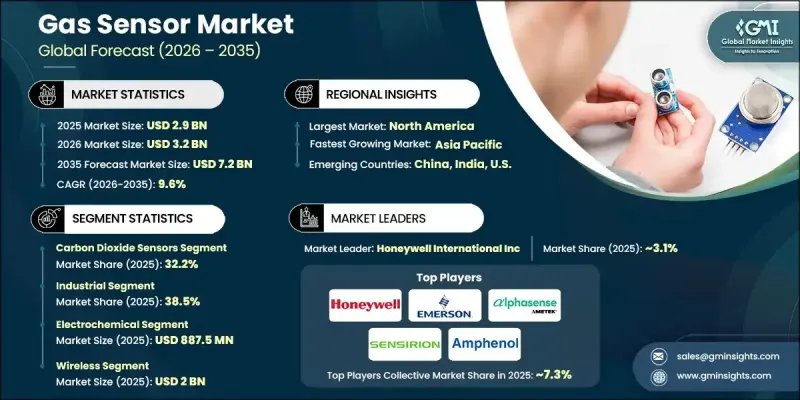
The market growth is fueled by increasing adoption of sensors across diverse industries, rising demand for autonomous vehicles, the growing need for air quality monitoring in smart cities, rapid integration of IoT and cloud-based technologies, and strengthened government regulations and initiatives. Urbanization and industrialization are intensifying the focus on environmental monitoring and workplace safety, which drives sensor adoption. Technological advancements such as nanotechnology and microelectromechanical systems (MEMS) are enabling the development of smaller, more sensitive, and highly reliable sensors suitable for portable, wearable, and confined applications. The integration of AI and IoT facilitates real-time monitoring, data analysis, and smarter systems that improve operational efficiency and safety across industries, further accelerating market expansion.
| Market Scope | |
|---|---|
| Start Year | 2025 |
| Forecast Year | 2026-2035 |
| Start Value | $2.9 Billion |
| Forecast Value | $7.2 Billion |
| CAGR | 9.6% |
The carbon dioxide sensors segment held a 32.2% share in 2025.CO2 sensors maintain a significant position due to their application in industrial, environmental, and healthcare monitoring, assessing emissions, ventilation systems, and indoor air quality. Manufacturers are focusing on improving sensor accuracy, response times, durability, cost-effectiveness, and incorporating real-time tracking, AI, and IoT connectivity to create user-friendly solutions that meet modern requirements.
The industrial segment held 38.5% share in 2025. Industrial organizations are prioritizing worker safety, compliance with regulations, real-time gas leak detection, and automated processes in chemical, oil and gas, and manufacturing industries. Providers must deliver advanced gas detection technologies, demonstrate regulatory compliance, and ensure sensor reliability and durability for industrial applications.
North America Gas Sensor Market held 32.6% share in 2025. Growth in the region is driven by industrial automation, smart technologies, adoption in healthcare and environmental monitoring, and stringent safety regulations. Rising demand for gas sensors in automotive and healthcare applications continues to bolster market expansion.
Key players in the Global Gas Sensor Market include Siemens AG, Honeywell International Inc., Dynament Ltd., ABB Ltd., Aeroqual, Alphasense (AMETEK), ams Osram AG, Bosch Sensortec GmbH, BlueSens gas sensor GmbH, Membrapor AG, METTLER TOLEDO, Microsens SA, Nemoto & Co., Ltd., Emerson Electric Co., Figaro Engineering Inc., Gastec Corporation, SENSEAIR, Sensirion AG, and Amphenol Corporation. Companies in the Global Gas Sensor Market strengthen their position by investing in research and development to enhance sensitivity, miniaturization, and durability. Integration of AI, IoT, and cloud-based platforms improves real-time monitoring and data analytics capabilities. Firms pursue strategic partnerships with industrial, automotive, and healthcare companies to expand market reach. Offering customized solutions, adhering to regulatory standards, and focusing on energy-efficient, low-cost sensors help maintain a competitive advantage.
Table of Contents
Chapter 1 Methodology and Scope
- 1.1 Market scope and definition
- 1.2 Research design
- 1.2.1 Research approach
- 1.2.2 Data collection methods
- 1.3 Data mining sources
- 1.3.1 Global
- 1.3.2 Regional/Country
- 1.4 Base estimates and calculations
- 1.4.1 Base year calculation
- 1.4.2 Key trends for market estimation
- 1.5 Primary research and validation
- 1.5.1 Primary sources
- 1.6 Forecast model
- 1.7 Research assumptions and limitations
Chapter 2 Executive summary
- 2.1 Industry 360° synopsis
- 2.2 Key market trends
- 2.2.1 Product trends
- 2.2.2 Technology trends
- 2.2.3 Connectivity trends
- 2.2.4 Application trends
- 2.2.5 Regional trends
- 2.3 TAM Analysis, 2026-2035 (USD Million)
- 2.4 CXO perspectives: Strategic imperatives
- 2.4.1 Executive decision points
- 2.4.2 critical success factors
- 2.5 Future outlook and strategic recommendations
Chapter 3 Industry insights
- 3.1 Industry ecosystem analysis
- 3.1.1 Supplier landscape
- 3.1.2 Profit margin
- 3.1.3 Cost structure
- 3.1.4 Value addition at each stage
- 3.1.5 Factor affecting the value chain
- 3.1.6 Disruptions
- 3.2 Industry ecosystem analysis
- 3.3 Industry impact forces
- 3.3.1 Growth drivers
- 3.3.1.1 Growing sensor integration in the end use industry
- 3.3.1.2 Rising demand for autonomous vehicles
- 3.3.1.3 Increasing demand for air quality monitoring devices in smart cities
- 3.3.1.4 Rapid IoT and cloud computing integration
- 3.3.1.5 Increasing government initiatives and regulations
- 3.3.2 Pitfalls and challenges
- 3.3.2.1 High initial cost and technical issues
- 3.3.2.2 Environmental interference
- 3.3.3 Market opportunities
- 3.3.3.1 Growth in renewable energy sector
- 3.3.3.2 Emerging demand for indoor air quality monitoring
- 3.3.1 Growth drivers
- 3.4 Growth potential analysis
- 3.5 Regulatory landscape
- 3.5.1 North America
- 3.5.2 Europe
- 3.5.3 Asia Pacific
- 3.5.4 Latin America
- 3.5.5 Middle East & Africa
- 3.6 Porter's analysis
- 3.7 PESTEL analysis
- 3.8 Technology and Innovation landscape
- 3.8.1 Current technological trends
- 3.8.2 Emerging technologies
- 3.9 Price trends
- 3.9.1 By region
- 3.9.2 By product
- 3.10 Pricing Strategies
- 3.11 Emerging Business Models
- 3.12 Compliance Requirements
- 3.13 Sustainability Measures
- 3.14 Consumer Sentiment Analysis
- 3.15 Patent and IP analysis
- 3.16 Geopolitical and trade dynamics
Chapter 4 Competitive landscape, 2025
- 4.1 Introduction
- 4.2 Company market share analysis
- 4.2.1 By region
- 4.2.1.1 North America
- 4.2.1.2 Europe
- 4.2.1.3 Asia Pacific
- 4.2.1.4 Latin America
- 4.2.1.5 Middle East & Africa
- 4.2.2 Market concentration analysis
- 4.2.1 By region
- 4.3 Competitive benchmarking of key players
- 4.3.1 Financial performance comparison
- 4.3.1.1 Revenue
- 4.3.1.2 Profit margin
- 4.3.1.3 R&D
- 4.3.2 Product portfolio comparison
- 4.3.2.1 Product range breadth
- 4.3.2.2 Technology
- 4.3.2.3 Innovation
- 4.3.3 Geographic presence comparison
- 4.3.3.1 Global footprint analysis
- 4.3.3.2 Service network coverage
- 4.3.3.3 Market penetration by region
- 4.3.4 Competitive positioning matrix
- 4.3.4.1 Leaders
- 4.3.4.2 Challengers
- 4.3.4.3 Followers
- 4.3.4.4 Niche players
- 4.3.5 Strategic outlook matrix
- 4.3.1 Financial performance comparison
- 4.4 Key developments, 2021-2024
- 4.4.1 Mergers and acquisitions
- 4.4.2 Partnerships and collaborations
- 4.4.3 Technological advancements
- 4.4.4 Expansion and investment strategies
- 4.4.5 Sustainability initiatives
- 4.4.6 Digital transformation initiatives
- 4.5 Emerging/ startup competitors landscape
Chapter 5 Market Estimates and Forecast, By Product, 2022 - 2035 (USD Million & Units)
- 5.1 Key trends
- 5.2 Oxygen /lambda sensors
- 5.3 Carbon dioxide sensors
- 5.4 Carbon monoxide sensors
- 5.5 NOx sensors
- 5.6 Others
Chapter 6 Market Estimates and Forecast, By Technology, 2022 - 2035 (USD Million & Units)
- 6.1 Key trends
- 6.2 Electrochemical
- 6.3 Semiconductor
- 6.4 Solid State
- 6.5 PID (Photoionization Detection)
- 6.6 Catalytic
- 6.7 Infrared
- 6.7.1 Thermal
- 6.7.2 Quantum
- 6.8 Others
Chapter 7 Market Estimates and Forecast, By Connectivity, 2022 - 2035 (USD Million & Units)
- 7.1 Key trends
- 7.2 Wired
- 7.3 Wireless
Chapter 8 Market Estimates and Forecast, By Application, 2022 - 2035 (USD Million & Units)
- 8.1 Key trends
- 8.2 Consumer Electronics
- 8.3 Healthcare
- 8.4 Environmental
- 8.5 Petrochemical
- 8.6 Automotive
- 8.7 Industrial
- 8.8 Others
Chapter 9 Market Estimates and Forecast, By Region, 2022 - 2035 (USD Million & Units)
- 9.1 Key trends
- 9.2 North America
- 9.2.1 U.S.
- 9.2.2 Canada
- 9.3 Europe
- 9.3.1 Germany
- 9.3.2 UK
- 9.3.3 France
- 9.3.4 Spain
- 9.3.5 Italy
- 9.3.6 Netherlands
- 9.4 Asia Pacific
- 9.4.1 China
- 9.4.2 India
- 9.4.3 Japan
- 9.4.4 Australia
- 9.4.5 South Korea
- 9.5 Latin America
- 9.5.1 Brazil
- 9.5.2 Mexico
- 9.5.3 Argentina
- 9.6 Middle East and Africa
- 9.6.1 South Africa
- 9.6.2 Saudi Arabia
- 9.6.3 UAE
Chapter 10 Company Profiles
- 10.1 ABB Ltd.
- 10.2 Aeroqual
- 10.3 Alphasense (AMETEK)
- 10.4 Amphenol Corporation
- 10.5 ams Osram AG
- 10.6 BlueSens gas sensor GmbH
- 10.7 Bosch Sensortec GmbH
- 10.8 Dynament Ltd.
- 10.9 Emerson Electric Co.
- 10.10 Figaro Engineering Inc.
- 10.11 Gastec Corporation
- 10.12 Honeywell International Inc.
- 10.13 Membrapor AG
- 10.14 METTLER TOLEDO
- 10.15 Microsens SA
- 10.16 Nemoto & Co., Ltd.
- 10.17 SENSEAIR
- 10.18 Sensirion AG
- 10.19 Siemens AG
- 10.20 Spec Sensors

