
PUBLISHER: Global Market Insights Inc. | PRODUCT CODE: 1913337

PUBLISHER: Global Market Insights Inc. | PRODUCT CODE: 1913337
Pultrusion Products Market Opportunity, Growth Drivers, Industry Trend Analysis, and Forecast 2026 - 2035
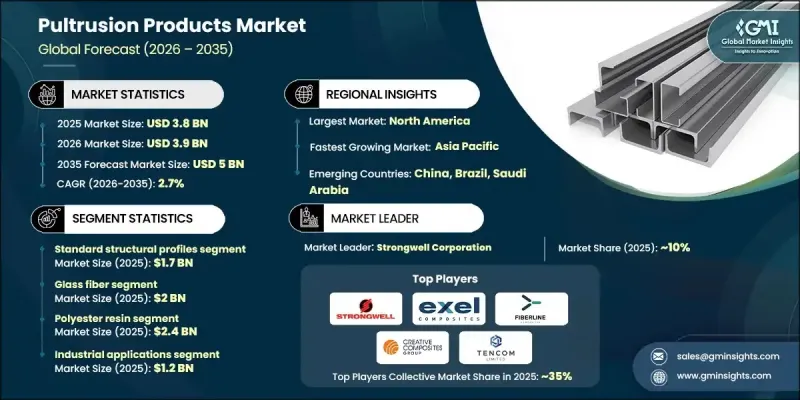
The Global Pultrusion Products Market was valued at USD 3.8 billion in 2025 and is estimated to grow at a CAGR of 2.7% to reach USD 5 billion by 2035.
Pultrusion products are continuous fiber-reinforced composite profiles produced through a fully automated process, where fibers are drawn through a resin bath and shaped in heated dies to achieve precise cross-sectional forms. These materials include structural profiles, rods, tubes, custom shapes, and specialty profiles, offering a high strength-to-weight ratio and excellent corrosion resistance. Pultrusion profiles are valued for their dimensional consistency, reliable mechanical performance, and ability to replace traditional materials like steel, aluminum, and wood in structural and industrial applications. Manufacturing relies on glass, carbon, or aramid fibers combined with thermoset resins such as polyester, epoxy, vinyl ester, and polyurethane. Recent technological improvements in fiber placement, resin formulation, die design, and automation have enabled higher fiber content, minimal voids, precise temperature control, and complex geometries with superior surface quality.
| Market Scope | |
|---|---|
| Start Year | 2025 |
| Forecast Year | 2026-2035 |
| Start Value | $3.8 Billion |
| Forecast Value | $5 Billion |
| CAGR | 2.7% |
The standard structural profiles segment generated USD 1.7 billion in 2025. These profiles maintain steady demand due to their versatility, cost-effectiveness for high-volume production, and ability to replace traditional metal profiles. Accounting for approximately 45% of the total market, standard profiles are widely used in infrastructure and construction projects. Their reliability is supported by extensive engineering data demonstrating load-bearing capabilities and corrosion resistance, alongside compliance with established design standards and building codes.
The glass fiber segment reached USD 2 billion in 2025. Its consistent demand stems from cost-effectiveness, robust mechanical properties, and ready availability through established supply networks. Representing around 52% of the market, glass fiber is preferred for high-volume structural and industrial applications. Its proven performance, including tensile strengths of 2,000-3,500 MPa, corrosion resistance, and electrical insulation, combined with lower raw material costs compared to carbon fiber, reinforces its widespread adoption across industrial, construction, and infrastructure sectors.
U.S. Pultrusion Products Market garnered USD 1.3 billion in 2025. Growth is fueled by established infrastructure rehabilitation programs, advanced composite manufacturing capabilities, and ongoing industrial facility development. Strong adoption of lightweight, corrosion-resistant composites in civil, chemical, and energy infrastructure, along with aerospace and automotive applications, supports consistent market demand. The presence of major manufacturers and compliance with recognized design standards ensure the continued adoption of high-performance pultruded profiles that meet structural and industry quality requirements.
Key players in the Global Pultrusion Products Market include Exel Composites Oyj, Rochling Group, Fiberline Composites A/S, Pultron Composites Ltd., Strongwell Corporation, Tencom Limited, Creative Composites Group, Top Glass Industries S.p.A., Epsilon Composite, Fibergrate Composite Structures, Enduro Composites Inc., Jiangsu Jiuding New Material Co., Shakespeare Composite Structures, Unique Fiberglass & Composites L.L.C., Pultrall Inc., and Bedford Reinforced Plastics. Leading companies in the Global Pultrusion Products Market are pursuing strategies to expand their market presence and strengthen competitive positioning. They are investing heavily in research and development to improve resin systems, fiber alignment, and production automation, enabling the manufacture of complex and high-performance profiles. Strategic partnerships and collaborations with engineering and construction firms help broaden applications and penetrate new geographies. Companies are also optimizing supply chains, expanding production facilities, and introducing cost-effective solutions to appeal to high-volume industrial and infrastructure clients.
Table of Contents
Chapter 1 Methodology & Scope
- 1.1 Market scope and definition
- 1.2 Research design
- 1.2.1 Research approach
- 1.2.2 Data collection methods
- 1.3 Data mining sources
- 1.3.1 Global
- 1.3.2 Regional/Country
- 1.4 Base estimates and calculations
- 1.4.1 Base year calculation
- 1.4.2 Key trends for market estimation
- 1.5 Primary research and validation
- 1.5.1 Primary sources
- 1.6 Forecast model
- 1.7 Research assumptions and limitations
Chapter 2 Executive Summary
- 2.1 Industry 3600 synopsis
- 2.2 Key market trends
- 2.2.1 Product
- 2.2.2 Fiber
- 2.2.3 Resin
- 2.2.4 Application
- 2.2.5 Regional
- 2.3 TAM Analysis, 2025-2035
- 2.4 CXO perspectives: Strategic imperatives
- 2.4.1 Executive decision points
- 2.4.2 Critical success factors
- 2.5 Future outlook and strategic recommendations
Chapter 3 Industry Insights
- 3.1 Industry ecosystem analysis
- 3.1.1 Supplier landscape
- 3.1.2 Profit margin
- 3.1.3 Value addition at each stage
- 3.1.4 Factor affecting the value chain
- 3.1.5 Disruptions
- 3.2 Industry impact forces
- 3.2.1 Growth drivers
- 3.2.2 Industry pitfalls and challenges
- 3.2.3 Market opportunities
- 3.3 Growth potential analysis
- 3.4 Regulatory landscape
- 3.4.1 North America
- 3.4.2 Europe
- 3.4.3 Asia Pacific
- 3.4.4 Latin America
- 3.4.5 Middle East & Africa
- 3.5 Porter's analysis
- 3.6 PESTEL analysis
- 3.7 Technology and innovation landscape
- 3.7.1 Current technological trends
- 3.7.2 Emerging technologies
- 3.8 Price trends
- 3.8.1 By region
- 3.8.2 By product
- 3.9 Future market trends
- 3.10 Technology and innovation landscape
- 3.10.1 Current technological trends
- 3.10.2 Emerging technologies
- 3.11 Patent landscape
- 3.12 Trade statistics (HS code) ( Note: the trade statistics will be provided for key countries only)
- 3.12.1 Major importing countries
- 3.12.2 Major exporting countries
- 3.13 Sustainability and environmental aspects
- 3.13.1 Sustainable practices
- 3.13.2 Waste reduction strategies
- 3.13.3 Energy efficiency in production
- 3.13.4 Eco-friendly initiatives
- 3.14 Carbon footprint consideration
Chapter 4 Competitive Landscape, 2025
- 4.1 Introduction
- 4.2 Company market share analysis
- 4.2.1 By region
- 4.2.1.1 North America
- 4.2.1.2 Europe
- 4.2.1.3 Asia Pacific
- 4.2.1.4 LATAM
- 4.2.1.5 MEA
- 4.2.1 By region
- 4.3 Company matrix analysis
- 4.4 Competitive analysis of major market players
- 4.5 Competitive positioning matrix
- 4.6 Key developments
- 4.6.1 Mergers & acquisitions
- 4.6.2 Partnerships & collaborations
- 4.6.3 New product launches
- 4.6.4 Expansion plans
Chapter 5 Market Estimates and Forecast, By Product, 2022-2035 (USD Billion) (Kilo Tons)
- 5.1 Key trends
- 5.2 Standard structural profiles
- 5.3 Rods & bars
- 5.4 Tubes (round & square)
- 5.5 Custom profiles
- 5.6 Others
Chapter 6 Market Estimates and Forecast, By Fiber, 2022-2035 (USD Billion) (Kilo Tons)
- 6.1 Key trends
- 6.2 Glass
- 6.3 Carbon
- 6.4 Aramid
- 6.5 Others
Chapter 7 Market Estimates and Forecast, By Resin, 2022-2035 (USD Billion) (Kilo Tons)
- 7.1 Key trends
- 7.2 Polyester
- 7.3 Epoxy
- 7.4 Polyurethane
- 7.5 Vinyl ester
- 7.6 Others
Chapter 8 Market Estimates and Forecast, By Application, 2022-2035 (USD Billion) (Kilo Tons)
- 8.1 Key trends
- 8.2 Industrial
- 8.3 Housing
- 8.4 Power & Energy
- 8.4.1 Wind energy
- 8.4.2 Solar energy
- 8.4.3 Hydroelectric power
- 8.5 Consumer goods
- 8.6 Civil engineering
- 8.7 Automotive
- 8.8 Aerospace
- 8.9 Others
Chapter 9 Market Estimates and Forecast, By Region, 2022-2035 (USD Billion) (Kilo Tons)
- 9.1 Key trends
- 9.2 North America
- 9.2.1 U.S.
- 9.2.2 Canada
- 9.3 Europe
- 9.3.1 Germany
- 9.3.2 UK
- 9.3.3 France
- 9.3.4 Spain
- 9.3.5 Italy
- 9.3.6 Rest of Europe
- 9.4 Asia Pacific
- 9.4.1 China
- 9.4.2 India
- 9.4.3 Japan
- 9.4.4 Australia
- 9.4.5 South Korea
- 9.4.6 Rest of Asia Pacific
- 9.5 Latin America
- 9.5.1 Brazil
- 9.5.2 Mexico
- 9.5.3 Argentina
- 9.5.4 Rest of Latin America
- 9.6 Middle East and Africa
- 9.6.1 Saudi Arabia
- 9.6.2 South Africa
- 9.6.3 UAE
- 9.6.4 Rest of Middle East and Africa
Chapter 10 Company Profiles
- 10.1 Strongwell Corporation
- 10.2 Exel Composites Oyj
- 10.3 Fiberline Composites A/S
- 10.4 Creative Composites Group
- 10.5 Tencom Limited
- 10.6 Rochling Group
- 10.7 Fibergrate Composite Structures
- 10.8 Epsilon Composite
- 10.9 Pultron Composites Ltd.
- 10.10 Top Glass Industries S.p.A.
- 10.11 Enduro Composites Inc.
- 10.12 Jiangsu Jiuding New Material Co.
- 10.13 Shakespeare Composite Structures
- 10.14 Unique Fiberglass & Composites L.L.C.
- 10.15 Pultrall Inc.

