
PUBLISHER: Global Market Insights Inc. | PRODUCT CODE: 1913339

PUBLISHER: Global Market Insights Inc. | PRODUCT CODE: 1913339
Self-service Technology Market Opportunity, Growth Drivers, Industry Trend Analysis, and Forecast 2026 - 2035
The Global Self-service Technology Market was The Global Self-service Technology Market was valued at USD 4.1 billion in 2025 and is estimated to grow at a CAGR of 11.2% to reach USD 11.6 billion by 2035.
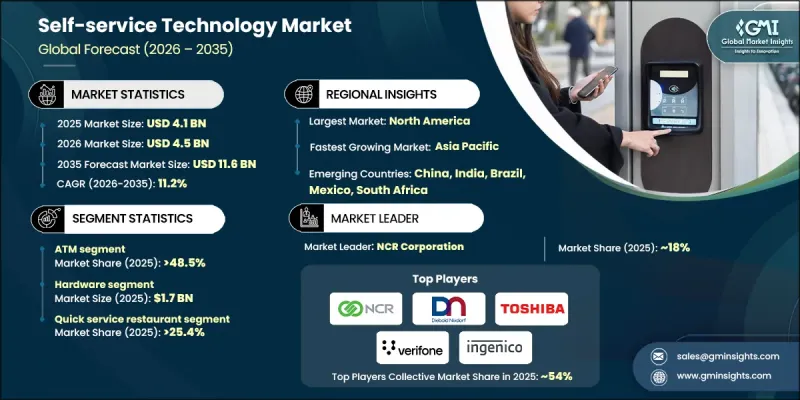
Growth is primarily driven by increasing consumer demand for contactless, convenient, and time-efficient service solutions across retail, banking, and hospitality industries. The adoption of advanced technologies such as AI, IoT, and cloud computing is enhancing the efficiency, intelligence, and personalization of self-service platforms. Consumers are increasingly seeking quick, seamless transactions, prompting businesses to invest in automated kiosks, mobile applications, and interactive terminals that reduce waiting times while improving overall user experience. The integration of predictive analytics, automated support, and connected systems allows businesses to deliver adaptive, personalized services. Furthermore, the rise of digital payments, mobile wallets, and contactless transactions has accelerated the deployment of self-service kiosks and terminals in retail, transportation, and banking, creating opportunities for smarter, more efficient service delivery.
| Market Scope | |
|---|---|
| Start Year | 2025 |
| Forecast Year | 2026-2035 |
| Start Value | $4.1 Billion |
| Forecast Value | $11.6 Billion |
| CAGR | 11.2% |
The ATM segment held a 48.5% share in 2025. Automated Teller Machines are evolving from traditional cash-dispensing roles to multifunctional banking kiosks, offering services such as deposits, fund transfers, bill payments, and prepaid card purchases. This transformation addresses consumer demand for versatile and convenient self-service solutions, expanding the scope of ATMs beyond basic banking operations.
The hardware segment generated USD 1.7 billion in 2025. Growth in this segment is fueled by the widespread installation of durable, advanced devices such as kiosks, ATMs, vending machines, and interactive terminals across healthcare, retail, banking, and hospitality. Demand for enhanced user interfaces, touchscreens, sensors, and secure payment modules, coupled with continuous innovations in hardware design and reliability, positions this segment as the primary revenue driver in the self-service technology industry.
North America Self-service Technology Market held a 28.1% share in 2025. Expansion in the region is propelled by the growing preference for contactless and automated services, adoption of digital payment systems, and increasing implementation of AI-driven kiosks and cloud-based platforms. Businesses leverage self-service technologies to streamline operations, reduce labor costs, and meet evolving customer expectations across multiple sectors, including retail, healthcare, financial services, and hospitality.
Key players in the Global Self-service Technology Market include GRG Banking, Ingenico Group, Olea Kiosks, Zebra Technologies, Elo Touch Solutions, RedyRef Interactive Kiosks, Diebold Nixdorf, Ugenie.io, KIOSK Information Systems, Phoenix Kiosk, NCR Corporation, Avanti Markets, SlabbKiosks, Meridian Kiosks, Toshiba Global Commerce Solutions, XIPHIAS Software Technologies, Verifone, Emergency Management, Embross, and Facility Management System. Companies in the Global Self-service Technology Market adopt multiple strategies to strengthen their market position and expand global presence. Investments in R&D and technological innovation enhance product capabilities, including AI-driven analytics, IoT integration, and cloud-based management. Strategic collaborations with banks, retailers, and hospitality providers help expand market reach and increase adoption of self-service solutions. Companies are also focusing on introducing multifunctional, secure, and user-friendly devices to meet evolving consumer expectations. Expanding production capacity, entering emerging markets, and optimizing supply chains improve responsiveness to regional demand valued at USD 4.1 billion in 2025 and is estimated to grow at a CAGR of 11.2% to reach USD 11.6 billion by 2035.
Table of Contents
Chapter 1 Methodology and Scope
- 1.1 Market scope and definition
- 1.2 Research design
- 1.2.1 Research approach
- 1.2.2 Data collection methods
- 1.3 Data mining sources
- 1.3.1 Global
- 1.3.2 Regional/Country
- 1.4 Base estimates and calculations
- 1.4.1 Base year calculation
- 1.4.2 Key trends for market estimation
- 1.5 Primary research and validation
- 1.5.1 Primary sources
- 1.6 Forecast model
- 1.7 Research assumptions and limitations
Chapter 2 Executive Summary
- 2.1 Industry snapshot
- 2.2 Key market trends
- 2.2.1 Type trends
- 2.2.2 Component trends
- 2.2.3 End Use trends
- 2.2.4 Regional
- 2.3 TAM Analysis, 2025-2034 (USD Million)
- 2.4 CXO perspectives: Strategic imperatives
- 2.4.1 Executive decision points
- 2.4.2 critical success factors
- 2.5 Future outlook and strategic recommendations
Chapter 3 Industry Insights
- 3.1 Industry ecosystem analysis
- 3.1.1 Supplier Landscape
- 3.1.2 Profit Margin
- 3.1.3 Cost structure
- 3.1.4 Value addition at each stage
- 3.1.5 Factor affecting the value chain
- 3.1.6 Disruptions
- 3.2 Industry impact forces
- 3.2.1 Growth drivers
- 3.2.1.1 Technological advancements
- 3.2.1.2 Cost savings for businesses
- 3.2.1.3 Globalization and market expansion
- 3.2.1.4 Growing consumer tech literacy
- 3.2.1.5 Increasing emphasis on contactless solutions
- 3.2.2 Industry pitfalls and challenges
- 3.2.2.1 Technical glitches and reliability issues
- 3.2.2.2 User resistance and adoption challenges
- 3.2.3 Market opportunities
- 3.2.4 Expansion in Emerging Markets
- 3.2.5 Integration of Advanced Technologies
- 3.2.1 Growth drivers
- 3.3 Growth potential analysis
- 3.4 Regulatory landscape
- 3.4.1 North America
- 3.4.2 Europe
- 3.4.3 Asia Pacific
- 3.4.4 Latin America
- 3.4.5 Middle East & Africa
- 3.5 Porter's analysis
- 3.6 PESTEL analysis
- 3.7 Technology and innovation landscape
- 3.7.1 Current technological trends
- 3.7.2 Emerging technologies
- 3.8 Price trends
- 3.8.1 Historical price analysis (2022-2024)
- 3.8.2 Price trend drivers
- 3.8.3 Regional price variations
- 3.8.4 Price forecast (2026-2035)
- 3.9 Pricing strategies
- 3.10 Emerging business models
- 3.11 Compliance requirements
- 3.12 Sustainability measures
- 3.12.1 Sustainable materials assessment
- 3.12.2 Carbon footprint analysis
- 3.12.3 Circular economy implementation
- 3.12.4 Sustainability certifications and standards
- 3.12.5 Sustainability roi analysis
- 3.13 Global consumer sentiment analysis
- 3.14 Patent analysis
Chapter 4 Competitive Landscape, 2025
- 4.1 Introduction
- 4.2 Company market share analysis
- 4.2.1 By region
- 4.2.1.1 North America
- 4.2.1.2 Europe
- 4.2.1.3 Asia Pacific
- 4.2.1.4 Latin America
- 4.2.1.5 Middle East & Africa
- 4.2.2 Market Concentration Analysis
- 4.2.1 By region
- 4.3 Competitive benchmarking of key players
- 4.3.1 Financial performance comparison
- 4.3.1.1 Revenue
- 4.3.1.2 Profit margin
- 4.3.1.3 R&D
- 4.3.2 Product portfolio comparison
- 4.3.2.1 Product range breadth
- 4.3.2.2 Technology
- 4.3.2.3 Innovation
- 4.3.3 Geographic presence comparison
- 4.3.3.1 Global footprint analysis
- 4.3.3.2 Service network coverage
- 4.3.3.3 Market penetration by region
- 4.3.4 Competitive positioning matrix
- 4.3.4.1 Leaders
- 4.3.4.2 Challengers
- 4.3.4.3 Followers
- 4.3.4.4 Niche players
- 4.3.5 Strategic outlook matrix
- 4.3.1 Financial performance comparison
- 4.4 Key developments, 2022-2025
- 4.4.1 Mergers and acquisitions
- 4.4.2 Partnerships and collaborations
- 4.4.3 Technological advancements
- 4.4.4 Expansion and investment strategies
- 4.4.5 Sustainability initiatives
- 4.4.6 Digital transformation initiatives
- 4.5 Emerging/ startup competitors landscape
Chapter 5 Self-service Technology Market Estimates & Forecast, By Component, 2022 - 2035 (USD Million)
- 5.1 Key trends, by component
- 5.2 Hardware
- 5.3 Software
- 5.4 Services
Chapter 6 Self-service Technology Market Estimates & Forecast, By Type, 2022 - 2035 (USD Million)
- 6.1 Key trends, by type
- 6.2 ATM
- 6.3 Vending Machine
- 6.4 Kiosks
- 6.5 Others
Chapter 7 Self-service Technology Market Estimates & Forecast, By End-Use, 2022 - 2035 (USD Million)
- 7.1 Key trends, by end-use
- 7.2 Retail
- 7.3 Quick Service Restaurant
- 7.4 Hospitality
- 7.5 Healthcare
- 7.6 Corporate Offices
- 7.7 Transportation
- 7.8 BFSI
- 7.9 Others
Chapter 8 Self-service Technology Market Estimates & Forecast, By Region, 2022 - 2035 (USD Million)
- 8.1 Key trends, by region
- 8.2 North America
- 8.2.1 U.S.
- 8.2.2 Canada
- 8.3 Europe
- 8.3.1 UK
- 8.3.2 Germany
- 8.3.3 France
- 8.3.4 Italy
- 8.3.5 Spain
- 8.3.6 Russia
- 8.3.7 Rest of Europe
- 8.4 Asia-Pacific
- 8.4.1 China
- 8.4.2 India
- 8.4.3 Japan
- 8.4.4 South Korea
- 8.4.5 ANZ
- 8.4.6 Rest of Asia-Pacific
- 8.5 Latin America
- 8.5.1 Brazil
- 8.5.2 Mexico
- 8.5.3 Rest of Latin America
- 8.6 MEA
- 8.6.1 Saudi Arabia
- 8.6.2 South Africa
- 8.6.3 UAE
- 8.6.4 Rest of MEA
Chapter 9 Company Profiles
- 1.1 Avanti Markets
- 1.2 Diebold Nixdorf
- 1.3 Elo Touch Solutions
- 1.4 Embross
- 1.5 Emergency Management
- 1.6 Facility Management System
- 1.7 GRG Banking
- 1.8 Ingenico Group
- 1.9 KIOSK Information Systems
- 1.10 Meridian Kiosks
- 1.11 NCR Corporation
- 1.12 Olea Kiosks
- 1.13 Phoenix Kiosk
- 1.14 RedyRef Interactive Kiosks
- 1.15 SlabbKiosks
- 1.16 Source Technologies
- 1.17 Toshiba Global Commerce Solutions
- 1.18 Ugenie.io
- 1.19 Verifone
- 1.20 Wincor Nixdorf (Now part of Diebold Nixdorf)
- 1.21 XIPHIAS Software Technologies
- 1.22 Zebra Technologies

