PUBLISHER: Global Market Insights Inc. | PRODUCT CODE: 1913348

PUBLISHER: Global Market Insights Inc. | PRODUCT CODE: 1913348
MEA Ferric Chloride Market Opportunity, Growth Drivers, Industry Trend Analysis, and Forecast 2026 - 2035
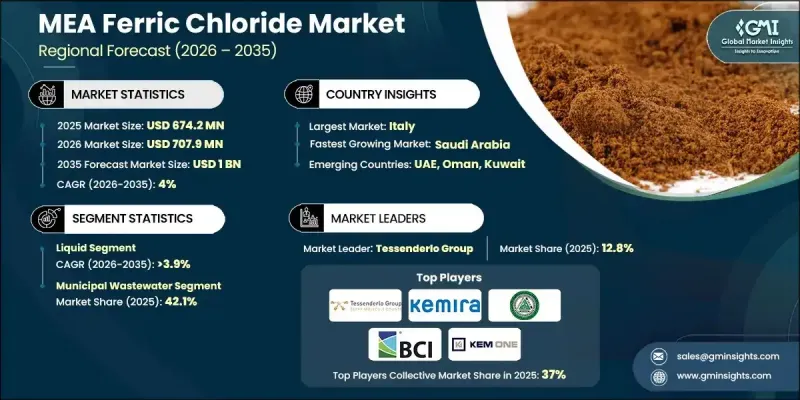
MEA Ferric Chloride Market was valued at USD 674.2 million in 2025 and is estimated to grow at a CAGR of 4% to reach USD 1 billion by 2035.
Ferric chloride, chemically known as FeCl2 , is widely utilized as a coagulating agent in water and wastewater treatment to remove contaminants and improve water quality. Beyond water treatment, it is also applied in metal processing, chemical synthesis, and pigment and dye production. Rising urban development and industrial expansion across the region are intensifying pressure on water resources, increasing the need for efficient treatment solutions. Governments and utilities continue to invest in modern water infrastructure to address scarcity concerns and environmental compliance. Broader industrial usage, stricter wastewater regulations, and technological progress in treatment processes are further supporting demand. The regional market benefits from strong activity in energy-intensive industries, which contributes to higher wastewater generation and treatment requirements. As sustainability and resource efficiency gain importance, ferric chloride continues to play a critical role in meeting water quality and environmental management objectives across the Middle East and Africa.
| Market Scope | |
|---|---|
| Start Year | 2025 |
| Forecast Year | 2026-2035 |
| Start Value | $674.2 Million |
| Forecast Value | $1 Billion |
| CAGR | 4% |
The municipal wastewater treatment segment held a 42.1% share in 2025. Ferric chloride is extensively used to support coagulation and flocculation processes that remove suspended solids, organic pollutants, and excess nutrients. Its role in odor control and nutrient reduction supports compliance with increasingly strict discharge standards, particularly in water-stressed urban areas.
The liquid form accounted for USD 414.2 million in revenue in 2024 and is growing at a CAGR of 3.9% during 2025-2035. This form is favored due to its handling efficiency, rapid dispersion, and high performance in both municipal and industrial treatment systems. Demand continues to rise as treatment volumes increase across the region.
Saudi Arabia MEA Ferric Chloride Market generated USD 30.6 million in 2025 and is projected to approach USD 59.8 million by 2035. Growth is supported by expanding industrial activity, rising urban populations, and strict water quality regulations. Increased use across municipal and industrial facilities continues to drive market expansion, although pricing volatility and import dependence remain influential factors.
Companies operating in the MEA Ferric Chloride Market include Kemira, BASF, Tessenderlo Group, Feracid, Agua Chem Ltd, Chemifloc, BorsodChem, Swedish Jordanian Chemicals, SAT Sulphur Company, and Al Kout. Companies in the MEA Ferric Chloride Market strengthen their market position through capacity expansion, supply chain optimization, and regional partnerships. Leading players focus on securing raw material availability and improving production efficiency to manage cost volatility. Investment in localized manufacturing and distribution networks enhances responsiveness to regional demand. Firms also emphasize technical support and customized solutions for municipal and industrial customers to improve treatment efficiency. Strategic collaborations with water utilities and industrial operators help build long-term contracts and recurring revenue streams. Sustainability initiatives, including reduced emissions and process optimization, further support brand credibility and competitive differentiation across the region.
Table of Contents
Chapter 1 Methodology & Scope
- 1.1 Market scope and definition
- 1.2 Research design
- 1.2.1 Research approach
- 1.2.2 Data collection methods
- 1.3 Data mining sources
- 1.3.1 Regional/Country
- 1.4 Base estimates and calculations
- 1.4.1 Base year calculation
- 1.4.2 Key trends for market estimation
- 1.5 Primary research and validation
- 1.5.1 Primary sources
- 1.6 Forecast model
- 1.7 Research assumptions and limitations
Chapter 2 Executive Summary
- 2.1 Industry 360° synopsis
- 2.2 Key market trends
- 2.2.1 Country
- 2.2.2 Form
- 2.2.3 Application
- 2.2.4 End Use
- 2.3 TAM Analysis, 2025-2034
- 2.4 CXO perspectives: Strategic imperatives
- 2.4.1 Executive decision points
- 2.4.2 Critical success factors
- 2.5 Future Outlook and Strategic Recommendations
Chapter 3 Industry Insights
- 3.1 Industry ecosystem analysis
- 3.1.1 Supplier landscape
- 3.1.2 Profit margin
- 3.1.3 Value addition at each stage
- 3.1.4 Factor affecting the value chain
- 3.1.5 Disruptions
- 3.2 Industry impact forces
- 3.2.1 Growth drivers
- 3.2.2 Industry pitfalls and challenges
- 3.2.3 Market opportunities
- 3.3 Growth potential analysis
- 3.4 Regulatory landscape
- 3.5 Porter's analysis
- 3.6 PESTEL analysis
- 3.7 Price trends
- 3.8 Future market trends
- 3.9 Technology and Innovation landscape
- 3.9.1 Current technological trends
- 3.9.2 Emerging technologies
- 3.10 Patent Landscape
- 3.11 Trade statistics (HS code)
Chapter 4 Competitive Landscape, 2025
- 4.1 Introduction
- 4.2 Company market share analysis
- 4.3 Company matrix analysis
- 4.4 Competitive analysis of major market players
- 4.5 Competitive positioning matrix
- 4.6 Key developments
- 4.6.1 Mergers & acquisitions
- 4.6.2 Partnerships & collaborations
- 4.6.3 New Product Launches
- 4.6.4 Expansion Plans
Chapter 5 Market Estimates and Forecast, By Form, 2022-2035 (USD Million & Kilo Tons)
- 5.1 Key trends
- 5.2 Powder
- 5.3 Liquid
- 5.4 Lumps
Chapter 6 Market Estimates and Forecast, By Application, 2022-2035 (USD Million & Kilo Tons)
- 6.1 Key trends
- 6.2 Potable Water
- 6.3 Industrial wastewater
- 6.4 Municipal wastewater
- 6.5 Specialty Pigment
- 6.6 Electronic Etchants
- 6.7 Chemical Intermediate
- 6.8 Metal Surface Treatment
- 6.9 Others (Cosmetics, feed additives, pesticides)
Chapter 7 Market Estimates and Forecast, By End Use, 2022-2035 (USD Million & Kilo Tons)
- 7.1 Key trends
- 7.2 Wastewater Treatment
- 7.3 Pharmaceuticals
- 7.4 Chemicals
- 7.5 Electronics
- 7.6 Metals & Metallurgy
- 7.7 Others
Chapter 8 Market Estimates and Forecast, By Country, 2022-2035 (USD Million & Kilo Tons)
- 8.1 Key trends
- 8.2 Saudi Arabia
- 8.3 UAE
- 8.4 Oman
- 8.5 Kuwait
- 8.6 Qatar
- 8.7 Mediterranean countries
- 8.7.1 Tunisia
- 8.7.2 Egypt
- 8.7.3 Morocco
- 8.7.4 Algeria
- 8.7.5 Israel
- 8.7.6 Jordan
- 8.7.7 Syria
- 8.7.8 Turkey
- 8.7.9 Greece
- 8.7.10 Italy
- 8.7.11 France
- 8.7.12 Spain
- 8.8 Africa
- 8.8.1 Cameroon
- 8.8.2 Republic of Congo
- 8.8.3 Equatorial Guinea
- 8.8.4 Nigeria
- 8.8.5 Senegal
- 8.8.6 Angola
- 8.9 Rest of Middle East & Africa
Chapter 9 Company Profiles
- 9.1 Agua Chem Ltd
- 9.2 Al-Kout
- 9.3 BASF
- 9.4 BorsodChem
- 9.5 Chemifloc
- 9.6 Feracid
- 9.7 Kemira
- 9.8 SAT Sulphur Company
- 9.9 Swedish Jordanian Chemicals
- 9.10 Tessenderlo Group

