
PUBLISHER: Global Market Insights Inc. | PRODUCT CODE: 1913366

PUBLISHER: Global Market Insights Inc. | PRODUCT CODE: 1913366
Leather Chemicals Market Opportunity, Growth Drivers, Industry Trend Analysis, and Forecast 2026 - 2035
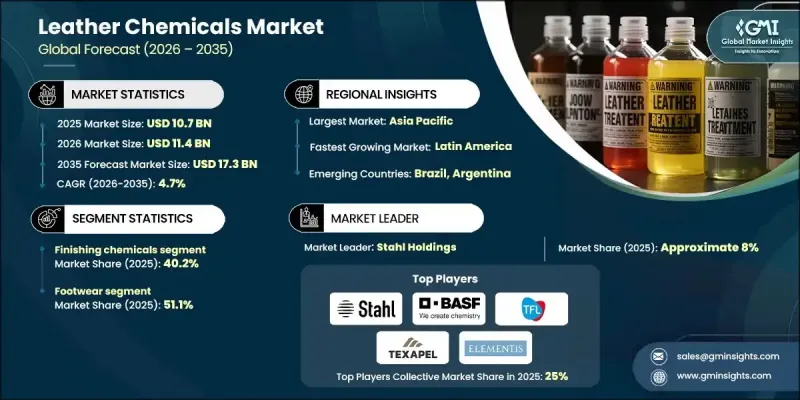
The Global Leather Chemicals Market was valued at USD 10.7 billion in 2025 and is estimated to grow at a CAGR of 4.7% to reach USD 17.3 billion by 2035.
Market growth is closely linked to rising consumption of premium leather across automotive interiors, luxury furniture, and high-end fashion segments. Increasing demand for refined texture, durability, and visual appeal has encouraged chemical producers to innovate advanced formulations that enhance leather quality during upstream processing. The automotive sector remains a significant growth engine, as manufacturers continue to prioritize lightweight and premium interior materials, leading to sustained demand for high-performance upholstery and interior leather. At the same time, the leather chemicals industry is undergoing a structural transformation driven by tightening environmental regulations. The shift toward alternative tanning systems and environmentally responsible processing methods is accelerating, particularly across developed regions. Chemical suppliers are responding by reformulating products to meet evolving compliance standards, resulting in higher adoption of eco-friendly auxiliaries, advanced dyes, and enzyme-driven solutions. These developments are reshaping leather production practices globally while maintaining performance, consistency, and aesthetic value across end-use industries.
| Market Scope | |
|---|---|
| Start Year | 2025 |
| Forecast Year | 2026-2035 |
| Start Value | $10.7 Billion |
| Forecast Value | $17.3 Billion |
| CAGR | 4.7% |
The finishing chemicals segment accounted for 40.2% share in 2025 and is projected to grow at a CAGR of 4.4% through 2035. This segment maintains leadership due to its critical role in enhancing surface appearance, durability, and functional performance of finished leather. The strong contribution of finishing chemicals is also supported by their ability to significantly increase the commercial value of leather products, making them indispensable within the production chain.
The footwear segment held 51.1% share in 2025 and is expected to grow at a CAGR of 4.7% between 2026 and 2035. Demand is driven by large-scale global footwear manufacturing and the need for leather that meets strict physical, visual, and performance standards. Rising preference for premium and durable footwear has increased reliance on specialized tanning agents, advanced finishing solutions, and performance-enhancing chemical systems, with notable growth observed across Asia-Pacific, Latin America, and parts of Europe.
North America Leather Chemicals Market accounted for 5% share in 2025. Regional demand is primarily supported by the automotive value chain and evolving preferences in upholstery and premium footwear. The United States continues to witness gradual shifts toward higher-quality and sustainable leather solutions, while Canada's emphasis on regulatory compliance and sustainable sourcing has strengthened demand for advanced finishing systems and alternative tanning chemistries.
Key companies active in the Global Leather Chemicals Market include BASF SE, Stahl Holdings, Clariant International Ltd., TFL Ledertechnik GmbH, DyStar Group, Zschimmer & Schwarz GmbH & Co KG, Trumpler GmbH & Co. KG, Balmer Lawrie & Co. Ltd., Schill + Seilacher GmbH, ATC Tannery Chemicals, Texapel, Texal, Sisecam Chemicals, Elementis plc, Kolon Industries, Inc., PIOVAN Leather Chemicals, Industrias Quimicas Iris, S.A., FGL International S.p.A., and Syntans & Colloids. Companies operating in the Global Leather Chemicals Market are strengthening their competitive position through product innovation, sustainability-focused reformulation, and geographic expansion. Key strategies include developing compliant and environmentally responsible chemical solutions that align with evolving regulatory frameworks. Firms are investing in research to improve leather performance while reducing environmental impact. Strategic partnerships with tanneries and OEMs are helping suppliers secure long-term contracts and enhance market reach.
Table of Contents
Chapter 1 Methodology & Scope
- 1.1 Market scope and definition
- 1.2 Research design
- 1.2.1 Research approach
- 1.2.2 Data collection methods
- 1.3 Data mining sources
- 1.3.1 Global
- 1.3.2 Regional/Country
- 1.4 Base estimates and calculations
- 1.4.1 Base year calculation
- 1.4.2 Key trends for market estimation
- 1.5 Primary research and validation
- 1.5.1 Primary sources
- 1.6 Forecast model
- 1.7 Research assumptions and limitations
Chapter 2 Executive Summary
- 2.1 Industry 3600 synopsis
- 2.2 Key market trends
- 2.2.1 Regional
- 2.2.2 Type
- 2.2.3 Application
- 2.3 TAM Analysis, 2026-2035
- 2.4 CXO perspectives: Strategic imperatives
- 2.4.1 Executive decision points
- 2.4.2 Critical success factors
- 2.5 Future Outlook and Strategic Recommendations
Chapter 3 Industry Insights
- 3.1 Industry ecosystem analysis
- 3.1.1 Supplier landscape
- 3.1.2 Profit margin
- 3.1.3 Value addition at each stage
- 3.1.4 Factor affecting the value chain
- 3.1.5 Disruptions
- 3.2 Industry impact forces
- 3.2.1 Growth drivers
- 3.2.2 Industry pitfalls and challenges
- 3.2.3 Market opportunities
- 3.3 Growth potential analysis
- 3.4 Regulatory landscape
- 3.4.1 North America
- 3.4.2 Europe
- 3.4.3 Asia Pacific
- 3.4.4 Latin America
- 3.4.5 Middle East & Africa
- 3.5 Porter's analysis
- 3.6 PESTEL analysis
- 3.7 Price trends
- 3.7.1 By region
- 3.7.2 By type
- 3.8 Future market trends
- 3.9 Technology and Innovation landscape
- 3.9.1 Current technological trends
- 3.9.2 Emerging technologies
- 3.10 Patent Landscape
- 3.11 Trade statistics (HS code) ( Note: the trade statistics will be provided for key countries only)
- 3.11.1 Major importing countries
- 3.11.2 Major exporting countries
- 3.12 Sustainability and environmental aspects
- 3.12.1 Sustainable practices
- 3.12.2 Waste reduction strategies
- 3.12.3 Energy efficiency in production
- 3.12.4 Eco-friendly initiatives
- 3.13 Carbon footprint consideration
Chapter 4 Competitive Landscape, 2025
- 4.1 Introduction
- 4.2 Company market share analysis
- 4.2.1 By region
- 4.2.1.1 North America
- 4.2.1.2 Europe
- 4.2.1.3 Asia Pacific
- 4.2.1.4 LATAM
- 4.2.1.5 MEA
- 4.2.1 By region
- 4.3 Company matrix analysis
- 4.4 Competitive analysis of major market players
- 4.5 Competitive positioning matrix
- 4.6 Key developments
- 4.6.1 Mergers & acquisitions
- 4.6.2 Partnerships & collaborations
- 4.6.3 New Product Launches
- 4.6.4 Expansion Plans
Chapter 5 Market Estimates and Forecast, By Type, 2022-2035 (USD Billion) (Kilo Tons)
- 5.1 Key trends
- 5.2 Beamhouse Chemicals
- 5.2.1 Soaking
- 5.2.2 Liming
- 5.2.3 Deliming and Bating
- 5.3 Tanning
- 5.3.1 Chrome
- 5.3.2 Non-Chrome
- 5.4 Dyeing
- 5.4.1 Water Soluble
- 5.4.2 Non-water Soluble
- 5.5 Finishing Chemicals
- 5.5.1 Polyurethane
- 5.5.2 Acrylic
- 5.5.3 Silicone
- 5.5.4 Others
- 5.6 Others
Chapter 6 Market Estimates and Forecast, By Application, 2022-2035 (USD Billion) (Kilo Tons)
- 6.1 Key trends
- 6.2 Footwear
- 6.2.1 Casual and Fashion Shoes
- 6.2.2 Sports Shoes
- 6.2.3 Safety/Industrial Footwear
- 6.2.4 Boots
- 6.3 Furniture
- 6.3.1 Residential Upholstery
- 6.3.2 Office Furniture
- 6.3.3 Hospitality Furniture
- 6.3.4 Luxury Leather Seating
- 6.4 Automobile
- 6.4.1 Car Seats & Upholstery
- 6.4.2 Steering Wheel & Gear Covers
- 6.4.3 Door Panels
- 6.4.4 Motorcycle Seats
- 6.5 Garments
- 6.5.1 Leather Jackets
- 6.5.2 Trousers & Skirts
- 6.5.3 Belts
- 6.5.4 Coats & Outerwear
- 6.6 Gloves
- 6.6.1 Industrial/Safety Gloves
- 6.6.2 Fashion Gloves
- 6.6.3 Sports Gloves
- 6.6.4 Tactical/Military Gloves
- 6.7 Others
- 6.7.1 Bags & Luggage
- 6.7.2 Wallets & Small Accessories
- 6.7.3 Saddlery
- 6.7.4 Sporting Goods
Chapter 7 Market Estimates and Forecast, By Region, 2022-2035 (USD Billion) (Kilo Tons)
- 7.1 Key trends
- 7.2 North America
- 7.2.1 U.S.
- 7.2.2 Canada
- 7.3 Europe
- 7.3.1 Germany
- 7.3.2 UK
- 7.3.3 France
- 7.3.4 Spain
- 7.3.5 Italy
- 7.3.6 Rest of Europe
- 7.4 Asia Pacific
- 7.4.1 China
- 7.4.2 India
- 7.4.3 Japan
- 7.4.4 Australia
- 7.4.5 South Korea
- 7.4.6 Rest of Asia Pacific
- 7.5 Latin America
- 7.5.1 Brazil
- 7.5.2 Mexico
- 7.5.3 Argentina
- 7.5.4 Rest of Latin America
- 7.6 Middle East and Africa
- 7.6.1 Saudi Arabia
- 7.6.2 South Africa
- 7.6.3 UAE
- 7.6.4 Rest of Middle East and Africa
Chapter 8 Company Profiles
- 8.1 ATC Tannery Chemicals
- 8.2 Balmer Lawrie & Co. Ltd.
- 8.3 BASF SE
- 8.4 Clariant International Ltd.
- 8.5 DyStar Group
- 8.6 Elementis plc
- 8.7 FGL International S.p.A.
- 8.8 Industrias Quimicas Iris, S.A.
- 8.9 Kolon Industries, Inc.
- 8.10 PIOVAN Leather Chemicals
- 8.11 Schill + Seilacher GmbH
- 8.12 Sisecam Chemicals
- 8.13 Stahl Holdings
- 8.14 Syntans & Colloids
- 8.15 Texal
- 8.16 Texapel
- 8.17 TFL Ledertechnik GmbH
- 8.18 Trumpler GmbH & Co. KG
- 8.19 Zschimmer & Schwarz GmbH & Co KG
- 8.20 Others

