
PUBLISHER: Global Market Insights Inc. | PRODUCT CODE: 1913372

PUBLISHER: Global Market Insights Inc. | PRODUCT CODE: 1913372
Zeolite Molecular Sieve Market Opportunity, Growth Drivers, Industry Trend Analysis, and Forecast 2026 - 2035
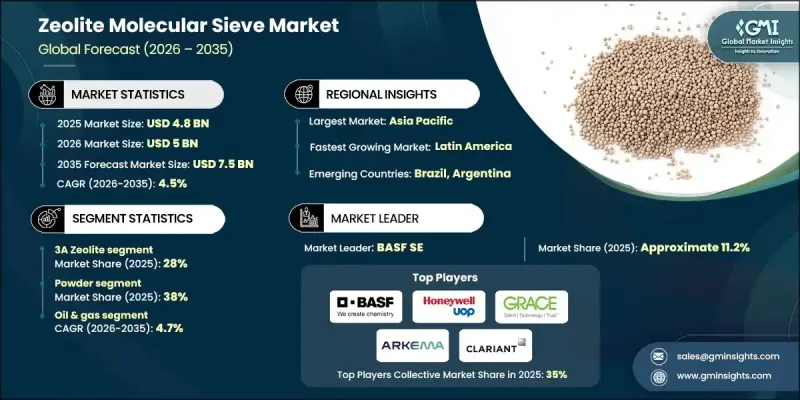
The Global Zeolite Molecular Sieve Market was valued at USD 4.8 billion in 2025 and is estimated to grow at a CAGR of 4.5% to reach USD 7.5 billion by 2035.
Zeolites are prized for their thermal stability, well-defined pore structures, and selective adsorption capabilities, making them essential across energy, petrochemical, automotive, and industrial applications. Demand is rising due to the need for gas separation, moisture removal, and purification in natural gas and LNG processing. Regulatory pressures and environmental standards are prompting manufacturers to adopt non-toxic, eco-friendly materials. The automotive sector also contributes significantly to market growth, driven by the adoption of zeolite-based selective catalytic reduction catalysts for controlling NOx emissions under evolving global emission norms. Technological advancements and stricter industry standards continue to fuel the adoption of high-performance molecular sieves worldwide, particularly in regions with growing natural gas and refining activities.
| Market Scope | |
|---|---|
| Start Year | 2025 |
| Forecast Year | 2026-2035 |
| Start Value | $4.8 Billion |
| Forecast Value | $7.5 Billion |
| CAGR | 4.5% |
The 3A zeolite segment held a 28% share in 2025 and is expected to grow at a CAGR of 4.6% through 2035. Its selective water adsorption while excluding larger hydrocarbons makes it critical for moisture-sensitive operations, particularly in natural gas dehydration, LNG facilities, and ethanol drying units, driving high adoption in North America, China, and the Middle East.
The powdered zeolites segment accounted for 38% share in 2025 and is expected to grow at a CAGR of 4.7% by 2035. Powdered forms are favored for high-volume applications due to their cost-effectiveness, uniform dispersion, and compatibility with large-scale industrial processes.
North America Zeolite Molecular Sieve Market held a 24.3% share in 2025, driven by expanding natural gas and refining industries. The surge in shale gas production and increasing investment in CCUS technologies further boost demand for zeolite molecular sieves for moisture and CO2 adsorption in gas processing facilities.
Key players in the Global Zeolite Molecular Sieve Market include Honeywell UOP, Arkema Group, BASF SE, Zeochem AG, AGN Group, Grace Catalysts Technologies, Zeolyst International, Clariant AG, Jiangxi Sanxin Hi-Tech Ceramics Co., Ltd., Axens Group, Taihei Chemical Industrial Co., Ltd., Qingdao Huanghai Marine Zeolite Co., Ltd., Toshika, LUOYANG JALON MICRO-NANO NEW MATERIALS CO., LTD., Shijiazhuang Jianda High-Tech Chemical Co., Ltd., Chemiewerk Bad Kostritz GmbH (CWK), Yingkou Liaodong Molecular Sieve Co., Ltd., and Shanghai Hengye Chemical Co., Ltd. Companies in the Global Zeolite Molecular Sieve Market are enhancing their market presence through innovation, capacity expansion, and strategic partnerships. Key strategies include developing high-efficiency, selective adsorption zeolites, investing in R&D for tailored molecular sieve solutions, and expanding production capabilities in high-demand regions. Firms are forming alliances with gas processing and petrochemical companies to secure long-term supply contracts and ensure early adoption of advanced molecular sieves.
Table of Contents
Chapter 1 Methodology & Scope
- 1.1 Market scope and definition
- 1.2 Research design
- 1.2.1 Research approach
- 1.2.2 Data collection methods
- 1.3 Data mining sources
- 1.3.1 Global
- 1.3.2 Regional/Country
- 1.4 Base estimates and calculations
- 1.4.1 Base year calculation
- 1.4.2 Key trends for market estimation
- 1.5 Primary research and validation
- 1.5.1 Primary sources
- 1.6 Forecast model
- 1.7 Research assumptions and limitations
Chapter 2 Executive Summary
- 2.1 Industry 360° synopsis
- 2.2 Key market trends
- 2.2.1 Regional
- 2.2.2 Product type
- 2.2.3 Form
- 2.2.4 End Use industry
- 2.3 TAM Analysis, 2026-2035
- 2.4 CXO perspectives: Strategic imperatives
- 2.4.1 Executive decision points
- 2.4.2 Critical success factors
- 2.5 Future Outlook and Strategic Recommendations
Chapter 3 Industry Insights
- 3.1 Industry ecosystem analysis
- 3.1.1 Supplier landscape
- 3.1.2 Profit margin
- 3.1.3 Value addition at each stage
- 3.1.4 Factor affecting the value chain
- 3.1.5 Disruptions
- 3.2 Industry impact forces
- 3.2.1 Growth drivers
- 3.2.2 Industry pitfalls and challenges
- 3.2.3 Market opportunities
- 3.3 Growth potential analysis
- 3.4 Regulatory landscape
- 3.4.1 North America
- 3.4.2 Europe
- 3.4.3 Asia Pacific
- 3.4.4 Latin America
- 3.4.5 Middle East & Africa
- 3.5 Porter's analysis
- 3.6 PESTEL analysis
- 3.7 Price trends
- 3.7.1 By region
- 3.7.2 By Product type
- 3.8 Future market trends
- 3.9 Technology and Innovation landscape
- 3.9.1 Current technological trends
- 3.9.2 Emerging technologies
- 3.10 Patent Landscape
- 3.11 Trade statistics (HS code) ( Note: the trade statistics will be provided for key countries only)
- 3.11.1 Major importing countries
- 3.11.2 Major exporting countries
- 3.12 Sustainability and environmental aspects
- 3.12.1 Sustainable practices
- 3.12.2 Waste reduction strategies
- 3.12.3 Energy efficiency in production
- 3.12.4 Eco-friendly initiatives
- 3.13 Carbon footprint consideration
Chapter 4 Competitive Landscape, 2025
- 4.1 Introduction
- 4.2 Company market share analysis
- 4.2.1 By region
- 4.2.1.1 North America
- 4.2.1.2 Europe
- 4.2.1.3 Asia Pacific
- 4.2.1.4 LATAM
- 4.2.1.5 MEA
- 4.2.1 By region
- 4.3 Company matrix analysis
- 4.4 Competitive analysis of major market players
- 4.5 Competitive positioning matrix
- 4.6 Key developments
- 4.6.1 Mergers & acquisitions
- 4.6.2 Partnerships & collaborations
- 4.6.3 New Product Launches
- 4.6.4 Expansion Plans
Chapter 5 Market Estimates and Forecast, By Product Type, 2022-2035 (USD Billion) (Kilo Tons)
- 5.1 Key trends
- 5.2 3A Zeolite
- 5.3 4A Zeolite
- 5.4 5A Zeolite
- 5.5 13X Zeolite
- 5.6 ZSM-5 Zeolite
- 5.7 Beta Zeolite
- 5.8 Other Zeolites
Chapter 6 Market Estimates and Forecast, By Form, 2022-2035 (USD Billion) (Kilo Tons)
- 6.1 Key trends
- 6.2 Powder
- 6.3 Beads/Pellets
- 6.4 Granules
- 6.5 Sheets/Disk
Chapter 7 Market Estimates and Forecast, By End Use Industry, 2022-2035 (USD Billion) (Kilo Tons)
- 7.1 Key trends
- 7.2 Oil & Gas
- 7.2.1 Natural Gas Drying
- 7.2.2 Gas Sweetening (H2S/CO2 Removal)
- 7.2.3 Gas Dehydration Units
- 7.2.4 LNG Processing
- 7.2.5 Refinery Gas Purification
- 7.3 Petrochemical & Refining
- 7.3.1 Catalytic Cracking (FCC/ Hydrocracking)
- 7.3.2 Olefin/Paraffin Separation
- 7.3.3 Synthesis Gas Purification
- 7.3.4 Aromatics Recovery
- 7.3.5 Isomer Separation
- 7.4 Water Treatment
- 7.4.1 Drinking Water Purification
- 7.4.2 Industrial Wastewater Treatment
- 7.4.3 Heavy Metal Removal
- 7.4.4 Ammonium Ion Removal
- 7.4.5 Aquaculture Water Purification
- 7.5 Detergents & Cleaning Agents
- 7.5.1 Laundry Detergents
- 7.5.2 Automatic Dishwasher Detergents
- 7.5.3 Eco-friendly Detergent Additives
- 7.5.4 Fabric Softeners
- 7.5.5 Detergent Builder Replacement
- 7.6 Chemicals
- 7.6.1 Separation of Solvents and Gases
- 7.6.2 Catalyst Supports
- 7.6.3 Organic Synthesis
- 7.6.4 Removal of Volatile Organic Compounds (VOC)
- 7.7 Construction
- 7.7.1 Lightweight Concrete Additives
- 7.7.2 Cement Blending
- 7.7.3 Moisture Control in Building Materials
- 7.7.4 Odor Control Materials
- 7.8 Paper & Pulp
- 7.8.1 Bleaching Process Additives
- 7.8.2 Effluent Treatment
- 7.8.3 Pitch and Resin Control
- 7.9 Automotive
- 7.9.1 Emission Control Systems
- 7.9.2 Cabin Air Purification
- 7.9.3 Exhaust Gas After-Treatment (SCR/DPF)
- 7.9.4 Air-Conditioning Systems
- 7.10 Agriculture
- 7.10.1 Animal Feed Additives
- 7.10.2 Soil Amendments
- 7.10.3 Fertilizer Carriers
- 7.10.4 Odor Control in Livestock Farming
- 7.11 Healthcare & Pharmaceutical
- 7.11.1 Medical Gas Purification
- 7.11.2 Drug Delivery Systems (Experimental)
- 7.11.3 Moisture Control in Packaging
- 7.11.4 Active Ingredient Processing
- 7.12 Food & Beverages
- 7.12.1 Odor Removal in Food Processing
- 7.12.2 Ethanol Dehydration
- 7.12.3 Food Packaging Desiccants
- 7.12.4 Beverage Gas Separation (CO2)
- 7.13 Electronics & Semiconductors
- 7.13.1 Semiconductor Gas Drying
- 7.13.2 Cleanroom Air Filtration
- 7.13.3 Electronic Component Packaging Desiccants
- 7.13.4 Removal of Impurities in Rare Gases
Chapter 8 Market Estimates and Forecast, By Region, 2022-2035 (USD Billion) (Kilo Tons)
- 8.1 Key trends
- 8.2 North America
- 8.2.1 U.S.
- 8.2.2 Canada
- 8.3 Europe
- 8.3.1 Germany
- 8.3.2 UK
- 8.3.3 France
- 8.3.4 Spain
- 8.3.5 Italy
- 8.3.6 Rest of Europe
- 8.4 Asia Pacific
- 8.4.1 China
- 8.4.2 India
- 8.4.3 Japan
- 8.4.4 Australia
- 8.4.5 South Korea
- 8.4.6 Rest of Asia Pacific
- 8.5 Latin America
- 8.5.1 Brazil
- 8.5.2 Mexico
- 8.5.3 Argentina
- 8.5.4 Rest of Latin America
- 8.6 Middle East and Africa
- 8.6.1 Saudi Arabia
- 8.6.2 South Africa
- 8.6.3 UAE
- 8.6.4 Rest of Middle East and Africa
Chapter 9 Company Profiles
- 9.1 AGN GROUP
- 9.2 Arkema Group
- 9.3 Axens Group
- 9.4 BASF SE
- 9.5 Chemiewerk Bad Kostritz GmbH (CWK)
- 9.6 Clariant AG
- 9.7 Grace Catalysts Technologies
- 9.8 Honeywell UOP
- 9.9 Jiangxi Sanxin Hi-Tech Ceramics Co., Ltd.
- 9.10 KNT Group
- 9.11 LUOYANG JALON MICRO-NANO NEW MATERIALS CO., LTD.
- 9.12 Qingdao Huanghai Marine Zeolite Co., Ltd.
- 9.13 Shanghai Hengye Chemical Co., Ltd.
- 9.14 Shijiazhuang Jianda High-Tech Chemical Co., Ltd.
- 9.15 Sorbead India
- 9.16 Taihei Chemical Industrial Co., Ltd.
- 9.17 Toshika
- 9.18 Yingkou Liaodong Molecular Sieve Co., Ltd.
- 9.19 Zeochem AG
- 9.20 Zeolyst International
- 9.21 Others

