
PUBLISHER: Global Market Insights Inc. | PRODUCT CODE: 1913377

PUBLISHER: Global Market Insights Inc. | PRODUCT CODE: 1913377
Protein A Resins Market Opportunity, Growth Drivers, Industry Trend Analysis, and Forecast 2026 - 2035
The Global Protein A Resins Market was valued at USD 1.4 billion in 2025 and is estimated to grow at a CAGR of 5.9% to reach USD 2.5 billion by 2035.
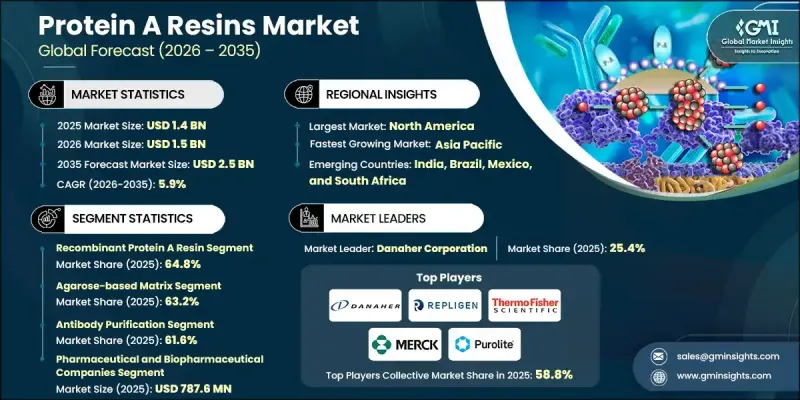
Market growth is linked to the rapid expansion of the biopharmaceutical industry and the rising production of biologic drugs. Protein A resins serve as high-affinity chromatography media that enable efficient purification of monoclonal antibodies and immunoglobulins during manufacturing. As demand for biologic therapies continues to rise, manufacturers are scaling up production capacities, which directly increases reliance on high-performance purification solutions. Aging populations across major regions are contributing to higher incidence rates of long-term health conditions that require advanced biologic treatments and vaccines, further strengthening demand for protein A resins. Continued investment in life sciences research, expansion of biopharmaceutical manufacturing infrastructure, and strict regulatory requirements for product quality and consistency are reinforcing steady market expansion. Together, these factors position protein A resins as an essential component within modern biologics manufacturing workflows.
| Market Scope | |
|---|---|
| Start Year | 2025 |
| Forecast Year | 2026-2035 |
| Start Value | $1.4 Billion |
| Forecast Value | $2.5 Billion |
| CAGR | 5.9% |
The recombinant protein A resins segment accounted 64.8% share in 2025, supported by their superior binding efficiency, improved stability, and consistent performance in large-scale biologics production environments. Technological progress has enhanced resin durability and operational lifespan, helping manufacturers optimize costs.
The agarose-based matrix products segment held 63.2% share in 2025, driven by their strong mechanical properties, favorable flow behavior, and suitability for industrial-scale chromatography systems.
U.S. Protein A Resins Market is expected to grow from USD 542.1 million in 2025 to USD 952.4 million by 2035, supported by strong biopharmaceutical research activity and rising development of antibody-based therapeutics.
Key companies operating in the Global Protein A Resins Market include Merck, Repligen Corporation, Thermo Fisher Scientific, Danaher Corporation, Tosoh Bioscience, Bio-Rad Laboratories, Agilent Technologies, Purolite, GenScript, Takara Bio, and Agarose Beads Technologies. Companies in the Global Protein A Resins Market are strengthening their market position through continuous investment in resin innovation to improve binding capacity, durability, and chemical resistance. Strategic collaborations with biopharmaceutical manufacturers help align product development with evolving production needs. Firms are expanding manufacturing capabilities to support large-scale biologics production and ensure reliable supply chains. Focusing on regulatory compliance, quality consistency, and cost optimization enables suppliers to meet stringent industry standards.
Table of Contents
Chapter 1 Methodology and Scope
- 1.1 Market scope and definitions
- 1.2 Research design
- 1.2.1 Research approach
- 1.2.2 Data collection methods
- 1.3 Data mining sources
- 1.3.1 Global
- 1.3.2 Regional/country
- 1.4 Base estimates and calculations
- 1.4.1 Base year calculation
- 1.4.2 Key trends for market estimation
- 1.5 Primary research and validation
- 1.5.1 Primary sources
- 1.6 Forecast model
- 1.7 Research assumptions and limitations
Chapter 2 Executive Summary
- 2.1 Industry 360º synopsis
- 2.2 Key market trends
- 2.2.1 Regional trends
- 2.2.2 Product trends
- 2.2.3 Matrix type trends
- 2.2.4 Application trends
- 2.2.5 End use trends
- 2.3 CXO perspectives: Strategic imperatives
- 2.3.1 Key decision points for industry executives
- 2.3.2 Critical success factors for market players
- 2.4 Future outlook and strategic recommendations
Chapter 3 Industry Insights
- 3.1 Industry ecosystem analysis
- 3.2 Industry impact forces
- 3.2.1 Growth drivers
- 3.2.1.1 Rising demand for vaccine and therapeutic antibodies
- 3.2.1.2 Increasing prevalence of chronic diseases
- 3.2.1.3 Growing drug discovery and research and development activity
- 3.2.1.4 Technology advancements in protein A resins
- 3.2.2 Industry pitfalls and challenges
- 3.2.2.1 Rise in alternative methods for the purification of monoclonal antibodies
- 3.2.2.2 High cost of the matrix resins
- 3.2.3 Market opportunities
- 3.2.3.1 Regional expansion in emerging markets
- 3.2.3.2 Sustainability and cost-effectiveness
- 3.2.1 Growth drivers
- 3.3 Growth potential analysis
- 3.4 Regulatory landscape
- 3.4.1 North America
- 3.4.2 Europe
- 3.4.3 Asia Pacific
- 3.5 Technology landscape
- 3.5.1 Current technological trends
- 3.5.2 Emerging technologies
- 3.6 Patent analysis
- 3.7 Future market trends
- 3.8 Pricing analysis
- 3.9 Porter's analysis
- 3.10 PESTEL analysis
Chapter 4 Competitive Landscape, 2025
- 4.1 Introduction
- 4.2 Company market share analysis
- 4.2.1 Global
- 4.2.2 North America
- 4.2.3 Europe
- 4.2.4 Asia Pacific
- 4.3 Company matrix analysis
- 4.4 Competitive analysis of major market players
- 4.5 Competitive positioning matrix
- 4.6 Key development
- 4.6.1 Mergers and acquisitions
- 4.6.2 Partnerships and collaborations
- 4.6.3 New product launches
- 4.6.4 Expansion plans
Chapter 5 Market Estimates and Forecast, By Product, 2022 - 2035 ($ Mn)
- 5.1 Key trends
- 5.2 Natural protein A resin
- 5.3 Recombinant protein A resin
Chapter 6 Market Estimates and Forecast, By Matrix Type, 2022 - 2035 ($ Mn)
- 6.1 Key trends
- 6.2 Agarose-based matrix
- 6.3 Glass or silica gel-based matrix
- 6.4 Organic polymer-based matrix
Chapter 7 Market Estimates and Forecast, By Application, 2022 - 2035 ($ Mn)
- 7.1 Key trends
- 7.2 Immunoprecipitation
- 7.3 Antibody purification
Chapter 8 Market Estimates and Forecast, By End Use, 2022 - 2035 ($ Mn)
- 8.1 Key trends
- 8.2 Pharmaceutical and biopharmaceutical companies
- 8.3 CROs and CDMOs
- 8.4 Academic and research institutes
- 8.5 Other end users
Chapter 9 Market Estimates and Forecast, By Region, 2022 - 2035 ($ Mn)
- 9.1 Key trends
- 9.2 North America
- 9.2.1 U.S.
- 9.2.2 Canada
- 9.3 Europe
- 9.3.1 Germany
- 9.3.2 UK
- 9.3.3 France
- 9.3.4 Italy
- 9.3.5 Spain
- 9.3.6 Netherlands
- 9.4 Asia Pacific
- 9.4.1 China
- 9.4.2 India
- 9.4.3 Japan
- 9.4.4 Australia
- 9.4.5 South Korea
- 9.5 Latin America
- 9.5.1 Brazil
- 9.5.2 Mexico
- 9.5.3 Argentina
- 9.6 Middle East and Africa
- 9.6.1 Saudi Arabia
- 9.6.2 South Africa
- 9.6.3 UAE
Chapter 10 Company Profiles
- 10.1 Agarose Beads Technologies
- 10.2 Agilent Technologies
- 10.3 Bio-Rad Laboratories
- 10.4 Danaher Corporation
- 10.5 GenScript
- 10.6 Merck
- 10.7 Purolite
- 10.8 Repligen Corporation
- 10.9 Takara Bio
- 10.10 Thermo Fisher Scientific
- 10.11 Tosoh Bioscience

