PUBLISHER: Global Market Insights Inc. | PRODUCT CODE: 1913383

PUBLISHER: Global Market Insights Inc. | PRODUCT CODE: 1913383
Polypropylene (PP) Nonwoven Fabrics Market Opportunity, Growth Drivers, Industry Trend Analysis, and Forecast 2026 - 2035
The Global Polypropylene (PP) Nonwoven Fabrics Market was valued at USD 50.2 billion in 2025 and is estimated to grow at a CAGR of 7.3% to reach USD 100.3 billion by 2035.
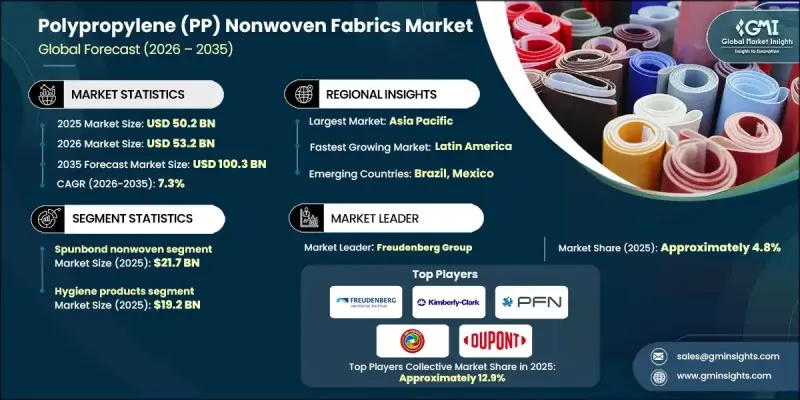
The market is witnessing rapid expansion due to increasing adoption in medical, hygiene, and industrial applications. Its lightweight, durable, and cost-effective nature makes it ideal for manufacturing masks, gowns, diapers, and sanitary products. Rising health awareness and stringent workplace safety standards have further fueled demand across healthcare and industrial sectors. Additionally, the automotive industry is embracing polypropylene nonwovens for seat covers, headliners, and cabin filters, especially in electric and hybrid vehicles, where lightweight materials improve efficiency and comfort. The surge in personal protective equipment (PPE) demand has also accelerated market growth, as these fabrics provide a breathable barrier, enhancing safety for medical and industrial personnel worldwide.
| Market Scope | |
|---|---|
| Start Year | 2025 |
| Forecast Year | 2026-2035 |
| Start Value | $50.2 Billion |
| Forecast Value | $100.3 Billion |
| CAGR | 7.3% |
The spunbond nonwoven segment generated USD 21.7 billion in 2025 and is projected to grow at a CAGR of 7.5% from 2026 to 2035. Its strength, multifunctionality, and lightweight properties make it a preferred choice for industries requiring durable yet cost-effective materials, including cleaning, agriculture, and automotive applications. The rising demand for both disposable and reusable products has further propelled adoption.
The hygiene products segment recorded USD 19.2 billion in 2025, representing a 38.2% share, and is expected to grow at a CAGR of 7.5% through 2035. Growth is driven by applications in diapers, sanitary pads, surgical gowns, and protective equipment, where comfort, absorbency, and protection are essential. Increasing consumer awareness regarding personal hygiene and infection control is driving adoption across healthcare and hygiene sectors globally.
North America Polypropylene (PP) Nonwoven Fabrics Market accounted for USD 12.9 billion in 2025. Expansion is supported by the region's robust healthcare and hygiene sectors, rising demand for medical disposables, industrial wipes, and PPE, and growing adoption in automotive interiors and filtration. Manufacturers are investing in advanced production technologies, sustainable processes, and local facilities to meet high-quality standards and regulatory compliance, reinforcing the market's development in the region.
Key players in the Global Polypropylene (PP) Nonwoven Fabrics Market include PFNonwovens A.S., DuPont de Nemours, Inc., Freudenberg Group, Kimberly-Clark Corporation, NW Fabric, and others. Companies in the Global Polypropylene (PP) Nonwoven Fabrics Market are adopting multiple strategies to strengthen their market presence and expand their foothold. Investments in advanced manufacturing technologies enhance production efficiency, product quality, and sustainability. Firms are focusing on developing specialized, high-performance fabrics tailored for healthcare, hygiene, automotive, and industrial applications. Strategic partnerships and collaborations with OEMs, healthcare providers, and hygiene product manufacturers broaden market reach. Expanding production capacities, entering emerging markets, and optimizing supply chains help meet growing global demand.
Table of Contents
Chapter 1 Methodology
- 1.1 Market scope and definition
- 1.2 Research design
- 1.2.1 Research approach
- 1.2.2 Data collection methods
- 1.3 Data mining sources
- 1.3.1 Global
- 1.3.2 Regional/Country
- 1.4 Base estimates and calculations
- 1.4.1 Base year calculation
- 1.4.2 Key trends for market estimation
- 1.5 Primary research and validation
- 1.5.1 Primary sources
- 1.6 Forecast model
- 1.7 Research assumptions and limitations
Chapter 2 Executive Summary
- 2.1 Industry 360° synopsis
- 2.2 Key market trends
- 2.2.1 Regional
- 2.2.2 Product Type
- 2.2.3 Application
- 2.3 TAM Analysis, 2026-2035
- 2.4 CXO perspectives: Strategic imperatives
- 2.4.1 Executive decision points
- 2.4.2 Critical success factors
- 2.5 Future Outlook and Strategic Recommendations
Chapter 3 Industry Insights
- 3.1 Industry ecosystem analysis
- 3.1.1 Supplier Landscape
- 3.1.2 Profit Margin
- 3.1.3 Value addition at each stage
- 3.1.4 Factor affecting the value chain
- 3.1.5 Disruptions
- 3.2 Industry impact forces
- 3.2.1 Growth drivers
- 3.2.2 Industry pitfalls and challenges
- 3.2.3 Market opportunities
- 3.3 Growth potential analysis
- 3.4 Regulatory landscape
- 3.4.1 North America
- 3.4.2 Europe
- 3.4.3 Asia Pacific
- 3.4.4 Latin America
- 3.4.5 Middle East & Africa
- 3.5 Porter's analysis
- 3.6 PESTEL analysis
- 3.7 Price trends
- 3.7.1 By region
- 3.7.2 By product
- 3.8 Future market trends
- 3.9 Technology and Innovation landscape
- 3.9.1 Current technological trends
- 3.9.2 Emerging technologies
- 3.10 Patent Landscape
- 3.11 Trade statistics (Note: the trade statistics will be provided for key countries only)
- 3.11.1 Major importing countries
- 3.11.2 Major exporting countries
- 3.12 Sustainability and Environmental Aspects
- 3.12.1 Sustainable Practices
- 3.12.2 Waste Reduction Strategies
- 3.12.3 Energy Efficiency in Production
- 3.12.4 Eco-friendly Initiatives
- 3.13 Carbon Footprint Considerations
Chapter 4 Competitive Landscape, 2025
- 4.1 Introduction
- 4.2 Company market share analysis
- 4.2.1 By region
- 4.2.1.1 North America
- 4.2.1.2 Europe
- 4.2.1.3 Asia Pacific
- 4.2.1.4 LATAM
- 4.2.1.5 MEA
- 4.2.1 By region
- 4.3 Company matrix analysis
- 4.4 Competitive analysis of major market players
- 4.5 Competitive positioning matrix
- 4.6 Key developments
- 4.6.1 Mergers & acquisitions
- 4.6.2 Partnerships & collaborations
- 4.6.3 New Product Launches
- 4.6.4 Expansion Plans
Chapter 5 Market Estimates and Forecast, By Product Type, 2022- 2035 (USD Billion, Kilo Tons)
- 5.1 Key trends
- 5.2 Spunbond Nonwoven
- 5.2.1 Single-layer spunbond
- 5.2.2 Multi-layer spunbond
- 5.3 Meltblown Nonwoven
- 5.3.1 Pure meltblown
- 5.3.2 Meltblown composites
- 5.4 Composite Nonwoven
- 5.4.1 Spunbond + Meltblown (SM)
- 5.4.2 Spunbond + Meltblown + Spunbond (SMS)
- 5.5 Others
Chapter 6 Market Estimates and Forecast, By Application, 2022- 2035 (USD Billion, Kilo Tons)
- 6.1 Key trends
- 6.2 Hygiene Products
- 6.2.1 Baby diapers
- 6.2.2 Feminine hygiene products
- 6.2.3 Adult incontinence products
- 6.3 Medical & Healthcare
- 6.3.1 Surgical gowns
- 6.3.2 Face masks
- 6.3.3 Drapes and covers
- 6.4 Agriculture
- 6.4.1 Crop protection covers
- 6.4.2 Seed blankets
- 6.5 Furniture & Upholstery
- 6.5.1 Mattress covers
- 6.5.2 Cushion linings
- 6.6 Automotive
- 6.6.1 Interior trims
- 6.6.2 Insulation layers
- 6.7 Industrial
- 6.7.1 Filtration media
- 6.7.2 Geotextiles
- 6.8 Others
Chapter 7 Market Estimates and Forecast, By Region, 2022 - 2035 (USD Billion, Kilo Tons)
- 7.1 Key trends
- 7.2 North America
- 7.2.1 U.S.
- 7.2.2 Canada
- 7.3 Europe
- 7.3.1 Germany
- 7.3.2 UK
- 7.3.3 France
- 7.3.4 Italy
- 7.3.5 Spain
- 7.3.6 Rest of Europe
- 7.4 Asia Pacific
- 7.4.1 China
- 7.4.2 India
- 7.4.3 Japan
- 7.4.4 Australia
- 7.4.5 South Korea
- 7.4.6 Rest of Asia Pacific
- 7.5 Latin America
- 7.5.1 Brazil
- 7.5.2 Mexico
- 7.5.3 Argentina
- 7.5.4 Rest of Latin America
- 7.6 Middle East & Africa
- 7.6.1 Saudi Arabia
- 7.6.2 South Africa
- 7.6.3 UAE
- 7.6.4 Rest of Middle East & Africa
Chapter 8 Company Profiles
- 8.1 DuPont de Nemours, Inc.
- 8.2 NW Fabric
- 8.3 Freudenberg Group
- 8.4 PFNonwovens A.S.
- 8.5 Kimberly-Clark Corporation
- 8.6 First Quality Nonwovens, Inc.
- 8.7 Toray Industries, Inc.
- 8.8 Lydall, Inc.
- 8.9 Mitsui Chemicals, Inc.
- 8.10 Ahlstrom-Munksjo
- 8.11 Asahi Kasei Corporation
- 8.12 Mogul Co., Ltd.
- 8.13 Global Nonwovens Ltd.
- 8.14 Mewar Polytex International

