
PUBLISHER: Global Market Insights Inc. | PRODUCT CODE: 1913388

PUBLISHER: Global Market Insights Inc. | PRODUCT CODE: 1913388
Enzyme Market Opportunity, Growth Drivers, Industry Trend Analysis, and Forecast 2026 - 2035
The Global Enzyme Market was valued at USD 15.2 billion in 2025 and is estimated to grow at a CAGR of 6.5% to reach USD 28.5 billion by 2035.
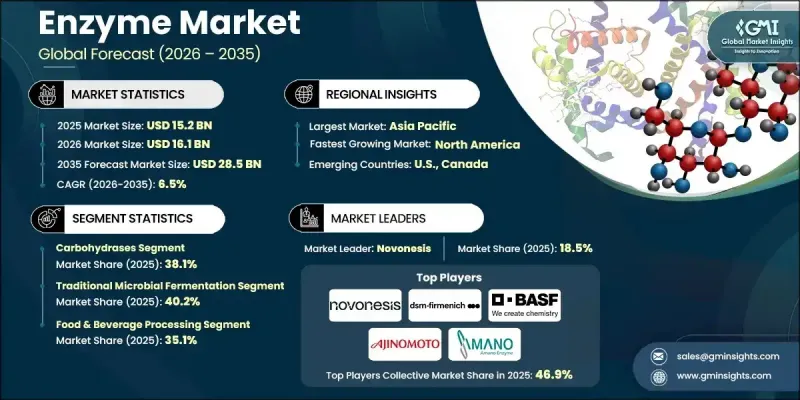
The market's remarkable growth is fueled by increasing adoption across diverse industries. Enzymes, as natural catalysts, enhance the efficiency of chemical processes, making operations more sustainable, cost-effective, and environmentally friendly. Their applications span healthcare, food and beverages, agriculture, and industrial production. In healthcare, enzymes improve outcomes in therapies and diagnostics. In food and beverage production, they optimize processing efficiency and product quality. In agriculture, enzyme integration enhances both crop yields and livestock well-being. Industrially, enzymes facilitate eco-conscious operations, reducing chemical usage and energy consumption. The rising global focus on green technologies and sustainable solutions continues to drive the demand for enzyme-based applications.
| Market Scope | |
|---|---|
| Start Year | 2025 |
| Forecast Year | 2026-2035 |
| Start Value | $15.2 Billion |
| Forecast Value | $28.5 Billion |
| CAGR | 6.5% |
The carbohydrases segment accounted for 38.1% share in 2025 and is expected to grow at a CAGR of 6.6% through 2035. These enzymes are widely utilized for breaking down complex carbohydrates into simpler sugars, a factor contributing to their growing popularity across industries that prioritize natural and efficient processes.
The traditional microbial fermentation segment held 40.2% share in 2025 and is projected to grow at a CAGR of 6.7% during 2026-2035. This production method, which relies on cultivating microbial strains in large-scale bioreactors, remains a cost-effective and established approach. Companies are increasingly optimizing fermentation conditions and selecting high-yield strains to improve both enzyme output and activity.
North America Enzyme Market held 28.2% share in 2025, making it a leading regional market. The growth is driven by increasing demand for natural enzymes, stringent regulatory standards promoting sustainable practices, and expansion in the healthcare and industrial sectors. Innovations targeting reduced chemical usage and enhanced efficiency continue to support market adoption in this region.
Key players in the Global Enzyme Market include Ajinomoto Co. Inc., Novonesis, BASF SE, Biocatalysts Ltd., Enzyme Development Corporation, Creative Enzymes, Dyadic International Inc., DSM-Firmenich, Advanced Enzyme Technologies, Codexis Inc., Amano Enzyme Inc., ArcticZymes Technologies ASA, and Specialty Enzymes & Probiotics. Leading companies are employing strategies such as advanced research and development to create high-efficiency enzymes, forming strategic partnerships to expand market reach, and focusing on sustainability-driven innovations. They are also optimizing production technologies, diversifying product portfolios, and targeting emerging regional markets to strengthen their market position and maintain a competitive edge.
Table of Contents
Chapter 1 Methodology & Scope
- 1.1 Market scope and definition
- 1.2 Research design
- 1.2.1 Research approach
- 1.2.2 Data collection methods
- 1.3 Data mining sources
- 1.3.1 Global
- 1.3.2 Regional/Country
- 1.4 Base estimates and calculations
- 1.4.1 Base year calculation
- 1.4.2 Key trends for market estimation
- 1.5 Primary research and validation
- 1.5.1 Primary sources
- 1.6 Forecast model
- 1.7 Research assumptions and limitations
Chapter 2 Executive Summary
- 2.1 Industry 360° synopsis
- 2.2 Key market trends
- 2.2.1 Regional
- 2.2.2 Enzyme class
- 2.2.3 Production technology
- 2.2.4 Application
- 2.3 TAM Analysis, 2026-2035
- 2.4 CXO perspectives: Strategic imperatives
- 2.4.1 Executive decision points
- 2.4.2 Critical success factors
- 2.5 Future Outlook and Strategic Recommendations
Chapter 3 Industry Insights
- 3.1 Industry ecosystem analysis
- 3.1.1 Supplier landscape
- 3.1.2 Profit margin
- 3.1.3 Value addition at each stage
- 3.1.4 Factor affecting the value chain
- 3.1.5 Disruptions
- 3.2 Industry impact forces
- 3.2.1 Growth drivers
- 3.2.2 Industry pitfalls and challenges
- 3.2.3 Market opportunities
- 3.3 Growth potential analysis
- 3.4 Regulatory landscape
- 3.4.1 North America
- 3.4.2 Europe
- 3.4.3 Asia Pacific
- 3.4.4 Latin America
- 3.4.5 Middle East & Africa
- 3.5 Porter's analysis
- 3.6 PESTEL analysis
- 3.7 Price trends
- 3.7.1 By region
- 3.7.2 By enzyme class
- 3.8 Future market trends
- 3.9 Technology and Innovation landscape
- 3.9.1 Current technological trends
- 3.9.2 Emerging technologies
- 3.10 Patent Landscape
- 3.11 Trade statistics (HS code) ( Note: the trade statistics will be provided for key countries only)
- 3.11.1 Major importing countries
- 3.11.2 Major exporting countries
- 3.12 Sustainability and environmental aspects
- 3.12.1 Sustainable practices
- 3.12.2 Waste reduction strategies
- 3.12.3 Energy efficiency in production
- 3.12.4 Eco-friendly initiatives
- 3.13 Carbon footprint consideration
Chapter 4 Competitive Landscape, 2025
- 4.1 Introduction
- 4.2 Company market share analysis
- 4.2.1 By region
- 4.2.1.1 North America
- 4.2.1.2 Europe
- 4.2.1.3 Asia Pacific
- 4.2.1.4 LATAM
- 4.2.1.5 MEA
- 4.2.1 By region
- 4.3 Company matrix analysis
- 4.4 Competitive analysis of major market players
- 4.5 Competitive positioning matrix
- 4.6 Key developments
- 4.6.1 Mergers & acquisitions
- 4.6.2 Partnerships & collaborations
- 4.6.3 New Product Launches
- 4.6.4 Expansion Plans
Chapter 5 Market Estimates and Forecast, By Enzyme Class, 2022-2035 (USD Billion) (Kilo Tons)
- 5.1 Key trends
- 5.2 Carbohydrases
- 5.2.1 Amylases (Alpha, Beta, Glucoamylase)
- 5.2.2 Cellulases & hemicellulases
- 5.2.3 Pectinases & pectin esterases
- 5.2.4 Xylanases & arabinofuranosidases
- 5.2.5 Invertases & glucose isomerases
- 5.3 Proteases
- 5.3.1 Alkaline proteases
- 5.3.2 Acid proteases
- 5.3.3 Neutral proteases
- 5.3.4 Specialty proteases
- 5.4 Lipases & Esterases
- 5.4.1 Industrial lipases
- 5.4.2 Food-grade lipases
- 5.4.3 Pharmaceutical lipases
- 5.4.4 Specialty esterases
- 5.5 Oxidoreductases
- 5.5.1 Catalases
- 5.5.2 Glucose oxidases
- 5.5.3 Laccases
- 5.5.4 Peroxidases
- 5.6 Specialized enzymes
- 5.6.1 Nucleases (DNases, RNases, Salt-Active)
- 5.6.2 Transglutaminases
- 5.6.3 Phytases
- 5.6.4 Restriction enzymes
- 5.6.5 DNA polymerases
Chapter 6 Market Estimates and Forecast, By Production Technology, 2022-2035 (USD Billion) (Kilo Tons)
- 6.1 Key trends
- 6.2 Traditional microbial fermentation
- 6.2.1 Submerged liquid fermentation
- 6.2.2 Solid-state fermentation (SSF)
- 6.2.3 Fed-batch fermentation processes
- 6.2.4 Continuous fermentation systems
- 6.3 Recombinant DNA technology
- 6.3.1 Escherichia coli expression systems
- 6.3.2 Saccharomyces cerevisiae production
- 6.3.3 Pichia pastoris Methylotrophic systems
- 6.3.4 Aspergillus niger filamentous fungi
- 6.3.5 Bacillus subtilis GRAS organisms
- 6.4 Advanced biotechnology platforms
- 6.4.1 Synthetic biology & metabolic engineering
- 6.4.2 Directed evolution & protein engineering
- 6.4.3 Cell-free protein synthesis
- 6.4.4 Mammalian cell expression systems
- 6.5 Others
Chapter 7 Market Estimates and Forecast, By Application, 2022-2035 (USD Billion) (Kilo Tons)
- 7.1 Key trends
- 7.2 Food & beverage processing
- 7.2.1 Baking industry (Bread, Pastries, Gluten-Free)
- 7.2.2 Dairy processing (Cheese, Yogurt, Lactose-Free)
- 7.2.3 Beverage production (Beer, Wine, Juice Clarification)
- 7.2.4 Meat processing & tenderization
- 7.2.5 Starch processing & high fructose corn syrup
- 7.2.6 Functional foods & nutraceuticals
- 7.3 Industrial manufacturing
- 7.3.1 Detergent & cleaning product manufacturing
- 7.3.2 Textile processing & fabric treatment
- 7.3.3 Pulp & paper industry applications
- 7.3.4 Leather processing & tanning
- 7.3.5 Biofuel production (Ethanol, Biodiesel)
- 7.3.6 Chemical synthesis & fine chemicals
- 7.4 Healthcare & pharmaceutical
- 7.4.1 Therapeutic enzyme replacement therapies
- 7.4.2 Diagnostic testing & clinical chemistry
- 7.4.3 Drug discovery & development tools
- 7.4.4 Biomanufacturing & bioprocessing
- 7.4.5 Wound care & medical devices
- 7.5 Research & biotechnology
- 7.5.1 Molecular biology research tools
- 7.5.2 Genomics & next-generation sequencing
- 7.5.3 Proteomics & protein analysis
- 7.5.4 Cell culture & tissue engineering
- 7.5.5 Agricultural biotechnology applications
- 7.6 Animal feed
- 7.7 Others
Chapter 8 Market Estimates and Forecast, By Region, 2022-2035 (USD Billion) (Kilo Tons)
- 8.1 Key trends
- 8.2 North America
- 8.2.1 U.S.
- 8.2.2 Canada
- 8.3 Europe
- 8.3.1 Germany
- 8.3.2 UK
- 8.3.3 France
- 8.3.4 Spain
- 8.3.5 Italy
- 8.3.6 Rest of Europe
- 8.4 Asia Pacific
- 8.4.1 China
- 8.4.2 India
- 8.4.3 Japan
- 8.4.4 Australia
- 8.4.5 South Korea
- 8.4.6 Rest of Asia Pacific
- 8.5 Latin America
- 8.5.1 Brazil
- 8.5.2 Mexico
- 8.5.3 Argentina
- 8.5.4 Rest of Latin America
- 8.6 Middle East and Africa
- 8.6.1 Saudi Arabia
- 8.6.2 South Africa
- 8.6.3 UAE
- 8.6.4 Rest of Middle East and Africa
Chapter 9 Company Profiles
- 9.1 Advanced Enzyme Technologies
- 9.2 Ajinomoto Co. Inc.
- 9.3 Amano Enzyme Inc.
- 9.4 ArcticZymes Technologies ASA
- 9.5 BASF SE
- 9.6 Biocatalysts Ltd.
- 9.7 Codexis Inc.
- 9.8 Creative Enzymes
- 9.9 dsm-firmenich
- 9.10 Dyadic International Inc.
- 9.11 Enzyme Development Corporation
- 9.12 Novonesis
- 9.13 Specialty Enzymes & Probiotics

