PUBLISHER: Global Market Insights Inc. | PRODUCT CODE: 1913399

PUBLISHER: Global Market Insights Inc. | PRODUCT CODE: 1913399
Household Robots Market Opportunity, Growth Drivers, Industry Trend Analysis, and Forecast 2026 - 2035
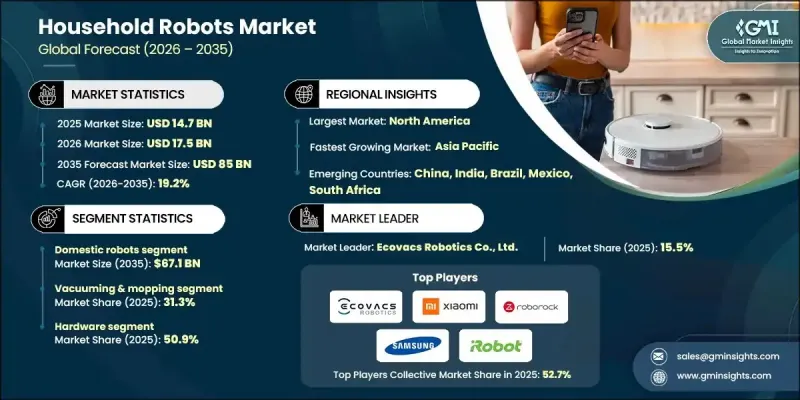
The Global Household Robots Market was valued at USD 14.7 billion in 2025 and is estimated to grow at a CAGR of 19.2% to reach USD 85 billion by 2035.
Rising penetration of connected living environments and the accelerating shift toward digital retail platforms are driving market momentum worldwide. Consumers are increasingly prioritizing convenience, automation, and efficiency in daily household management, which is translating into higher adoption of robotic solutions. Continuous advancements in artificial intelligence, connectivity frameworks, and user-centric design are reshaping how household robots integrate into everyday life. Developed economies are witnessing faster uptake due to advanced digital infrastructure and higher disposable incomes, while global online sales channels are expanding product visibility and accessibility. Competitive pricing transparency, wider product availability, and rapid fulfillment models are also contributing to stronger consumer interest. These combined factors are positioning household robots as a core component of modern residential technology ecosystems.
| Market Scope | |
|---|---|
| Start Year | 2025 |
| Forecast Year | 2026-2035 |
| Start Value | $14.7 Billion |
| Forecast Value | $85 Billion |
| CAGR | 19.2% |
The adoption of intelligent living environments is acting as a primary catalyst for household robot demand. Seamless digital integration allows robots to function efficiently within interconnected home systems, increasing their operational value. As awareness grows and purchasing decisions become more data-driven through online platforms, demand continues to rise. Global digital commerce is accelerating market reach by improving affordability, shortening delivery timelines, and supporting promotional strategies that encourage adoption.
The domestic robots segment is expected to reach USD 67.1 billion by 2035. Advances in artificial intelligence and learning algorithms have significantly enhanced automation performance, driving interest in robots capable of handling multiple household functions. The growing preference for connected and adaptive home systems is further strengthening demand for intelligent domestic robotics solutions.
The robotic solutions segment held a 31.3% share in 2025. These systems are increasingly evolving toward fully independent operation with improved navigation, space recognition, and automated maintenance capabilities. Consumers are showing a strong preference for multifunctional devices supported by intelligent routing, real-time digital controls, and remote performance tracking, which is redefining efficiency standards across this segment.
North America Household Robots Market captured 32.7% share in 2025. Rapid deployment of connected home technologies and AI-driven automation is accelerating regional adoption. Demand is rising for advanced residential robots designed to deliver multiple functions, supported by widespread integration of intelligent digital systems within households.
Key companies active in the Global Household Robots Market include LG Electronics Inc., iRobot Corporation, Samsung Electronics Co., Ltd., Ecovacs Robotics Co., Ltd., Dyson Limited, Xiaomi Corporation, UBTECH Robotics, Neato Robotics, Inc., Maytronics Ltd, LEGO A/S, and Hayward Holdings, Inc. Companies in the Global Household Robots Market are strengthening their market position through continuous investment in artificial intelligence, sensor technology, and software upgrades to enhance product intelligence and autonomy. Many players are expanding their portfolios with multifunctional models to address broader consumer needs while improving cost efficiency through scalable manufacturing. Strategic partnerships with digital platform providers and smart ecosystem developers are helping brands improve interoperability and user experience. Firms are also prioritizing global distribution expansion through e-commerce channels and regional partnerships to increase accessibility.
Table of Contents
Chapter 1 Methodology and Scope
- 1.1 Market scope and definition
- 1.2 Research design
- 1.2.1 Research approach
- 1.2.2 Data collection methods
- 1.3 Data mining sources
- 1.3.1 Global
- 1.3.2 Regional/Country
- 1.4 Base estimates and calculations
- 1.4.1 Base year calculation
- 1.4.2 Key trends for market estimation
- 1.5 Primary research and validation
- 1.5.1 Primary sources
- 1.6 Forecast model
- 1.7 Research assumptions and limitations
Chapter 2 Executive Summary
- 2.1 Industry 3600 synopsis, 2021 - 2034
- 2.2 Key market trends
- 2.2.1 Type trends
- 2.2.2 Component trends
- 2.2.3 Application trends
- 2.2.4 Distribution channel trends
- 2.2.5 Regional trends
- 2.3 TAM analysis, 2025-2034
- 2.4 CXO perspectives: Strategic imperatives
- 2.4.1 Executive decision points
- 2.4.2 Critical success factors
- 2.5 Future outlook and strategic recommendations
Chapter 3 Industry Insights
- 3.1 Industry ecosystem analysis
- 3.1.1 Supplier landscape
- 3.1.2 Profit margin analysis
- 3.1.3 Cost structure
- 3.1.4 Value addition at each stage
- 3.1.5 Factor affecting the value chain
- 3.1.6 Disruptions
- 3.2 Industry impact forces
- 3.2.1 Growth drivers
- 3.2.1.1 Rising adoption of smart homes and IoT integration
- 3.2.1.2 Growing consumer demand for convenience and automation
- 3.2.1.3 Growth in e-commerce and online retail for robotics
- 3.2.1.4 Increasing aging population and need for elderly assistance
- 3.2.2 Industry pitfalls and challenges
- 3.2.2.1 Evolving regulations related to data privacy and safety
- 3.2.2.2 Low consumer awareness in price-sensitive and rural markets
- 3.2.3 Market opportunities
- 3.2.3.1 Increased focus on home security and indoor surveillance solutions.
- 3.2.3.2 Integration of voice assistants and natural language processing for intuitive user interaction
- 3.2.1 Growth drivers
- 3.3 Growth potential analysis
- 3.4 Regulatory landscape
- 3.4.1 North America
- 3.4.2 Europe
- 3.4.3 Asia Pacific
- 3.4.4 Latin America
- 3.4.5 Middle East & Africa
- 3.5 Porter's analysis
- 3.6 PESTEL analysis
- 3.7 Technology and innovation landscape
- 3.7.1 Current technological trends
- 3.7.2 Emerging technologies
- 3.8 Emerging business models
- 3.9 Compliance requirements
- 3.10 Patent and IP analysis
- 3.11 Geopolitical and trade dynamics
Chapter 4 Competitive Landscape, 2024
- 4.1 Introduction
- 4.2 Company market share analysis
- 4.2.1 By region
- 4.2.1.1 North America
- 4.2.1.2 Europe
- 4.2.1.3 Asia Pacific
- 4.2.1.4 Latin America
- 4.2.1.5 Middle East & Africa
- 4.2.1 By region
- 4.3 Competitive benchmarking of key players
- 4.3.1 Financial performance comparison
- 4.3.1.1 Revenue
- 4.3.1.2 Profit margin
- 4.3.1.3 R&D
- 4.3.2 Product portfolio comparison
- 4.3.2.1 Product range breadth
- 4.3.2.2 Technology
- 4.3.2.3 Innovation
- 4.3.3 Geographic presence comparison
- 4.3.3.1 Global footprint analysis
- 4.3.3.2 Service network coverage
- 4.3.3.3 Market penetration by region
- 4.3.4 Competitive positioning matrix
- 4.3.4.1 Leaders
- 4.3.4.2 Challengers
- 4.3.4.3 Followers
- 4.3.4.4 Niche players
- 4.3.5 Strategic outlook matrix
- 4.3.1 Financial performance comparison
- 4.4 Key developments, 2021-2024
- 4.4.1 Mergers and acquisitions
- 4.4.2 Partnerships and collaborations
- 4.4.3 Technological advancements
- 4.4.4 Expansion and investment strategies
- 4.4.5 Digital transformation initiatives
- 4.5 Emerging/ startup competitors landscape
Chapter 5 Market Estimates and Forecast, By Type, 2022 - 2035 ($ Mn & Units)
- 5.1 Key trends
- 5.2 Domestic Robots
- 5.3 Entertainment & Leisure Robots
Chapter 6 Market Estimates and Forecast, By Component, 2022 - 2035 ($ Mn & Units)
- 6.1 Key trends
- 6.2 Hardware
- 6.3 Software
- 6.4 Service
Chapter 7 Market Estimates and Forecast, By Wafer Thickness, 2022 - 2035 ($ Mn & Units)
- 7.1 Key trends
- 7.2 750 µm (standard / less thin)
- 7.3 120 µm (advanced mainstream)
- 7.4 50 µm and below
Chapter 8 Market Estimates and Forecast, By Application, 2022 - 2035 ($ Mn & Units)
- 8.1 Key trends
- 8.2 Vacuuming & Mopping
- 8.3 Lawn Mowing
- 8.4 Pool Cleaning
- 8.5 Companionship
- 8.6 Others
Chapter 9 Market Estimates and Forecast, By Distribution Channel, 2022 - 2035 ($ Mn & Units)
- 9.1 Key trends
- 9.2 Online sales
- 9.3 Offline sales
- 9.3.1 Retail Stores
- 9.3.2 Home Improvement Stores
- 9.3.3 Appliance Stores
Chapter 10 Market Estimates and Forecast, By Region, 2022 - 2035 ($ Mn & Units)
- 10.1 Key trends
- 10.2 North America
- 10.2.1 U.S.
- 10.2.2 Canada
- 10.3 Europe
- 10.3.1 Germany
- 10.3.2 UK
- 10.3.3 France
- 10.3.4 Spain
- 10.3.5 Italy
- 10.3.6 Netherlands
- 10.4 Asia Pacific
- 10.4.1 China
- 10.4.2 India
- 10.4.3 Japan
- 10.4.4 Australia
- 10.4.5 South Korea
- 10.5 Latin America
- 10.5.1 Brazil
- 10.5.2 Mexico
- 10.5.3 Argentina
- 10.6 Middle East and Africa
- 10.6.1 South Africa
- 10.6.2 Saudi Arabia
- 10.6.3 UAE
Chapter 11 Company Profiles
- 11.1 Global Key Players
- 11.1.1 iRobot
- 11.1.2 Samsung Electronics
- 11.1.3 Ecovacs Robotics
- 11.1.4 Roborock
- 11.2 Regional Key Players
- 11.2.1 North America
- 11.2.1.1 SharkNinja
- 11.2.1.2 Bissell
- 11.2.1.3 Neato Robotics
- 11.2.2 Europe
- 11.2.2.1 Dyson
- 11.2.2.2 Husqvarna
- 11.2.2.3 Maytronics
- 11.2.3 APAC
- 11.2.3.1 LG Electronics
- 11.2.3.2 Xiaomi
- 11.2.3.3 Sharp
- 11.2.1 North America
- 11.3 Niche Players / Disruptors
- 11.3.1 Bobsweep
- 11.3.2 Coredy
- 11.3.3 Dreame
- 11.3.4 Hanwha Robotics
- 11.3.5 Keenon Robotics
- 11.3.6 Lefant
- 11.3.7 Narwal Robotics
- 11.3.8 Proscenic
- 11.3.9 Yeedi

