
PUBLISHER: Global Market Insights Inc. | PRODUCT CODE: 1913405

PUBLISHER: Global Market Insights Inc. | PRODUCT CODE: 1913405
Fire Truck Market Opportunity, Growth Drivers, Industry Trend Analysis, and Forecast 2026 - 2035
The Global Fire Truck Market was valued at USD 8.7 billion in 2025 and is estimated to grow at a CAGR of 7.1% to reach USD 16.9 billion by 2035.
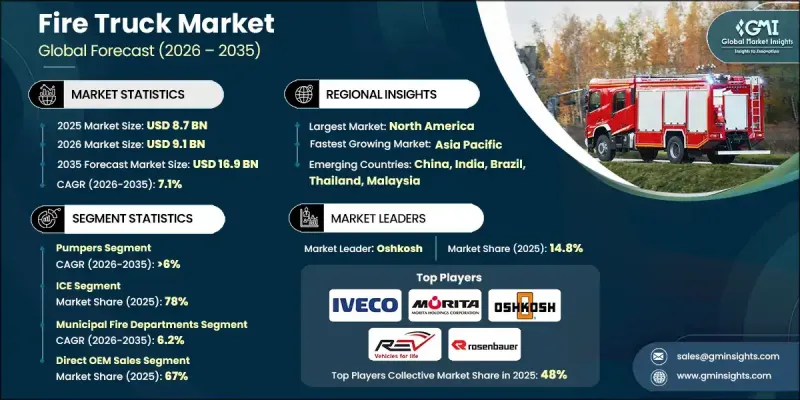
The market is gaining steady momentum as rapid urbanization continues to increase population density, vertical construction, and industrial activity, all of which elevate fire risk and emergency preparedness requirements. Municipal bodies and industrial zones are allocating higher budgets toward modern firefighting fleets to safeguard expanding residential areas, commercial complexes, and infrastructure assets. Fire authorities are increasingly prioritizing fleet modernization to align with evolving safety mandates, emission norms, and performance expectations. Many departments are retiring legacy vehicles that no longer meet operational reliability or compliance benchmarks and are investing in advanced apparatus with enhanced pumping capacity, extended reach, and improved crew safety systems. Modern fire trucks deliver greater reliability, reduced downtime, and better integration of digital technologies, helping agencies strengthen emergency response readiness. The market is also benefiting from rising adoption of connected systems that support real-time diagnostics, situational awareness, and efficient resource deployment, enabling fire services to respond faster and operate more effectively in complex emergency scenarios.
| Market Scope | |
|---|---|
| Start Year | 2025 |
| Forecast Year | 2026-2035 |
| Start Value | $8.7 Billion |
| Forecast Value | $16.9 Billion |
| CAGR | 7.1% |
The pumper category accounted for 43% share in 2025 and is anticipated to grow at a CAGR of 6% from 2026 to 2035. Demand is supported by advancements in pump efficiency, improved vehicle handling, and the ability to operate effectively in dense urban environments. Replacement of aging units and growing interest in cost-effective, multipurpose firefighting vehicles continue to support this segment's expansion.
The internal combustion engine-based fire trucks held a share of 78% in 2025 and are projected to grow at a CAGR of 6.6% through 2035. This dominance is supported by established drivetrain technology, widespread fuel availability, and the ability to deliver sustained power output for demanding firefighting operations. Ongoing enhancements in emissions control and onboard monitoring systems are helping these vehicles remain compliant with tightening environmental standards.
U.S. Fire Truck Market generated USD 3.19 billion in 2025. Replacement of aging fleets remains a primary growth driver as departments address rising maintenance expenses, safety gaps, and compliance with updated operational standards. Funding initiatives at multiple levels are accelerating procurement of modern emergency vehicles, supporting faster replacement cycles and higher investment in firefighter protection and vehicle reliability.
Key companies active in the Global Fire Truck Market include Rosenbauer, Oshkosh, REV Group, Morita, Ziegler, Bronto Skylift, Metz Fire & Rescue, KME Fire Apparatus, IVECO (Magirus), and HME Ahrens. Manufacturers in the Global Fire Truck Market are reinforcing their market position through continuous product innovation, customization, and long-term service offerings. Companies are investing in advanced chassis design, digital control systems, and modular configurations to meet diverse operational needs across regions. Strategic focus on lifecycle support, including maintenance contracts and parts availability, is helping strengthen customer relationships. Localization of manufacturing and supplier networks is being used to improve delivery timelines and cost efficiency. Partnerships with fire departments for co-development and testing are enabling manufacturers to align products with real-world requirements while ensuring compliance with evolving safety and environmental regulations.
Table of Contents
Chapter 1 Methodology
- 1.1 Research approach
- 1.2 Quality commitments
- 1.2.1 GMI AI policy & data integrity commitment
- 1.2.2 Research trail & confidence scoring
- 1.2.2.1 Research trail components
- 1.2.2.2 Scoring components
- 1.3 Data collection
- 1.3.1 Partial list of primary sources
- 1.4 Data mining sources
- 1.4.1 Paid sources
- 1.5 Base estimates and calculations
- 1.5.1 Base year calculation
- 1.6 Forecast model
- 1.7 Research transparency addendum
Chapter 2 Executive Summary
- 2.1 Industry 360° synopsis
- 2.2 Key market trends
- 2.2.1 Regional
- 2.2.2 Vehicle
- 2.2.3 Powertrain
- 2.2.4 Application
- 2.2.5 Capacity
- 2.2.6 Sales channel
- 2.3 TAM analysis, 2026-2035
- 2.4 CXO perspectives: Strategic imperatives
- 2.4.1 Executive decision points
- 2.4.2 Critical success factors
- 2.5 Future outlook
- 2.6 Strategic recommendations
Chapter 3 Industry Insights
- 3.1 Industry ecosystem analysis
- 3.1.1 Supplier landscape
- 3.1.2 Profit margin
- 3.1.3 Cost structure
- 3.1.4 Value addition at each stage
- 3.1.5 Factor affecting the value chain
- 3.1.6 Disruptions
- 3.2 Industry impact forces
- 3.2.1 Growth drivers
- 3.2.1.1 Urbanization & infrastructure expansion
- 3.2.1.2 Stringent fire safety regulations
- 3.2.1.3 Fleet modernization & replacement cycles
- 3.2.1.4 Technological advancements in firefighting equipment
- 3.2.2 Industry pitfalls and challenges
- 3.2.2.1 High vehicle & maintenance costs
- 3.2.2.2 Long OEM lead times & budget constraints
- 3.2.3 Market opportunities
- 3.2.3.1 Electrification & hybrid fire trucks
- 3.2.3.2 Airport & industrial firefighting demand
- 3.2.3.3 Telemetry & telematics integration
- 3.2.3.4 Aftermarket upgrades & retrofitting
- 3.2.1 Growth drivers
- 3.3 Growth potential analysis
- 3.4 Regulatory landscape
- 3.4.1 North America
- 3.4.1.1 Federal Motor Vehicle Safety Standards (FMVSS)
- 3.4.1.2 Environmental Protection Agency (EPA)Europe
- 3.4.2 Europe
- 3.4.2.1 VDA Guidelines (VDA 5)
- 3.4.2.2 EU Type-Approval / Whole Vehicle Type Approval (WVTA)
- 3.4.2.3 UNE Standards (Asociacion Espanola de Normalizacion)
- 3.4.2.4 Decreto Ministeriale & UNI Standards
- 3.4.2.5 BS EN Standards & UK Type Approval
- 3.4.3 Asia Pacific
- 3.4.3.1 China GB (Guobiao) national standards
- 3.4.3.2 Japan JIS requirements
- 3.4.3.3 Korea KS certification
- 3.4.3.4 Automotive Industry Standard 140
- 3.4.3.5 Thai Industrial Standards Institute (TISI)
- 3.4.4 Latin America
- 3.4.4.1 INMETRO (National Institute of Metrology)
- 3.4.4.2 INTI certification (Instituto Nacional de Tecnologia Industrial)
- 3.4.4.3 NOM standards (Norma Official Mexicana)
- 3.4.5 Middle East & Africa
- 3.4.5.1 ESMA / Emirates Conformity Assessment Scheme (ECAS)
- 3.4.5.2 GCC technical regulations
- 3.4.5.3 SABS certification
- 3.4.1 North America
- 3.5 Porter's analysis
- 3.6 PESTEL analysis
- 3.7 Technology and innovation landscape
- 3.7.1 Current technological trends
- 3.7.2 Emerging technologies
- 3.8 Pricing analysis
- 3.8.1 By product
- 3.8.2 By region
- 3.9 Cost breakdown analysis
- 3.9.1 Total cost of ownership (TCO) framework
- 3.9.2 TCO by technology type
- 3.9.3 Cost-per-part analysis
- 3.9.4 AM vs. traditional manufacturing cost comparison
- 3.10 Production statistics
- 3.10.1 Production hubs
- 3.10.2 Consumption hubs
- 3.10.3 Export and import
- 3.11 Patent analysis
- 3.12 Sustainability and environmental aspects
- 3.12.1 Sustainable practices
- 3.12.2 Waste reduction strategies
- 3.12.3 Energy efficiency in production
- 3.12.4 Eco-friendly initiatives
- 3.12.5 Carbon footprint considerations
- 3.13 Use cases
- 3.14 Aftermarket services & refurbishment ecosystem
- 3.14.1 Maintenance & service contracts
- 3.14.2 Spare parts & retrofit demand
- 3.14.3 Lifecycle service revenue contribution
- 3.15 Fleet lifecycle & replacement cycle analysis
Chapter 4 Competitive Landscape, 2025
- 4.1 Introduction
- 4.2 Company market share analysis
- 4.2.1 North America
- 4.2.2 Europe
- 4.2.3 Asia Pacific
- 4.2.4 LATAM
- 4.2.5 MEA
- 4.3 Competitive analysis of major market players
- 4.4 Competitive positioning matrix
- 4.5 Strategic outlook matrix
- 4.6 Key developments
- 4.6.1 Mergers & acquisitions
- 4.6.2 Partnerships & collaborations
- 4.6.3 New product launches
- 4.6.4 Expansion plans and funding
Chapter 5 Market Estimates & Forecast, By Vehicle, 2022 - 2035 ($Mn, Units)
- 5.1 Key trends
- 5.2 Pumpers
- 5.3 Aerial ladder trucks
- 5.4 Tankers
- 5.5 Rescue trucks
- 5.6 Aircraft Rescue and firefighting (ARFF) vehicles
- 5.7 Industrial trucks
- 5.8 Specialty trucks
Chapter 6 Market Estimates & Forecast, By Powertrain, 2022 - 2035 ($Mn, Units)
- 6.1 Key trends
- 6.2 ICE
- 6.3 Electric
- 6.4 Hybrid
Chapter 7 Market Estimates & Forecast, By Application, 2022 - 2035 ($Mn, Units)
- 7.1 Key trends
- 7.2 Municipal fire departments
- 7.3 Airport fire services
- 7.4 Industrial fire services
- 7.5 Wildfire management
- 7.6 Others
Chapter 8 Market Estimates & Forecast, By Capacity, 2022 - 2035 ($Mn, Units)
- 8.1 Key trends
- 8.2 Below 1,000 gallons
- 8.3 1,000-2,000 gallons
- 8.4 Above 2,000 gallons
Chapter 9 Market Estimates & Forecast, By Sales channel, 2022 - 2035 ($Mn, Units)
- 9.1 Key trends
- 9.2 Direct OEM Sales
- 9.3 Authorized dealers / Distributor
Chapter 10 Market Estimates & Forecast, By Region, 2022 - 2035 ($Mn, Units)
- 10.1 Key trends
- 10.2 North America
- 10.2.1 US
- 10.2.2 Canada
- 10.3 Europe
- 10.3.1 Germany
- 10.3.2 UK
- 10.3.3 France
- 10.3.4 Italy
- 10.3.5 Spain
- 10.3.6 Nordics
- 10.3.7 Russia
- 10.3.8 Poland
- 10.3.9 Romania
- 10.4 Asia Pacific
- 10.4.1 China
- 10.4.2 India
- 10.4.3 Japan
- 10.4.4 South Korea
- 10.4.5 ANZ
- 10.4.6 Vietnam
- 10.4.7 Indonesia
- 10.5 Latin America
- 10.5.1 Brazil
- 10.5.2 Mexico
- 10.5.3 Argentina
- 10.6 MEA
- 10.6.1 South Africa
- 10.6.2 Saudi Arabia
- 10.6.3 UAE
Chapter 11 Company Profiles
- 11.1 Global companies
- 11.1.1 Bronto Skylift
- 11.1.2 IVECO (Magirus)
- 11.1.3 KME Fire Apparatus
- 11.1.4 Metz Fire & Rescue
- 11.1.5 Morita
- 11.1.6 Oshkosh
- 11.1.7 REV
- 11.1.8 Rosenbauer
- 11.1.9 Seagrave Fire Apparatus
- 11.1.10 Ziegler
- 11.2 Regional players
- 11.2.1 Danko Emergency Equipment
- 11.2.2 Darley
- 11.2.3 Desautel
- 11.2.4 E-ONE
- 11.2.5 Ferrara Fire Apparatus
- 11.2.6 HME Ahrens
- 11.2.7 Marion Body Works
- 11.2.8 Smeal Fire Apparatus
- 11.2.9 Terberg DTS
- 11.2.10 Vema Lift
- 11.3 Emerging players
- 11.3.1 Chase enterprise
- 11.3.2 FPT Industrial Electric Fire Truck
- 11.3.3 Minerva Fire Trucks
- 11.3.4 Sino Fire Trucks
- 11.3.5 TATA Fire Trucks
- 11.3.6 Volkan Fire Trucks

