PUBLISHER: Global Market Insights Inc. | PRODUCT CODE: 1913413

PUBLISHER: Global Market Insights Inc. | PRODUCT CODE: 1913413
Antimicrobial Textile Market Opportunity, Growth Drivers, Industry Trend Analysis, and Forecast 2026 - 2035
The Global Antimicrobial Textile Market was valued at USD 14.1 billion in 2025 and is estimated to grow at a CAGR of 12% to reach USD 43.6 billion by 2035.
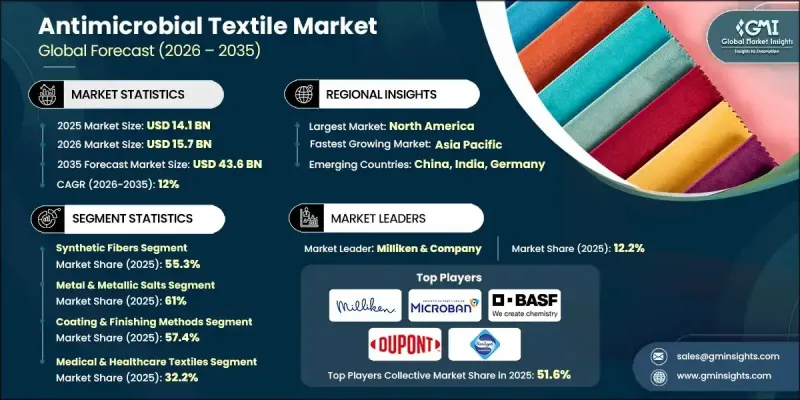
The market growth is fueled by rising awareness of hygiene, infection control, and consumer demand for safe, long-lasting fabrics. Manufacturers are increasingly embedding antimicrobial agents into textiles to enhance durability, prevent microbial growth, and reduce odor. Synthetics dominate the market due to their superior durability, moisture management, and adaptability to advanced antimicrobial coatings. Natural fibers are rapidly gaining traction for their comfort, breathability, and biodegradability, and are expected to capture over 30% of the market by 2035. While many technical textiles utilize synthetic compounds such as Quaternary Ammonium Compounds and Triclosan, demand for bio-based antimicrobial agents is surging with the emphasis on sustainability. Medical and healthcare applications remain the largest segment, followed by apparel, home, commercial, and specialty textiles. North America leads adoption due to advanced healthcare systems, Europe focuses on hygiene and sustainability, while Asia-Pacific grows fastest because of strong textile manufacturing and rising healthcare standards.
| Market Scope | |
|---|---|
| Start Year | 2025 |
| Forecast Year | 2026-2035 |
| Start Value | $14.1 Billion |
| Forecast Value | $43.6 Billion |
| CAGR | 12% |
The synthetic fibers segment held a 55.3% share in 2025 and is projected to grow at a CAGR of 13.2% through 2035. Their performance-enhancing features, including durability, moisture control, and compatibility with advanced antimicrobial coatings, make them ideal for sportswear, hospital textiles, and technical fabrics.
The coatings and finishing methods segment held 57.4% share in 2025 and is expected to grow at a CAGR of 11% by 2035. These post-manufacturing treatments distribute antimicrobial agents evenly across fabric surfaces, protecting against bacterial growth and working effectively with natural, synthetic, and blended textiles for applications spanning healthcare, clothing, and home products.
North America Antimicrobial Textile Market generated USD 4.5 billion in 2025. Adoption is driven by advanced healthcare infrastructure, stringent hygiene regulations, and growing consumer awareness about infection prevention. Hospitals, laboratories, and sportswear manufacturers are primary consumers, prompting continued innovation in functional fibers and finishing technologies to sustain market dynamics.
Major players operating in the Global Antimicrobial Textile Market include BASF SE, Clariant AG, DuPont de Nemours Inc., Fuji Chemical Industries, Ltd., Indorama Ventures Public Company Limited, Milliken & Company, Microban International, Polygiene AB, Sanitized AG, and The Dow Chemical Company. To strengthen their presence, companies in the Antimicrobial Textile Market are focusing on strategic R&D investments to develop sustainable, high-performance fibers and coatings, expanding their product portfolios to cover diverse end-use applications, and forging collaborations with textile manufacturers and healthcare institutions. They are also prioritizing geographic expansion into emerging regions, adopting digital marketing and e-commerce channels to reach broader audiences, and implementing advanced manufacturing technologies to enhance production efficiency and cost-effectiveness.
Table of Contents
Chapter 1 Methodology & Scope
- 1.1 Market scope and definition
- 1.2 Research design
- 1.2.1 Research approach
- 1.2.2 Data collection methods
- 1.3 Data mining sources
- 1.3.1 Global
- 1.3.2 Regional/Country
- 1.4 Base estimates and calculations
- 1.4.1 Base year calculation
- 1.4.2 Key trends for market estimation
- 1.5 Primary research and validation
- 1.5.1 Primary sources
- 1.6 Forecast model
- 1.7 Research assumptions and limitations
Chapter 2 Executive Summary
- 2.1 Industry 3600 synopsis
- 2.2 Key market trends
- 2.2.1 Regional
- 2.2.2 Fabric Type
- 2.2.3 Antimicrobial Agent
- 2.2.4 Finishing Technique
- 2.2.5 End Use
- 2.3 TAM Analysis, 2025-2034
- 2.4 CXO perspectives: Strategic imperatives
- 2.4.1 Executive decision points
- 2.4.2 Critical success factors
- 2.5 Future Outlook and Strategic Recommendations
Chapter 3 Industry Insights
- 3.1 Industry ecosystem analysis
- 3.1.1 Supplier landscape
- 3.1.2 Profit margin
- 3.1.3 Value addition at each stage
- 3.1.4 Factor affecting the value chain
- 3.1.5 Disruptions
- 3.2 Industry impact forces
- 3.2.1 Growth drivers
- 3.2.1.1 Rising global focus on hygiene and infection control
- 3.2.1.2 Healthcare and hospital-acquired infection prevention
- 3.2.2 Industry pitfalls and challenges
- 3.2.2.1 High production and treatment costs
- 3.2.2.2 Regulatory and environmental safety concerns
- 3.2.3 Market opportunities
- 3.2.3.1 Eco-friendly and natural antimicrobial agents
- 3.2.3.2 Growth in activewear, sportswear, home-textiles
- 3.2.1 Growth drivers
- 3.3 Growth potential analysis
- 3.4 Regulatory landscape
- 3.4.1 North America
- 3.4.2 Europe
- 3.4.3 Asia Pacific
- 3.4.4 Latin America
- 3.4.5 Middle East & Africa
- 3.5 Porter's analysis
- 3.6 PESTEL analysis
- 3.7 Price trends
- 3.7.1 By region
- 3.7.2 By fiber type
- 3.8 Future market trends
- 3.9 Technology and Innovation landscape
- 3.9.1 Current technological trends
- 3.9.2 Emerging technologies
- 3.10 Patent Landscape
- 3.11 Trade statistics (HS code) ( Note: the trade statistics will be provided for key countries only)
- 3.11.1 Major importing countries
- 3.11.2 Major exporting countries
- 3.12 Sustainability and environmental aspects
- 3.12.1 Sustainable practices
- 3.12.2 Waste reduction strategies
- 3.12.3 Energy efficiency in production
- 3.12.4 Eco-friendly initiatives
- 3.13 Carbon footprint consideration
Chapter 4 Competitive Landscape, 2025
- 4.1 Introduction
- 4.2 Company market share analysis
- 4.2.1 By region
- 4.2.1.1 North America
- 4.2.1.2 Europe
- 4.2.1.3 Asia Pacific
- 4.2.1.4 LATAM
- 4.2.1.5 MEA
- 4.2.1 By region
- 4.3 Company matrix analysis
- 4.4 Competitive analysis of major market players
- 4.5 Competitive positioning matrix
- 4.6 Key developments
- 4.6.1 Mergers & acquisitions
- 4.6.2 Partnerships & collaborations
- 4.6.3 New Product Launches
- 4.6.4 Expansion Plans
Chapter 5 Market Estimates and Forecast, By Fabric Type, 2022-2035 (USD Billion) (Kilo Tons)
- 5.1 Key trends
- 5.2 Natural Fibers
- 5.2.1 Cotton
- 5.2.2 Wool
- 5.2.3 Silk
- 5.2.4 Other Natural Fibers
- 5.3 Synthetic Fibers
- 5.3.1 Polyester
- 5.3.2 Polyamide (Nylon)
- 5.3.3 Polypropylene
- 5.3.4 Other Synthetic Fibers
- 5.4 Blended Fabrics
Chapter 6 Market Estimates and Forecast, By Antimicrobial Agent, 2022-2035 (USD Billion) (Kilo Tons)
- 6.1 Key trends
- 6.2 Metal & Metallic Salts
- 6.2.1 Silver & Silver Nanoparticles
- 6.2.2 Copper & Copper Oxide
- 6.2.3 Zinc Oxide
- 6.2.4 Titanium Dioxide
- 6.2.5 Other Metallic Agents
- 6.3 Synthetic Organic Compounds
- 6.3.1 Quaternary Ammonium Compounds (QACs)
- 6.3.2 Triclosan
- 6.3.3 Polyhexamethylene Biguanide (PHMB)
- 6.3.4 N-Halamines
- 6.3.5 Chlorhexidine
- 6.3.6 Other Synthetic Compounds
- 6.4 Bio-Based Agents
- 6.4.1 Chitosan
- 6.4.2 Plant Extracts
- 6.4.3 Essential Oils
- 6.4.4 Lignin
- 6.4.5 Other Natural Agents
Chapter 7 Market Estimates and Forecast, By Finishing Technique, 2022-2035 (USD Billion) (Kilo Tons)
- 7.1 Key trends
- 7.2 Coating & Finishing Methods
- 7.2.1 Pad-Dry-Cure
- 7.2.2 Spray Coating
- 7.2.3 Dip Coating
- 7.2.4 Others
- 7.3 Incorporation during Fiber Production
- 7.3.1 Melt Spinning
- 7.3.2 Electrospinning
- 7.3.3 Others
- 7.4 Surface Modification Techniques
- 7.4.1 Chemical Grafting
- 7.4.2 Plasma Treatment
- 7.4.3 Sol-Gel Process
- 7.4.4 Layer-by-Layer Assembly
- 7.4.5 Others
Chapter 8 Market Estimates and Forecast, By End Use, 2022-2035 (USD Billion) (Kilo Tons)
- 8.1 Key trends
- 8.2 Medical & Healthcare Textiles
- 8.3 Apparel & Fashion
- 8.4 Home Textiles
- 8.5 Commercial & Industrial Textiles
- 8.6 Technical & Specialty End uses
Chapter 9 Market Estimates and Forecast, By Region, 2022-2035 (USD Billion) (Kilo Tons)
- 9.1 Key trends
- 9.2 North America
- 9.2.1 U.S.
- 9.2.2 Canada
- 9.3 Europe
- 9.3.1 Germany
- 9.3.2 UK
- 9.3.3 France
- 9.3.4 Spain
- 9.3.5 Italy
- 9.3.6 Rest of Europe
- 9.4 Asia Pacific
- 9.4.1 China
- 9.4.2 India
- 9.4.3 Japan
- 9.4.4 Australia
- 9.4.5 South Korea
- 9.4.6 Rest of Asia Pacific
- 9.5 Latin America
- 9.5.1 Brazil
- 9.5.2 Mexico
- 9.5.3 Argentina
- 9.5.4 Rest of Latin America
- 9.6 Middle East and Africa
- 9.6.1 Saudi Arabia
- 9.6.2 South Africa
- 9.6.3 UAE
- 9.6.4 Rest of Middle East and Africa
Chapter 10 Company Profiles
- 10.1 BASF SE
- 10.2 Clariant AG
- 10.3 DuPont de Nemours Inc.
- 10.4 Fuji Chemical Industries, Ltd.
- 10.5 Indorama Ventures Public Company Limited
- 10.6 Milliken & Company
- 10.7 Microban International
- 10.8 Polygiene AB
- 10.9 Sanitized AG
- 10.10 The Dow Chemical Company

