
PUBLISHER: Global Market Insights Inc. | PRODUCT CODE: 1913439

PUBLISHER: Global Market Insights Inc. | PRODUCT CODE: 1913439
Industrial Floor Coatings Market Opportunity, Growth Drivers, Industry Trend Analysis, and Forecast 2026 - 2035
The Global Industrial Floor Coatings Market was valued at USD 6.1 billion in 2025 and is estimated to grow at a CAGR of 7.2% to reach USD 12.3 billion by 2035.
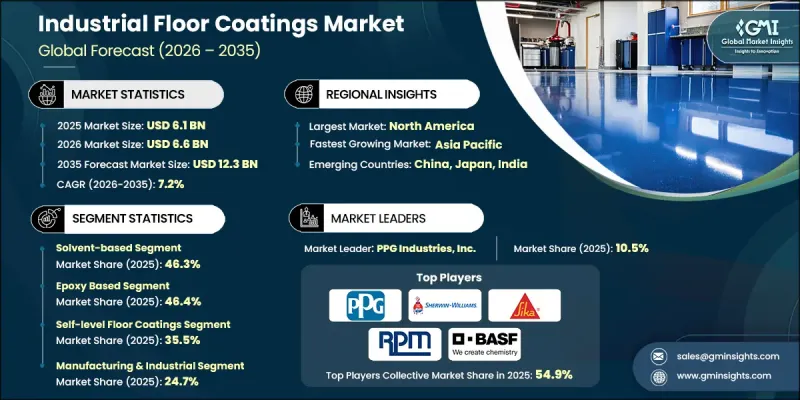
Market growth is driven by the rising demand for high-performance, durable flooring across industrial sectors and the shift toward sustainable coating solutions. Industries are increasingly adopting water-based, low-VOC, and bio-based resin coatings to reduce environmental impact, improve indoor air quality, and maintain durability and chemical resistance standards. The trend toward 100% solids formulations, especially in epoxy and polyurea systems, is gaining traction due to their zero-VOC benefits, superior chemical resistance, and extended service life in heavy-duty applications.
| Market Scope | |
|---|---|
| Start Year | 2025 |
| Forecast Year | 2026-2035 |
| Start Value | $6.1 Billion |
| Forecast Value | $12.3 Billion |
| CAGR | 7.2% |
The epoxy-based coatings segment accounted for a 46.4% share in 2025 owing to their cost-effectiveness and strong chemical resistance, while the overall industrial sector is prioritizing high-performance, environmentally compliant solutions to meet both operational and regulatory requirements.
The solvent-based coatings captured 46.3% share in 2025 and are anticipated to grow at a CAGR of 6.8% by 2035. While these coatings offer excellent adhesion and durability, demand is gradually shifting toward environmentally friendly alternatives due to stricter regulations and higher VOC content. Epoxy-based coatings remain the largest segment, reflecting their continued use in heavy-production and storage areas, whereas polyurethane-based systems are gaining traction for applications requiring flexibility, UV resistance, and thermal shock tolerance, especially in outdoor or high-temperature environments.
North America Industrial Floor Coatings Market generated USD 2.3 billion in 2025. The region benefits from a well-established industrial base, advanced infrastructure, and strict environmental and worker safety regulations. Adoption of low-VOC, environmentally compliant coatings, coupled with refurbishment and modernization of aging industrial facilities, warehouses, and production plants, continues to support market expansion. Regulatory emphasis on hygiene, safety, and sustainability is further driving demand for advanced coating solutions in the region.
Key players operating in the Global Industrial Floor Coatings Market include Akzo Nobel N.V., Axalta Coating Systems, LLC, BASF SE, Hempel A/S, Jotun A/S, MAPEI S.p.A., PPG Industries, Inc., RPM International Inc., Sika AG, and The Sherwin-Williams Company. Companies in the Global Industrial Floor Coatings Market are adopting multiple strategies to reinforce their market presence and growth. These include developing eco-friendly and low-VOC formulations, enhancing product performance with advanced chemical resistance, and expanding geographic reach to emerging industrial hubs. Firms focus on innovation in water-based, 100% solids, and polyurethane systems to meet diverse industrial needs. Collaborations with construction and industrial service providers improve market access, while refurbishment projects in existing industrial facilities boost adoption.
Table of Contents
Chapter 1 Methodology & Scope
- 1.1 Market scope and definition
- 1.2 Research design
- 1.2.1 Research approach
- 1.2.2 Data collection methods
- 1.3 Data mining sources
- 1.3.1 Global
- 1.3.2 Regional/Country
- 1.4 Base estimates and calculations
- 1.4.1 Base year calculation
- 1.4.2 Key trends for market estimation
- 1.5 Primary research and validation
- 1.5.1 Primary sources
- 1.6 Forecast model
- 1.7 Research assumptions and limitations
Chapter 2 Executive Summary
- 2.1 Industry 3600 synopsis
- 2.2 Key market trends
- 2.2.1 Regional
- 2.2.2 Formulation Type
- 2.2.3 Resin Type
- 2.2.4 Technology
- 2.2.5 End Use
- 2.3 TAM Analysis, 2025-2034
- 2.4 CXO perspectives: Strategic imperatives
- 2.4.1 Executive decision points
- 2.4.2 Critical success factors
- 2.5 Future Outlook and Strategic Recommendations
Chapter 3 Industry Insights
- 3.1 Industry ecosystem analysis
- 3.1.1 Supplier landscape
- 3.1.2 Profit margin
- 3.1.3 Value addition at each stage
- 3.1.4 Factor affecting the value chain
- 3.1.5 Disruptions
- 3.2 Industry impact forces
- 3.2.1 Growth drivers
- 3.2.1.1 Growing demand from manufacturing and warehouse facilities
- 3.2.1.2 Rising adoption of hygienic floors in food and pharma sectors
- 3.2.2 Industry pitfalls and challenges
- 3.2.2.1 High initial investment and installation costs for advanced coatings
- 3.2.2.2 Limited performance in extreme temperatures or heavy-load applications
- 3.2.3 Market opportunities
- 3.2.3.1 Adoption of automation in industrial facilities enhances flooring demand
- 3.2.3.2 Growth in emerging economies with infrastructure modernization
- 3.2.1 Growth drivers
- 3.3 Growth potential analysis
- 3.4 Regulatory landscape
- 3.4.1 North America
- 3.4.2 Europe
- 3.4.3 Asia Pacific
- 3.4.4 Latin America
- 3.4.5 Middle East & Africa
- 3.5 Porter's analysis
- 3.6 PESTEL analysis
- 3.7 Price trends
- 3.7.1 By region
- 3.7.2 By resin type
- 3.8 Future market trends
- 3.9 Technology and Innovation landscape
- 3.9.1 Current technological trends
- 3.9.2 Emerging technologies
- 3.10 Patent Landscape
- 3.11 Trade statistics (HS code) (Note: the trade statistics will be provided for key countries only)
- 3.11.1 Major importing countries
- 3.11.2 Major exporting countries
- 3.12 Sustainability and environmental aspects
- 3.12.1 Sustainable practices
- 3.12.2 Waste reduction strategies
- 3.12.3 Energy efficiency in production
- 3.12.4 Eco-friendly initiatives
- 3.13 Carbon footprint consideration
Chapter 4 Competitive Landscape, 2025
- 4.1 Introduction
- 4.2 Company market share analysis
- 4.2.1 By region
- 4.2.1.1 North America
- 4.2.1.2 Europe
- 4.2.1.3 Asia Pacific
- 4.2.1.4 LATAM
- 4.2.1.5 MEA
- 4.2.1 By region
- 4.3 Company matrix analysis
- 4.4 Competitive analysis of major market players
- 4.5 Competitive positioning matrix
- 4.6 Key developments
- 4.6.1 Mergers & acquisitions
- 4.6.2 Partnerships & collaborations
- 4.6.3 New Product Launches
- 4.6.4 Expansion Plans
Chapter 5 Market Estimates and Forecast, By Formulation type, 2022-2035 (USD Billion) (Kilo Tons)
- 5.1 Key trends
- 5.2 Solvent-Based
- 5.3 Water-Based
- 5.4 100% Solids
Chapter 6 Market Estimates and Forecast, By Resin type, 2022-2035 (USD Billion) (Kilo Tons)
- 6.1 Key trends
- 6.2 Epoxy-Based
- 6.3 Polyurethane-Based
- 6.4 MMA
- 6.5 Polyaspartic & Polyurea
- 6.6 Others
Chapter 7 Market Estimates and Forecast, By Technology, 2022-2035 (USD Billion) (Kilo Tons)
- 7.1 Key trends
- 7.2 Self-Leveling
- 7.3 High-Build/Trowel
- 7.4 Thin-Film
- 7.5 Broadcast/Aggregate
Chapter 8 Market Estimates and Forecast, By End Use, 2022-2035 (USD Billion) (Kilo Tons)
- 8.1 Key trends
- 8.2 Manufacturing & Industrial
- 8.2.1 General Manufacturing
- 8.2.2 Metal Working
- 8.2.3 Others
- 8.3 Warehousing & Logistics
- 8.4 Food & Beverage
- 8.4.1 Processing Plants
- 8.4.2 Production Facilities
- 8.4.3 Others
- 8.5 Pharmaceutical & Biotech
- 8.6 Healthcare Facilities
- 8.6.1 Hospitals
- 8.6.2 Laboratories
- 8.7 Automotive Manufacturing
- 8.8 Aerospace & Aviation
- 8.9 Electronics & Semiconductor
- 8.10 Commercial & Retail
- 8.11 Others (educational institutes and government & military facilities)
Chapter 9 Market Estimates and Forecast, By Region, 2022-2035 (USD Billion) (Kilo Tons)
- 9.1 Key trends
- 9.2 North America
- 9.2.1 U.S.
- 9.2.2 Canada
- 9.3 Europe
- 9.3.1 Germany
- 9.3.2 UK
- 9.3.3 France
- 9.3.4 Spain
- 9.3.5 Italy
- 9.3.6 Rest of Europe
- 9.4 Asia Pacific
- 9.4.1 China
- 9.4.2 India
- 9.4.3 Japan
- 9.4.4 Australia
- 9.4.5 South Korea
- 9.4.6 Rest of Asia Pacific
- 9.5 Latin America
- 9.5.1 Brazil
- 9.5.2 Mexico
- 9.5.3 Argentina
- 9.5.4 Rest of Latin America
- 9.6 Middle East and Africa
- 9.6.1 Saudi Arabia
- 9.6.2 South Africa
- 9.6.3 UAE
- 9.6.4 Rest of Middle East and Africa
Chapter 10 Company Profiles
- 10.1 Akzo Nobel N.V.
- 10.2 Axalta Coating Systems, LLC
- 10.3 BASF SE
- 10.4 Hempel A/S
- 10.5 Jotun A/S
- 10.6 MAPEI S.p.A.
- 10.7 PPG Industries, Inc.
- 10.8 RPM International Inc.
- 10.9 Sika AG
- 10.10 The Sherwin-Williams Company

