PUBLISHER: Global Market Insights Inc. | PRODUCT CODE: 1913445

PUBLISHER: Global Market Insights Inc. | PRODUCT CODE: 1913445
Aerosol Market Opportunity, Growth Drivers, Industry Trend Analysis, and Forecast 2026 - 2035
The Global Aerosol Market was valued at USD 98.8 billion in 2025 and is estimated to grow at a CAGR of 6.6% to reach USD 187.4 billion by 2035.
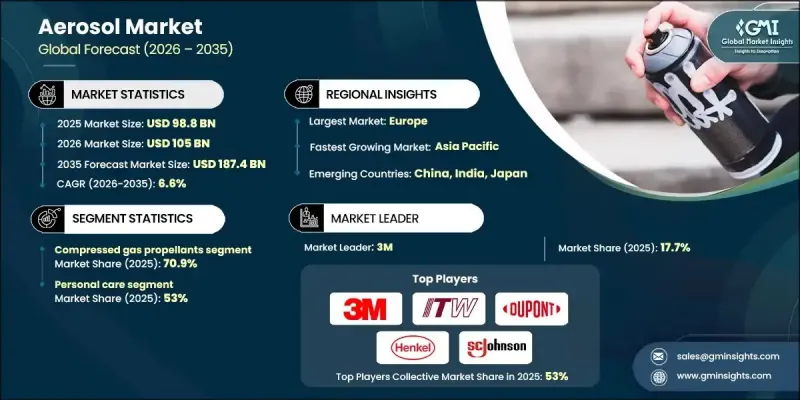
The market includes pressurized dispensing systems designed to release sprays, foams, mists, or gels across a wide range of applications, including personal care, household products, automotive maintenance, industrial uses, food, and pharmaceutical solutions. Aerosol products function using propellants that push contents out of sealed containers made from metal, plastic, or composite materials. These systems are valued for their controlled delivery, hygienic application, and consistent performance. Continuous innovation in packaging formats, propellant chemistry, and container recyclability is supporting market expansion. The industry is steadily transitioning toward lower-emission propellants with reduced environmental impact, alongside advanced dispensing formats that improve product evacuation and usage efficiency. Regulatory pressure aimed at reducing volatile organic compounds and environmental footprint is encouraging reformulation and technology upgrades. As a result, aerosols continue to gain acceptance as precise, convenient, and increasingly sustainable delivery systems across both consumer and professional markets worldwide.
| Market Scope | |
|---|---|
| Start Year | 2025 |
| Forecast Year | 2026-2035 |
| Start Value | $98.8 Billion |
| Forecast Value | $187.4 Billion |
| CAGR | 6.6% |
The compressed gas propellants segment accounted for 70.9% share in 2025. Their compatibility with advanced dispensing systems, ability to deliver accurate dosing, and strong alignment with low-emission objectives have positioned them as a core component of modern aerosol formulations. These gases are widely recognized for having negligible ozone impact and very low or zero global warming potential, depending on formulation, making them a preferred choice in sustainability-driven reformulation strategies.
The personal care applications segment held 53% share in 2025. This segment includes products such as deodorants, hair styling solutions, shaving products, body sprays, sunscreens, and cosmetic sprays. Aerosols in this category are favored for contact-free use, consistent coverage, improved hygiene, and the recyclability of metal containers. Spray-based deodorants hold the largest share within this segment due to ease of application, quick drying performance, lighter skin feel, and longer-lasting freshness.
U.S. Aerosol Market was valued at USD 25.5 billion in 2025 and is projected to reach USD 48.2 billion by 2035. North America accounted for roughly 30.7% of the global market in 2025, supported by strong consumer spending on personal care products, a well-established home maintenance culture, and a structured regulatory environment that emphasizes emission control and material safety. Streamlined recycling classification for aerosol containers has further strengthened collection efficiency and supported higher recycling rates across the region.
Key companies operating in the Global Aerosol Market include SC Johnson, 3M, Henkel Corporation, DuPont, Illinois Tool Works, CRC Industries, European Aerosols, Aramco through its Valvoline business, Pidilite Industries Limited, Rymax Lubricants, Aerol, Chemz Limited, Guangdong Theaoson Technology Co., Ltd, and Zenith Spray and Aerosols Private Limited. Companies in the Global Aerosol Market are reinforcing their competitive position through innovation, sustainability initiatives, and global expansion strategies. Manufacturers are investing in research to develop low-emission propellants, lightweight packaging, and high-efficiency dispensing technologies that meet evolving regulatory standards. Many players are focusing on recyclable materials and improved container recovery to align with circular economy goals. Strategic collaborations with raw material suppliers and brand owners help accelerate product development and market entry.
Table of Contents
Chapter 1 Methodology & Scope
- 1.1 Market scope and definition
- 1.2 Research design
- 1.2.1 Research approach
- 1.2.2 Data collection methods
- 1.3 Data mining sources
- 1.3.1 Global
- 1.3.2 Regional/Country
- 1.4 Base estimates and calculations
- 1.4.1 Base year calculation
- 1.4.2 Key trends for market estimation
- 1.5 Primary research and validation
- 1.5.1 Primary sources
- 1.6 Forecast model
- 1.7 Research assumptions and limitations
Chapter 2 Executive Summary
- 2.1 Industry 3600 synopsis
- 2.2 Key market trends
- 2.2.1 Regional
- 2.2.2 Propellent Type
- 2.2.3 Can Type
- 2.2.4 End use
- 2.3 TAM Analysis, 2025-2034
- 2.4 CXO perspectives: Strategic imperatives
- 2.4.1 Executive decision points
- 2.4.2 Critical success factors
- 2.5 Future Outlook and Strategic Recommendations
Chapter 3 Industry Insights
- 3.1 Industry ecosystem analysis
- 3.1.1 Supplier landscape
- 3.1.2 Profit margin
- 3.1.3 Value addition at each stage
- 3.1.4 Factor affecting the value chain
- 3.1.5 Disruptions
- 3.2 Industry impact forces
- 3.2.1 Growth drivers
- 3.2.2 Industry pitfalls and challenges
- 3.2.3 Market opportunities
- 3.3 Growth potential analysis
- 3.4 Regulatory landscape
- 3.4.1 North America
- 3.4.2 Europe
- 3.4.3 Asia Pacific
- 3.4.4 Latin America
- 3.4.5 Middle East & Africa
- 3.5 Porter's analysis
- 3.6 PESTEL analysis
- 3.7 Price trends
- 3.8 Future market trends
- 3.9 Technology and Innovation landscape
- 3.9.1 Current technological trends
- 3.9.2 Emerging technologies
- 3.10 Patent Landscape
- 3.11 Trade statistics (HS code) ( Note: the trade statistics will be provided for key countries only)
- 3.11.1 Major importing countries
- 3.11.2 Major exporting countries
Chapter 4 Competitive Landscape, 2025
- 4.1 Introduction
- 4.2 Company market share analysis
- 4.2.1 By region
- 4.2.1.1 North America
- 4.2.1.2 Europe
- 4.2.1.3 Asia Pacific
- 4.2.1.4 LATAM
- 4.2.1.5 MEA
- 4.2.1 By region
- 4.3 Company matrix analysis
- 4.4 Competitive analysis of major market players
- 4.5 Competitive positioning matrix
- 4.6 Key developments
- 4.6.1 Mergers & acquisitions
- 4.6.2 Partnerships & collaborations
- 4.6.3 New Product Launches
- 4.6.4 Expansion Plans
Chapter 5 Market Estimates and Forecast, By Propellent Type, 2022-2035 (USD Billion & Million Units)
- 5.1 Key trends
- 5.2 Compressed gas propellants
- 5.3 Liquefied gas propellants
- 5.4 Miscellaneous propellants
Chapter 6 Market Estimates and Forecast, By Can Type, 2022-2035 (USD Billion & Million Units)
- 6.1 Key trends
- 6.2 Aluminum
- 6.3 Steel
- 6.4 Plastic
- 6.5 Others
Chapter 7 Market Estimates and Forecast, By End Use, 2022-2035 (USD Billion & Million Units)
- 7.1 Key trends
- 7.2 Personal Care
- 7.2.1 Hair Care
- 7.2.2 Body Care
- 7.2.3 Facial Care
- 7.2.4 Others
- 7.3 Household
- 7.3.1 Surface & Furniture Cleaners
- 7.3.2 Air Treatment
- 7.3.3 Pest Control
- 7.3.4 Fabric & Laundry Care
- 7.3.5 Others
- 7.4 Medical and Pharmaceutical
- 7.4.1 Inhalation Therapies
- 7.4.2 Nasal & Oral Sprays
- 7.4.3 Topical Drug Delivery
- 7.4.4 Others
- 7.5 Electronics cleaning aerosols
- 7.5.1 Circuit boards
- 7.5.2 Coils
- 7.5.3 Tuners
- 7.5.4 Switches
- 7.5.5 Others
- 7.6 Industrial aerosols
- 7.6.1 Heavy-Duty Lubricants & Greases
- 7.6.2 Paints & Coatings
- 7.6.3 Industrial Cleaners & Degreasers
- 7.6.4 Adhesives & Sealants
- 7.6.5 Maintenance & Repair
- 7.6.6 Others
- 7.7 Automotive
- 7.7.1 Lubricants & Penetrants
- 7.7.2 Paints & Coatings
- 7.7.3 Cleaners & Degreasers
- 7.7.4 Tire & Wheel Products
- 7.7.5 Winter & Specialty
- 7.7.6 Others
- 7.8 Food Products
- 7.8.1 Cooking Sprays
- 7.8.2 Whipped Cream
- 7.8.3 Edible Oils
- 7.8.4 Others
Chapter 8 Market Estimates and Forecast, By Region, 2022-2035 (USD Billion & Million Units)
- 8.1 Key trends
- 8.2 North America
- 8.2.1 U.S.
- 8.2.2 Canada
- 8.3 Europe
- 8.3.1 Germany
- 8.3.2 UK
- 8.3.3 France
- 8.3.4 Spain
- 8.3.5 Italy
- 8.3.6 Rest of Europe
- 8.4 Asia Pacific
- 8.4.1 China
- 8.4.2 India
- 8.4.3 Japan
- 8.4.4 Australia
- 8.4.5 South Korea
- 8.4.6 Rest of Asia Pacific
- 8.5 Latin America
- 8.5.1 Brazil
- 8.5.2 Mexico
- 8.5.3 Argentina
- 8.5.4 Rest of Latin America
- 8.6 Middle East and Africa
- 8.6.1 Saudi Arabia
- 8.6.2 South Africa
- 8.6.3 UAE
- 8.6.4 Rest of Middle East and Africa
Chapter 9 Company Profiles
- 9.1 3M
- 9.2 Illinois Tool Works
- 9.3 DuPont
- 9.4 Henkel Corporation.
- 9.5 SC Johnson
- 9.6 Aramco (Valvoline)
- 9.7 Pidilite Industries Limited
- 9.8 CRC Industries
- 9.9 European Aerosols
- 9.10 Aerol
- 9.11 Rymax Lubricants
- 9.12 Chemz Limited
- 9.13 Guangdong Theaoson Technology Co.,Ltd
- 9.14 Zenith Spray and Aerosols Private Limited

