
PUBLISHER: Global Market Insights Inc. | PRODUCT CODE: 1913475

PUBLISHER: Global Market Insights Inc. | PRODUCT CODE: 1913475
Edge Data Center Market Opportunity, Growth Drivers, Industry Trend Analysis, and Forecast 2026 - 2035
The Global Edge Data Center Market was valued at USD 14.7 billion in 2025 and is estimated to grow at a CAGR of 17.5% to reach USD 71.9 billion by 2035.
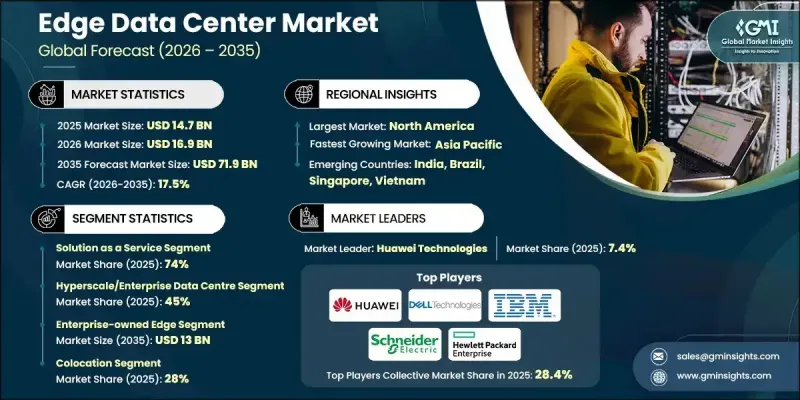
Market expansion reflects the accelerating demand for low-latency digital infrastructure as real-time computing requirements continue to rise across connected ecosystems. Organizations increasingly require computing resources to be deployed closer to end users and data generation points to support instantaneous data processing, faster response times, and uninterrupted service delivery. The rapid rollout of next-generation connectivity and distributed computing frameworks is reshaping infrastructure strategies, encouraging decentralized architectures that reduce reliance on centralized cloud facilities. As data volumes surge, localized processing enables enterprises to manage workloads more efficiently while reducing network congestion and improving operational continuity. Artificial intelligence adoption is further reinforcing the need for geographically distributed computing, as near-source inference enhances speed, accuracy, and reliability. Additionally, compliance requirements related to data residency and governance are pushing enterprises and public institutions to store and process information within defined geographic boundaries, reinforcing the strategic importance of edge data centers in modern digital ecosystems.
| Market Scope | |
|---|---|
| Start Year | 2025 |
| Forecast Year | 2026-2035 |
| Start Value | $14.7 Billion |
| Forecast Value | $71.9 Billion |
| CAGR | 17.5% |
The solution-as-a-service segment accounted for 74% share in 2025 and is forecast to reach USD 50.3 billion by 2035. This dominance is driven by demand for integrated platforms that enable seamless coordination across distributed infrastructure while ensuring consistent performance, scalability, and operational resilience.
The hyperscale and enterprise data center segment held a 45% share in 2025 and is expected to reach USD 32.1 billion by 2035. Large operators continue to deploy smaller, distributed facilities closer to population and data hubs to improve latency performance, workload resilience, and computing efficiency.
China Edge Data Center Market is projected to reach USD 9.7 billion by 2035. Policy support, digital infrastructure expansion, and national technology initiatives are accelerating localized data processing investments.
Key companies active in the Global Edge Data Center Market include Schneider Electric, Dell Technologies, Vertiv, Huawei Technologies, Hewlett Packard Enterprise Company, Eaton, IBM, Fujitsu, EdgeConnex, Rittal, Flexential, Vapor, and EdgePresence. Companies operating in the Global Edge Data Center Market are strengthening their market position through strategic infrastructure expansion, modular deployment models, and technology integration. Providers are investing in scalable and standardized solutions to accelerate deployment timelines and reduce operational complexity. Partnerships with telecom operators, cloud platforms, and enterprise clients support ecosystem integration and long-term contracts. Firms are also prioritizing energy efficiency, automation, and remote management capabilities to improve reliability and cost performance.
Table of Contents
Chapter 1 Methodology
- 1.1 Market scope and definition
- 1.2 Research design
- 1.2.1 Research approach
- 1.2.2 Data collection methods
- 1.3 Data mining sources
- 1.3.1 Global
- 1.3.2 Regional/Country
- 1.4 Base estimates and calculations
- 1.4.1 Base year calculation
- 1.4.2 Key trends for market estimation
- 1.5 Primary research and validation
- 1.5.1 Primary sources
- 1.6 Forecast
- 1.7 Research assumptions and limitations
Chapter 2 Executive Summary
- 2.1 Industry 360° synopsis, 2022 - 2035
- 2.2 Key market trends
- 2.2.1 Regional
- 2.2.2 Component
- 2.2.3 Data center size
- 2.2.4 Ownership
- 2.2.5 Rack count
- 2.2.6 Application
- 2.3 TAM Analysis, 2026-2035
- 2.4 CXO perspectives: Strategic imperatives
- 2.4.1 Executive decision points
- 2.4.2 Critical success factors
- 2.5 Future outlook & strategic recommendations
Chapter 3 Industry Insights
- 3.1 Industry ecosystem analysis
- 3.1.1 Supplier landscape
- 3.1.2 Profit margin analysis
- 3.1.3 Cost structure
- 3.1.4 Value addition at each stage
- 3.1.5 Factor affecting the value chain
- 3.1.6 Disruptions
- 3.2 Industry impact forces
- 3.2.1.1 Growth drivers
- 3.2.1.2 Ultra-low latency requirements
- 3.2.1.3 5G and MEC expansion
- 3.2.1.4 AI inference at edge
- 3.2.1.5 IoT and sensor proliferation
- 3.2.1.6 Data sovereignty compliance
- 3.2.2 Industry pitfalls and challenges
- 3.2.2.1 High infrastructure deployment costs
- 3.2.2.2 Security and management complexity
- 3.2.3 Market opportunities
- 3.2.3.1 Edge AI and automation growth
- 3.2.3.2 Smart city infrastructure expansion
- 3.2.3.3 Multi-tenant edge colocation
- 3.2.3.4 Hyperscaler-telco edge partnerships
- 3.3 Growth potential analysis
- 3.4 Regulatory landscape
- 3.4.1 North America
- 3.4.1.1 U.S. - California Consumer Privacy Act
- 3.4.1.2 Canada - Personal Information Protection and Electronic Documents Act
- 3.4.2 Europe
- 3.4.2.1 UK - Data Protection Act
- 3.4.2.2 Germany - Federal Data Protection Act
- 3.4.2.3 France - Digital Republic Act
- 3.4.2.4 Italy - Personal Data Protection Code
- 3.4.2.5 Spain - Organic Law on Data Protection and Digital Rights
- 3.4.3 Asia Pacific
- 3.4.3.1 China - Personal Information Protection Law
- 3.4.3.2 Japan - Act on the Protection of Personal Information
- 3.4.3.3 India - Digital Personal Data Protection Act
- 3.4.4 Latin America
- 3.4.4.1 Brazil - General Data Protection Law
- 3.4.4.2 Mexico - Federal Law on Protection of Personal Data Held by Private Parties
- 3.4.4.3 Argentina - Personal Data Protection Law
- 3.4.5 Middle East & Africa
- 3.4.5.1 UAE - Personal Data Protection Law
- 3.4.5.2 South Africa - Protection of Personal Information Act
- 3.4.5.3 Saudi Arabia - Personal Data Protection Law
- 3.4.1 North America
- 3.5 Porter's analysis
- 3.6 PESTEL analysis
- 3.7 Technology and innovation landscape
- 3.7.1 Current technological trends
- 3.7.2 Emerging technologies
- 3.8 Cost breakdown analysis
- 3.8.1 Development cost structure
- 3.8.2 R&D cost analysis
- 3.8.3 Marketing & sales costs
- 3.9 Patent analysis
- 3.10 Sustainability and environmental aspects
- 3.10.1 Sustainable practices
- 3.10.2 Waste reduction strategies
- 3.10.3 Energy efficiency in production
- 3.10.4 Eco-friendly Initiatives
- 3.11 Edge deployment models & topology framework
- 3.11.1 On-premise, near-edge & far-edge architectures
- 3.11.2 Network edge vs compute edge vs data edge
- 3.11.3 Urban vs rural deployment considerations
- 3.12 Edge vs hyperscale dynamics
- 3.13 Edge operations, remote management & reliability risks
- 3.14 Interconnection & network dependency analysis
- 3.15 Future edge architecture evolution
- 3.15.1 AI-native edge infrastructure
- 3.15.2 Convergence of edge, cloud and network functions
- 3.15.3 Long-term implications of sovereign and regulated edge
Chapter 4 Competitive Landscape, 2025
- 4.1 Introduction
- 4.2 Company market share analysis
- 4.2.1 North America
- 4.2.2 Europe
- 4.2.3 Asia Pacific
- 4.2.4 LATAM
- 4.2.5 MEA
- 4.3 Competitive analysis of major market players
- 4.4 Competitive positioning matrix
- 4.5 Strategic outlook matrix
- 4.6 Key developments
- 4.6.1 Mergers & acquisitions
- 4.6.2 Partnerships & collaborations
- 4.6.3 New Product Launches
- 4.6.4 Expansion Plans and funding
Chapter 5 Market Estimates & Forecast, By Component, 2022 - 2035 ($Bn)
- 5.1 Key trends
- 5.2 Solution
- 5.3 Service
Chapter 6 Market Estimates & Forecast, By Data Center Size, 2022 - 2035 ($Bn)
- 6.1 Key trends
- 6.2 Micro Data Center
- 6.3 Hyperscale/Enterprise Data Center
- 6.4 Others
Chapter 7 Market Estimates & Forecast, By Ownership, 2022 - 2035 ($Bn)
- 7.1 Key trends
- 7.2 Telecom operator edge
- 7.3 Hyperscale cloud edge
- 7.4 Enterprise-owned edge
- 7.5 CDN provider edge
Chapter 8 Market Estimates & Forecast, By Rack Count, 2022-2035 (USD Mn)
- 8.1 Key trends
- 8.2 Small (1-10 racks)
- 8.3 Medium (10-100 racks)
- 8.4 Large (>100 racks)
Chapter 9 Market Estimates & Forecast, By Application, 2022 - 2035 (USD Mn)
- 9.1 Key trends
- 9.2 BFSI
- 9.3 Colocation
- 9.4 Energy
- 9.5 Government
- 9.6 Healthcare
- 9.7 Manufacturing
- 9.8 IT & Telecom
- 9.9 Others
Chapter 10 Market Estimates & Forecast, By Region, 2022 - 2035 (USD Mn)
- 10.1 Key trends
- 10.2 North America
- 10.2.1 US
- 10.2.2 Canada
- 10.3 Europe
- 10.3.1 Germany
- 10.3.2 UK
- 10.3.3 France
- 10.3.4 Italy
- 10.3.5 Spain
- 10.3.6 Russia
- 10.3.7 Nordics
- 10.3.8 Portugal
- 10.3.9 Croatia
- 10.3.10 Benelux
- 10.4 Asia Pacific
- 10.4.1 China
- 10.4.2 India
- 10.4.3 Japan
- 10.4.4 Australia
- 10.4.5 South Korea
- 10.4.6 Singapore
- 10.4.7 Thailand
- 10.4.8 Indonesia
- 10.4.9 Vietnam
- 10.5 Latin America
- 10.5.1 Brazil
- 10.5.2 Mexico
- 10.5.3 Argentina
- 10.5.4 Colombia
- 10.6 MEA
- 10.6.1 South Africa
- 10.6.2 Saudi Arabia
- 10.6.3 UAE
- 10.6.4 Turkey
Chapter 11 Company Profiles
- 11.1 Global Players
- 11.1.1 Dell Technologies
- 11.1.2 IBM
- 11.1.3 Huawei Technologies
- 11.1.4 Hewlett Packard Enterprise Company
- 11.1.5 Eaton
- 11.1.6 Vertiv
- 11.1.7 Fujitsu
- 11.1.8 Schneider Electric
- 11.1.9 Cisco Systems
- 11.1.10 Oracle
- 11.2 Regional Players
- 11.2.1 Rittal
- 11.2.2 Flexential
- 11.2.3 EdgeConnex
- 11.2.4 NTT
- 11.2.5 Equinix
- 11.2.6 a. Digital Realty
- 11.2.7 CyrusOne
- 11.2.8 QTS Realty Trust
- 11.2.9 CoreSite Realty
- 11.2.10 Interxion
- 11.3 Emerging / Disruptor Players
- 11.3.1. 365 Operating Company
- 11.3.2 Vapor IO
- 11.3.3 EdgePresence
- 11.3.4 Vantage Data Centers
- 11.3.5 EdgeMicro
- 11.3.6 Compass Data Centers
- 11.3.7 Aligned Energy
- 11.3.8 Cologix
- 11.3.9 DataBank

