
PUBLISHER: Global Market Insights Inc. | PRODUCT CODE: 1928894

PUBLISHER: Global Market Insights Inc. | PRODUCT CODE: 1928894
Body Worn Insect Repellent Market Opportunity, Growth Drivers, Industry Trend Analysis, and Forecast 2026 - 2035
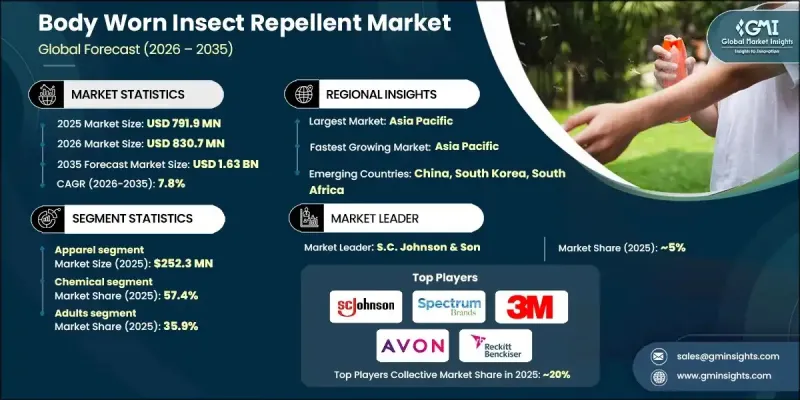
The Global Body Worn Insect Repellent Market was valued at USD 791.9 million in 2025 and is estimated to grow at a CAGR of 7.8% to reach USD 1.63 billion by 2035.
The rising popularity of outdoor activities such as hiking, camping, and adventure sports, combined with rapid growth in global tourism, has fueled demand for personal insect protection solutions. Consumers increasingly seek products that provide reliable protection against harmful insects while complementing their lifestyle and personal aesthetics. The growing awareness of insect-borne illnesses, particularly in tropical and subtropical regions, has further amplified interest in body-worn repellents. Vector-borne diseases like malaria, dengue, Zika, and Lyme disease are driving adoption, especially in regions of Asia-Pacific and Africa where prevalence is high. Public health campaigns promoting preventive measures are supporting market expansion, while the combination of convenience, functionality, and lifestyle integration is encouraging regular usage among tourists, adventure enthusiasts, and professionals in high-risk environments.
| Market Scope | |
|---|---|
| Start Year | 2025 |
| Forecast Year | 2026-2035 |
| Start Value | $791.9 Million |
| Forecast Value | $1.63 Billion |
| CAGR | 7.8% |
The apparel-based insect repellents segment accounted for USD 252.3 million in 2025 and is expected to grow at a CAGR of 7.6% through 2035. Treated clothing remains popular because it offers extended protection without repeated applications. This segment attracts outdoor enthusiasts, travelers, and individuals working in high-risk areas, as it merges practical protection with convenience. The fashion-forward positioning of treated apparel and adoption in disease-prone regions strengthen its market appeal.
The chemical repellents segment held a 57.4% share in 2025 and is projected to grow at a CAGR of 7.6% from 2026 to 2035. These products, containing active ingredients such as DEET, picaridin, and IR3535, are preferred due to their proven effectiveness and durable protection against diverse insects. They are often recommended by health authorities and trusted by consumers in regions with high vector-borne disease transmission, making them the primary choice for travelers and professionals in endemic zones.
United States Body Worn Insect Repellent Market reached USD 198.3 million in 2025 and is expected to grow at a CAGR of 8.1% through 2035. High consumer awareness, disposable income, and a strong outdoor lifestyle contribute to consistent demand. Widespread retail distribution and e-commerce accessibility further enhance market penetration. Concerns about mosquito-borne illnesses such as the West Nile virus also reinforce the adoption of body-worn insect repellents across the country.
Leading companies in the Global Body Worn Insect Repellent Market include Burt's Bees, S.C. Johnson & Son, Coleman, ThermaCELL, 3M Company, Insect Shield, Avon Products Inc., Ecolab, Sawyer Products, Mosquito Squad, Para'Kito, Cascadia Essentials, ExOfficio, Spectrum Brands, and Reckitt Benckiser. Market leaders are strengthening their foothold by investing in innovative, long-lasting, and safe formulations that appeal to both casual consumers and professionals. Companies focus on expanding their apparel-based and chemical repellent offerings to address different lifestyle needs and climatic conditions. Collaborations with tourism and outdoor activity brands, combined with targeted marketing campaigns, increase visibility and adoption. Additionally, firms emphasize compliance with regulatory standards, sustainability initiatives, and product certifications to boost consumer trust.
Table of Contents
Chapter 1 Methodology & Scope
- 1.1 Market scope & definitions
- 1.2 Research design
- 1.2.1 Research approach
- 1.2.2 Data collection methods
- 1.3 Base estimates and calculations
- 1.3.1 Base year calculation
- 1.3.2 Market estimates & forecasts parameters
- 1.4 Forecast Model
- 1.4.1 Key trends for market estimates
- 1.4.2 Quantified market impact analysis
- 1.4.2.1 Mathematical impact of growth parameters on forecast
- 1.4.3 Scenario analysis framework
- 1.5 Primary research and validation
- 1.5.1 Some of the primary sources (but not limited to)
- 1.6 Data mining sources
- 1.6.1 Paid Sources
- 1.7 Primary research and validation
- 1.7.1 Primary sources
- 1.8 Research Trail & confidence scoring
- 1.8.1 Research trail components
- 1.8.2 Scoring components
- 1.9 Research transparency addendum
- 1.9.1 Source attribution framework
- 1.9.2 Quality assurance metrics
- 1.9.3 Our commitment to trust
- 1.10 Market Definitions
Chapter 2 Executive Summary
- 2.1 Industry 360° synopsis
- 2.2 Key market trends
- 2.2.1 Regional
- 2.2.2 Product type
- 2.2.3 Ingredient
- 2.2.4 Price Range
- 2.2.5 Application
- 2.2.6 End User
- 2.2.7 Distribution channels
- 2.3 CXO perspectives: Strategic imperatives
- 2.3.1 Key decision points for industry executives
- 2.3.2 Critical success factors for market players
- 2.4 Future outlook and strategic recommendations
Chapter 3 Industry Insights
- 3.1 Industry ecosystem analysis
- 3.1.1 Supplier landscape
- 3.1.2 Profit margin
- 3.1.3 Value addition at each stage
- 3.1.4 Factor affecting the value chain
- 3.2 Industry impact forces
- 3.2.1 Growth drivers
- 3.2.1.1 Outdoor lifestyle & travel boom
- 3.2.1.2 Rising incidence of vector-borne diseases
- 3.2.1.3 Preference for eco-friendly & natural products
- 3.2.2 Pitfalls & Challenges
- 3.2.2.1 Regulatory compliance & safety concerns
- 3.2.2.2 Price sensitivity
- 3.2.3 Opportunities
- 3.2.3.1 Smart wearable integration
- 3.2.3.2 Expansion in high-risk regions
- 3.2.1 Growth drivers
- 3.3 Growth potential analysis
- 3.4 Future market trends
- 3.5 Technology and innovation landscape
- 3.5.1 Current technological trends
- 3.5.2 Emerging technologies
- 3.6 Price trends
- 3.6.1 By region
- 3.6.2 By product
- 3.7 Regulatory landscape
- 3.7.1 North America
- 3.7.1.1 US: Consumer Product Safety Commission (CPSC) 16 Code of Federal Regulations (CFR) part 1512
- 3.7.1.2 Canada: International Organization for Standardization (ISO) 4210
- 3.7.2 Europe
- 3.7.2.1 Germany: Deutsches Institut fur Normung (DIN) European Norm (EN) ISO 4210
- 3.7.2.2 UK: European Norm (EN) ISO 4210 / United Kingdom Conformity Assessed (UKCA)
- 3.7.2.3 France: European Norm (EN) ISO 4210
- 3.7.3 Asia Pacific
- 3.7.3.1 China: Guobiao (GB) 3565
- 3.7.3.2 India: Indian Standard (IS) 10613
- 3.7.3.3 Japan: Japanese Industrial Standard (JIS) D 9110
- 3.7.4 Latin America
- 3.7.4.1 Brazil: Associacao Brasileira de Normas Tecnicas (ABNT) Norma Brasileira (NBR) ISO 4210
- 3.7.4.2 Mexico: International Organization for Standardization (ISO) 4210
- 3.7.5 Middle East & Africa
- 3.7.5.1 South Africa: South African National Standard (SANS) 311
- 3.7.5.2 Saudi Arabia: Saudi Standards, Metrology and Quality Organization (SASO) Gulf Standardization Organization (GSO) ISO 4210
- 3.7.1 North America
- 3.8 Trade statistics (HS Code - 3307.20)
- 3.8.1 Major importing countries
- 3.8.2 Major exporting countries
- 3.9 Porter';s analysis
- 3.10 PESTEL analysis
Chapter 4 Competitive Landscape, 2025
- 4.1 Introduction
- 4.2 Company market share analysis
- 4.2.1 By Region
- 4.2.1.1 North America
- 4.2.1.2 Europe
- 4.2.1.3 Asia Pacific
- 4.2.1.4 Latin America
- 4.2.1.5 Middle East & Africa
- 4.2.1 By Region
- 4.3 Company matrix analysis
- 4.4 Competitive analysis of major market players
- 4.5 Competitive positioning matrix
- 4.6 Key developments
- 4.6.1 Mergers & acquisitions
- 4.6.2 Partnerships & collaborations
- 4.6.3 New product launches
- 4.6.4 Expansion plans
Chapter 5 Market Estimates & Forecast, By Product Type, 2022 - 2035, (USD Million) (Thousand Units)
- 5.1 Key trends
- 5.2 Apparel
- 5.3 Sprays
- 5.4 Oils & creams
- 5.5 Stickers & patches
- 5.6 Roll ons
- 5.7 Wipes & towelettes
- 5.8 Wearable devices
- 5.9 Others
Chapter 6 Market Estimates & Forecast, By Ingredient, 2022 - 2035, (USD Million) (Thousand Units)
- 6.1 Key trends
- 6.2 Natural
- 6.3 Chemical
Chapter 7 Market Estimates & Forecast, By Price Range, 2022 - 2035, (USD Million) (Thousand Units)
- 7.1 Key trends
- 7.2 Low
- 7.3 Medium
- 7.4 High
Chapter 8 Market Estimates & Forecast, By End User, 2022 - 2035, (USD Million) (Thousand Units)
- 8.1 Key trends
- 8.2 Adults
- 8.3 Children
- 8.4 Travelers
- 8.5 Military personnel
- 8.6 Healthcare/industrial users
Chapter 9 Market Estimates & Forecast, By Application, 2022 - 2035, (USD Million) (Thousand Units)
- 9.1 Key trends
- 9.2 Mosquitoes
- 9.3 Ticks
- 9.4 Fleas
- 9.5 Outdoor activities (camping, hiking, sports)
- 9.6 Travel & tourism
- 9.7 Home use
- 9.8 Commercial/industrial
Chapter 10 Market Estimates & Forecast, By Distribution Channel, 2022 - 2035, (USD Million) (Thousand Units)
- 10.1 Key trends
- 10.2 Online
- 10.2.1 E-commerce
- 10.2.2 Company websites
- 10.3 Offline
- 10.3.1 Supermarkets/hypermarkets
- 10.3.2 Specialty stores
- 10.3.3 Others (pharmacies, etc.)
Chapter 11 Market Estimates & Forecast, By Region, 2022 - 2035, (USD Million) (Thousand Units)
- 11.1 Key trends
- 11.2 North America
- 11.2.1 U.S.
- 11.2.2 Canada
- 11.3 Europe
- 11.3.1 Germany
- 11.3.2 UK
- 11.3.3 France
- 11.3.4 Italy
- 11.3.5 Spain
- 11.4 Asia Pacific
- 11.4.1 China
- 11.4.2 India
- 11.4.3 Japan
- 11.4.4 South Korea
- 11.4.5 Australia
- 11.5 Latin America
- 11.5.1 Brazil
- 11.5.2 Mexico
- 11.5.3 Argentina
- 11.6 MEA
- 11.6.1 Saudi Arabia
- 11.6.2 UAE
- 11.6.3 South Africa
Chapter 12 Company Profiles
- 12.1 3M Company
- 12.2 Avon Products Inc.
- 12.3 Burt’s Bees
- 12.4 Cascadia Essentials
- 12.5 Coleman
- 12.6 Ecolab
- 12.7 ExOfficio
- 12.8 Insect Shield
- 12.9 Mosquito Squad
- 12.10 Para'Kito
- 12.11 Reckitt Benckiser
- 12.12 S.C. Johnson & Son
- 12.13 Sawyer Products
- 12.14 Spectrum Brands
- 12.15 ThermaCELL

