PUBLISHER: Global Market Insights Inc. | PRODUCT CODE: 1928922

PUBLISHER: Global Market Insights Inc. | PRODUCT CODE: 1928922
Advanced Tires Market Opportunity, Growth Drivers, Industry Trend Analysis, and Forecast 2026 - 2035
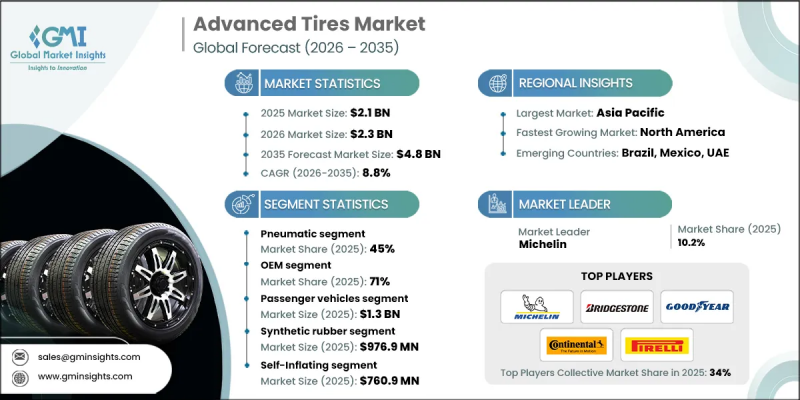
The global advanced tires market was valued at USD 1.8 billion in 2024 and is projected to grow at a CAGR of 8.8% between 2025 and 2034, driven by rapid advancements in automotive technology and the increasing demand for high-performance tires. As the automotive sector transitions toward electric vehicles (EVs), manufacturers are focusing on next-generation tires that enhance vehicle efficiency, safety, and durability. Advanced tires incorporate intelligent monitoring systems, predictive maintenance technologies, and low rolling resistance designs to optimize vehicle performance and energy efficiency. These innovations are crucial for electric and autonomous vehicles, ensuring extended battery life, superior road safety, and minimal maintenance. The rising demand for sustainable and technologically advanced transportation solutions is driving automakers and tire manufacturers to collaborate on cutting-edge tire developments that align with the future of mobility.
Smart tires equipped with embedded sensors are gaining traction across commercial and personal vehicle fleets. These sensors provide real-time data on critical performance metrics such as tire pressure, temperature, and tread wear, enabling predictive maintenance and reducing the risk of blowouts. Enhanced safety features and improved fuel efficiency make smart tires a preferred choice among fleet operators and individual consumers. The increasing integration of telematics and vehicle diagnostics into tire technology further supports market growth as manufacturers continue to develop solutions that improve vehicle uptime and on-road performance.
| Market Scope | |
|---|---|
| Start Year | 2025 |
| Forecast Year | 2026-2035 |
| Start Value | $2.1 Billion |
| Forecast Value | $4.8 Billion |
| CAGR | 8.8% |
Segmented by vehicle type, the market sees light-duty vehicles holding a major revenue share. In 2024, this segment was valued at USD 800 million, with expectations of substantial growth due to the rising adoption of EVs. Advanced tires specifically designed for electric models focus on reducing rolling resistance, which directly impacts energy efficiency and driving range. By integrating intelligent monitoring systems, these tires offer real-time tracking of tire conditions, helping drivers maintain optimal performance and safety. Automakers are prioritizing investments in high-efficiency tire solutions that cater to evolving consumer preferences and regulatory requirements.
Based on sales channels, the advanced tires market is divided into OEM and aftermarket, with OEMs dominating at a 71% share in 2024. Automakers are increasingly integrating smart tire technologies into new vehicle models, equipping them with real-time pressure monitoring, automated diagnostics, and predictive maintenance capabilities. These advanced features enhance overall vehicle performance while supporting the push toward connected and autonomous driving. The growing emphasis on vehicle automation is accelerating the adoption of intelligent tire systems that require minimal maintenance while maximizing safety and efficiency. By leveraging these innovations, automakers can offer enhanced user experiences and refine their vehicle performance strategies.
The Asia Pacific region accounted for 40% of the global advanced tires market in 2024, driven by large-scale infrastructure developments and the booming automotive industry. China emerged as the leading contributor, generating USD 250 million in regional revenue. The rapid expansion of the construction sector, increasing investments in transportation networks, and strong production capabilities are fueling demand for durable, high-performance tires. As technological advancements continue to shape the industry, growing collaborations between automakers and tire manufacturers are expected to drive sustained market growth in the coming years.
Table of Contents
Chapter 1 Methodology & Scope
- 1.1 Market scope and definition
- 1.2 Research design
- 1.2.1 Research approach
- 1.2.2 Data collection methods
- 1.3 Data mining sources
- 1.3.1 Global
- 1.3.2 Regional/Country
- 1.4 Base estimates and calculations
- 1.4.1 Base year calculation
- 1.4.2 Key trends for market estimation
- 1.5 Primary research and validation
- 1.5.1 Primary sources
- 1.6 Forecast
- 1.7 Research assumptions and limitations
Chapter 2 Executive Summary
- 2.1 Industry 360° synopsis, 2022 - 2035
- 2.2 Key market trends
- 2.2.1 Regional
- 2.2.2 Tire
- 2.2.3 Vehicle
- 2.2.4 Material
- 2.2.5 Technology
- 2.2.6 Sales Channel
- 2.3 TAM Analysis, 2026-2035
- 2.4 CXO perspectives: Strategic imperatives
- 2.4.1 Executive decision points
- 2.4.2 Critical success factors
- 2.5 Future outlook and strategic recommendations
Chapter 3 Industry Insights
- 3.1 Industry ecosystem analysis
- 3.1.1 Supplier Landscape
- 3.1.2 Profit Margin
- 3.1.3 Cost structure
- 3.1.4 Value addition at each stage
- 3.1.5 Factor affecting the value chain
- 3.1.6 Disruptions
- 3.2 Industry impact forces
- 3.2.1 Growth drivers
- 3.2.1.1 Rising electric & hybrid vehicle adoption
- 3.2.1.2 Growing demand for safety & vehicle performance
- 3.2.1.3 Technological advancements in tire design
- 3.2.1.4 Expansion of global vehicle production & mobility services
- 3.2.2 Industry pitfalls and challenges
- 3.2.2.1 High development & manufacturing costs
- 3.2.2.2 Limited consumer awareness & infrastructure readiness
- 3.2.3 Market opportunities
- 3.2.3.1 Growth of Smart & Connected Vehicle Ecosystems
- 3.2.3.2 Rising Demand for Sustainable & Eco-Friendly Tires
- 3.2.3.3 Technological Advancements in Materials and Design
- 3.2.3.4 OEM Collaborations and Platform-Based Deployments
- 3.2.1 Growth drivers
- 3.3 Growth potential analysis
- 3.4 Regulatory landscape
- 3.4.1 North America
- 3.4.1.1 U.S. Federal Motor Vehicle Safety Standards (FMVSS)
- 3.4.1.2 Canada Motor Vehicle Safety Standards (CMVSS)
- 3.4.2 Europe
- 3.4.2.1 Germany TUV & BaFin Compliance
- 3.4.2.2 France DGITM Guidelines
- 3.4.2.3 UK Vehicle Certification Agency (VCA) Regulations
- 3.4.2.4 Italy Ministry of Infrastructure & Transport Compliance
- 3.4.3 Asia Pacific
- 3.4.3.1 China MIIT Guidelines
- 3.4.3.2 Japan MLIT Standards
- 3.4.3.3 South Korea MOLIT Regulations
- 3.4.3.4 India Ministry of MoRTH & BIS Guidelines
- 3.4.4 Latin America
- 3.4.4.1 Brazil DENATRAN & ANFAVEA Regulations
- 3.4.4.2 Mexico SCT & NOM Standards
- 3.4.5 Middle East and Africa
- 3.4.5.1 UAE Roads & Transport Authority (RTA) Guidelines
- 3.4.5.2 Saudi Arabia General Authority for Transport (GAT) Regulations
- 3.4.1 North America
- 3.5 Porter';s analysis
- 3.6 PESTEL analysis
- 3.7 Technology and Innovation Landscape
- 3.7.1 Current technological trends
- 3.7.2 Emerging technologies
- 3.8 Price trends
- 3.8.1 By region
- 3.8.2 By product
- 3.9 Cost breakdown analysis
- 3.10 Patent analysis
- 3.11 Sustainability and Environmental Aspects
- 3.11.1 Sustainable practices
- 3.11.2 Waste reduction strategies
- 3.11.3 Energy efficiency in production
- 3.11.4 Eco-friendly initiatives
- 3.11.5 Carbon footprint considerations
- 3.12 Use case scenarios
- 3.13 OEM Integration & Vehicle Platform Alignment
- 3.13.1 OEM co-development & homologation strategy
- 3.13.2 EV & autonomous vehicle tire specifications
- 3.14 EV-Specific Tire Economics & Performance Trade-offs
- 3.15 Fleet & Commercial Adoption Analysis
- 3.16 Manufacturing Process Innovation
Chapter 4 Competitive Landscape, 2025
- 4.1 Introduction
- 4.2 Company market share analysis
- 4.2.1 North America
- 4.2.2 Europe
- 4.2.3 Asia Pacific
- 4.2.4 Latin America
- 4.2.5 Middle East & Africa
- 4.3 Competitive analysis of major market players
- 4.4 Competitive positioning matrix
- 4.5 Strategic outlook matrix
- 4.6 Key developments
- 4.6.1 Mergers & acquisitions
- 4.6.2 Partnerships & collaborations
- 4.6.3 New product launches
- 4.6.4 Expansion plans and funding
Chapter 5 Market Estimates & Forecast, By Tire, 2022 - 2035 ($ Bn, Units)
- 5.1 Key trends
- 5.2 Pneumatic
- 5.3 Airless
- 5.4 Run-flat
- 5.5 Others
Chapter 6 Market Estimates & Forecast, By Vehicle, 2022 - 2035 ($ Bn, Units)
- 6.1 Key trends
- 6.2 Passenger vehicles
- 6.2.1 Hatchbacks
- 6.2.2 Sedans
- 6.2.3 SUV
- 6.3 Commercial vehicles
- 6.3.1 Light commercial vehicles (LCV)
- 6.3.2 Medium commercial vehicles (MCV)
- 6.3.3 Heavy commercial vehicles (HCV)
Chapter 7 Market Estimates & Forecast, By Material, 2022 - 2035 ($ Bn, Units)
- 7.1 Key trends
- 7.2 Synthetic rubber
- 7.3 Natural rubber
- 7.4 Elastomers
- 7.5 Others
Chapter 8 Market Estimates & Forecast, By Technology, 2022 - 2035 ($ Bn, Units)
- 8.1 Key trends
- 8.2 Self-Inflating
- 8.3 Chip-Embedded
- 8.4 Self-Sealing
- 8.5 Multi-chamber
- 8.6 All-In-One
Chapter 9 Market Estimates & Forecast, By Sales Channel, 2022 - 2035 ($ Bn, Units)
- 9.1 Key trends
- 9.2 OEM
- 9.3 Aftermarket
Chapter 10 Market Estimates & Forecast, By Region, 2022 - 2035 ($ Bn, Units)
- 10.1 Key trends
- 10.2 North America
- 10.2.1 US
- 10.2.2 Canada
- 10.3 Europe
- 10.3.1 UK
- 10.3.2 Germany
- 10.3.3 France
- 10.3.4 Italy
- 10.3.5 Spain
- 10.3.6 Belgium
- 10.3.7 Netherlands
- 10.3.8 Sweden
- 10.4 Asia Pacific
- 10.4.1 China
- 10.4.2 India
- 10.4.3 Japan
- 10.4.4 Australia
- 10.4.5 Singapore
- 10.4.6 South Korea
- 10.4.7 Vietnam
- 10.4.8 Indonesia
- 10.4.9 Malaysia
- 10.5 Latin America
- 10.5.1 Brazil
- 10.5.2 Mexico
- 10.5.3 Argentina
- 10.6 MEA
- 10.6.1 UAE
- 10.6.2 South Africa
- 10.6.3 Saudi Arabia
Chapter 11 Company Profiles
- 11.1 Global Player
- 11.1.1 Bridgestone
- 11.1.2 Continental
- 11.1.3 Cooper-Standard
- 11.1.4 Goodyear
- 11.1.5 Michelin
- 11.1.6 Pirelli
- 11.1.7 Sumitomo
- 11.1.8 Tenneco (DRiV)
- 11.1.9 Vibracoustic
- 11.1.10 Yokohama
- 11.2 Regional Player
- 11.2.1 Apollo Tyres
- 11.2.2 Giti Tire
- 11.2.3 Hankook Tire
- 11.2.4 Jinyu Tire
- 11.2.5 Kumho Tire
- 11.2.6 Linglong Tire
- 11.2.7 MRF
- 11.2.8 Nexen Tire
- 11.2.9 Sailun Tire
- 11.2.10 Triangle Tire
- 11.3 Emerging Players
- 11.3.1 Aeolus Tyre
- 11.3.2 CEAT
- 11.3.3 Double Coin
- 11.3.4 Ovation Tyres
- 11.3.5 Tigar Tyres

