
PUBLISHER: Global Market Insights Inc. | PRODUCT CODE: 1928956

PUBLISHER: Global Market Insights Inc. | PRODUCT CODE: 1928956
Language Learning Market Opportunity, Growth Drivers, Industry Trend Analysis, and Forecast 2026 - 2035
The Global Language Learning Market was valued at USD 85.1 billion in 2025 and is estimated to grow at a CAGR of 22.9% to reach USD 649 billion by 2035.
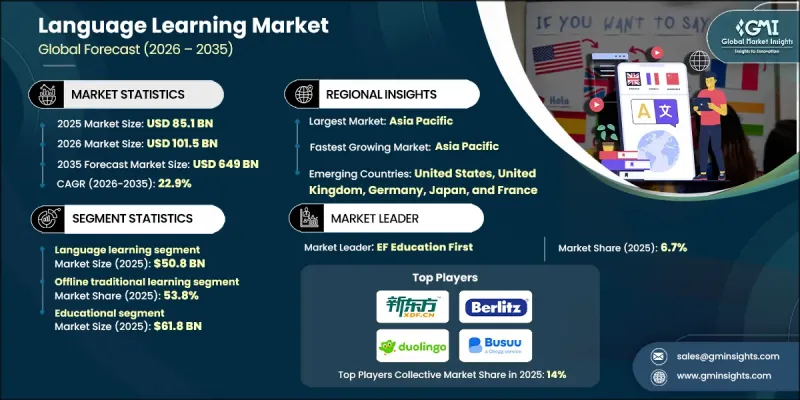
Growth is fueled by deeper global integration, rising cross-border interaction, and the widespread adoption of digital learning tools. Individuals increasingly pursue language skills to support education, career mobility, and cultural integration as international travel, migration, and study opportunities continue to rise. Demand from enterprises is also accelerating, as organizations prioritize multilingual capabilities to operate efficiently in globalized work environments. Corporate language training has become a strategic investment across sectors focused on productivity and collaboration. The expansion of remote work and international teams has further increased the need for effective communication across languages. Technology is reshaping the industry, with AI-driven platforms enabling customized learning paths and interactive experiences. Digital tools that emphasize engagement, adaptability, and immersion are redefining how learners acquire language skills and driving sustained market expansion worldwide.
| Market Scope | |
|---|---|
| Start Year | 2025 |
| Forecast Year | 2026-2035 |
| Start Value | $85.1 Billion |
| Forecast Value | $649 Billion |
| CAGR | 22.9% |
The organized language learning segment generated USD 50.8 billion in 2025, driven by the rising demand for structured programs that improve academic performance, professional growth, and global mobility opportunities. Learners increasingly seek formal courses that combine curriculum-based instruction, certified assessments, and measurable outcomes, which makes organized learning the preferred choice for both students and working professionals.
The offline or traditional classroom-based learning segment accounted for 53.8% share in 2025, highlighting the continued importance of instructor-led teaching, peer collaboration, and immersive learning experiences. Many learners value face-to-face interaction, immediate feedback, and the structured environment that physical classrooms provide, especially in regions where internet connectivity or digital infrastructure is limited. This segment remains strong due to the tangible benefits of guided learning and personal engagement with experienced instructors.
North America Language Learning Market generated USD 23.9 billion in 2025, cementing its position as a key growth region. The market is propelled by widespread adoption of educational technology, integration of digital learning tools, and the expansion of hybrid models that combine online flexibility with traditional classroom support. The region's focus on innovative curricula, skill-based language programs, and corporate training initiatives continues to drive growth and adoption across diverse learner segments.
Key companies active in the Global Language Learning Market include Duolingo, EF Education First, Babbel Gmbh, Berlitz Corporation, Busuu Ltd. (Chegg), Inlingua International Ltd., Memrise, McGraw-Hill Education, Inc., eLanguage, LLC, and HHM Education Company. Companies in the Global Language Learning Market are strengthening their market position by investing heavily in artificial intelligence and data-driven personalization to improve learner engagement and outcomes. Many players are expanding digital platforms to support scalable, mobile-first learning experiences that appeal to global audiences. Strategic partnerships with educational institutions and corporate clients help broaden customer reach and diversify revenue streams. Firms are also enhancing content libraries with culturally relevant and industry-specific language modules. Flexible pricing models, subscription plans, and freemium offerings are being used to attract and retain users.
Table of Contents
Chapter 1 Methodology and Scope
- 1.1 Market scope and definition
- 1.2 Research design
- 1.2.1 Research approach
- 1.2.2 Data collection methods
- 1.3 Data mining sources
- 1.3.1 Global
- 1.3.2 Regional/Country
- 1.4 Base estimates and calculations
- 1.4.1 Base year calculation
- 1.4.2 Key trends for market estimation
- 1.5 Primary research and validation
- 1.5.1 Primary sources
- 1.6 Forecast model
- 1.7 Research assumptions and limitations
Chapter 2 Executive Summary
- 2.1 Industry 3600 synopsis
- 2.2 Key market trends
- 2.2.1 Language trends
- 2.2.2 Learning mode trends
- 2.2.3 Application trends
- 2.2.4 End-user trends
- 2.2.5 Regional trends
- 2.3 TAM Analysis, 2026-2035 (USD Billion)
- 2.4 CXO perspectives: Strategic imperatives
- 2.4.1 Executive decision points
- 2.4.2 Critical success factors
- 2.5 Future outlook and strategic recommendations
Chapter 3 Industry Insights
- 3.1 Industry ecosystem analysis
- 3.1.1 Supplier landscape
- 3.1.2 Profit margin
- 3.1.3 Cost structure
- 3.1.4 Value addition at each stage
- 3.1.5 Factor affecting the value chain
- 3.1.6 Disruptions
- 3.2 Industry impact forces
- 3.2.1 Growth drivers
- 3.2.1.1 AI-Driven Personalization
- 3.2.1.2 Digital Transformation and Mobile Platforms
- 3.2.1.3 Corporate Training Demands
- 3.2.1.4 Globalization and Immigration Trends
- 3.2.1.5 Rising popularity of study abroad and international travel
- 3.2.2 Pitfalls and challenges
- 3.2.2.1 Teacher Shortages
- 3.2.2.2 Limited Internet Access in Some Regions
- 3.2.1 Growth drivers
- 3.3 Growth potential analysis
- 3.4 Regulatory landscape
- 3.4.1 North America
- 3.4.2 Europe
- 3.4.3 Asia Pacific
- 3.4.4 Latin America
- 3.4.5 Middle East & Africa
- 3.5 Porter';s analysis
- 3.6 PESTEL analysis
- 3.7 Technology and Innovation landscape
- 3.7.1 Current technological trends
- 3.7.2 Emerging technologies
- 3.8 Emerging Business Models
- 3.9 Compliance Requirements
- 3.10 Supply Chain Resilience
- 3.11 Geopolitical Analysis
- 3.12 Digital Transformation
- 3.13 Risk Assessment and Management
Chapter 4 Competitive Landscape, 2025
- 4.1 Introduction
- 4.2 Company market share analysis
- 4.2.1 By region
- 4.2.1.1 North America
- 4.2.1.2 Europe
- 4.2.1.3 Asia Pacific
- 4.2.1.4 Latin America
- 4.2.1.5 Middle East & Africa
- 4.2.2 Market concentration analysis
- 4.2.1 By region
- 4.3 Competitive benchmarking of key players
- 4.3.1 Product portfolio comparison
- 4.3.1.1 Product range breadth
- 4.3.1.2 Technology
- 4.3.1.3 Innovation
- 4.3.2 Geographic presence comparison
- 4.3.2.1 Global footprint analysis
- 4.3.2.2 Service network coverage
- 4.3.2.3 Market penetration by region
- 4.3.3 Competitive positioning matrix
- 4.3.3.1 Leaders
- 4.3.3.2 Challengers
- 4.3.3.3 Followers
- 4.3.3.4 Niche players
- 4.3.4 Strategic outlook matrix
- 4.3.1 Product portfolio comparison
- 4.4 Key developments, 2022-2025
- 4.4.1 Mergers and acquisitions
- 4.4.2 Partnerships and collaborations
- 4.4.3 Technological advancements
- 4.4.4 Expansion and investment strategies
- 4.4.5 Sustainability initiatives
- 4.4.6 Digital transformation initiatives
- 4.5 Emerging/ startup competitors landscape
Chapter 5 Market Estimates and Forecast, By Language, 2022 - 2035 (USD Billion)
- 5.1 English
- 5.2 Spanish
- 5.3 German
- 5.4 Chinese
- 5.5 French
- 5.6 Russian
- 5.7 Portuguese
- 5.8 Italian
- 5.9 Korean
- 5.10 Japanese
- 5.11 Others
Chapter 6 Market Estimates and Forecast, By Learning Mode, 2022 - 2035 (USD Billion)
- 6.1 Key trends
- 6.2 Digital platforms
- 6.3 Offline traditional learning
- 6.4 Hybrid
Chapter 7 Market Estimates and Forecast, By Application, 2022 - 2035 (USD Billion)
- 7.1 Key trends
- 7.2 Educational
- 7.3 Professional
- 7.4 Others
Chapter 8 Market Estimates and Forecast, By Learning Type, 2022 - 2035 (USD Billion)
- 8.1 Key trends
- 8.2 Language learning
- 8.3 Immersive learning
Chapter 9 Market Estimates and Forecast, By End User, 2022 - 2035 (USD Billion)
- 9.1 Key trends
- 9.2 K-12 Students
- 9.3 Higher Education Students
- 9.4 Corporate / Professional Learners
- 9.5 Direct-to-Consumer (DTC) Learners
Chapter 10 Market Estimates and Forecast, By Region, 2022 - 2035 (USD Billion)
- 10.1 Key trends
- 10.2 North America
- 10.2.1 U.S.
- 10.2.2 Canada
- 10.3 Europe
- 10.3.1 Germany
- 10.3.2 UK
- 10.3.3 France
- 10.3.4 Spain
- 10.3.5 Italy
- 10.3.6 Netherlands
- 10.4 Asia Pacific
- 10.4.1 China
- 10.4.2 India
- 10.4.3 Japan
- 10.4.4 Australia
- 10.4.5 South Korea
- 10.5 Latin America
- 10.5.1 Brazil
- 10.5.2 Mexico
- 10.5.3 Argentina
- 10.6 Middle East and Africa
- 10.6.1 Saudi Arabia
- 10.6.2 South Africa
- 10.6.3 UAE
Chapter 11 Company Profiles
- 11.1 Babbel Gmbh
- 11.2 Berlitz Corporation
- 11.3 Busuu Ltd. (Chegg)
- 11.4 Duolingo
- 11.5 EF Education First
- 11.6 eLanguage, LLC
- 11.7 HHM Education Company
- 11.8 Inlingua International Ltd.
- 11.9 McGraw-Hill Education, Inc.
- 11.10 Memrise
- 11.11 New Oriental Education & Technology Group Inc.
- 11.12 Rosetta Stone LLC
- 11.13 Sanako Corporation
- 11.14 Speexx
- 11.15 Voxy

