
PUBLISHER: Global Market Insights Inc. | PRODUCT CODE: 1928971

PUBLISHER: Global Market Insights Inc. | PRODUCT CODE: 1928971
Fluorosurfactants Market Opportunity, Growth Drivers, Industry Trend Analysis, and Forecast 2026 - 2035
The Global Fluorosurfactants Market was valued at USD 1.5 billion in 2025 and is estimated to grow at a CAGR of 2.4% to reach USD 1.91 billion by 2035.
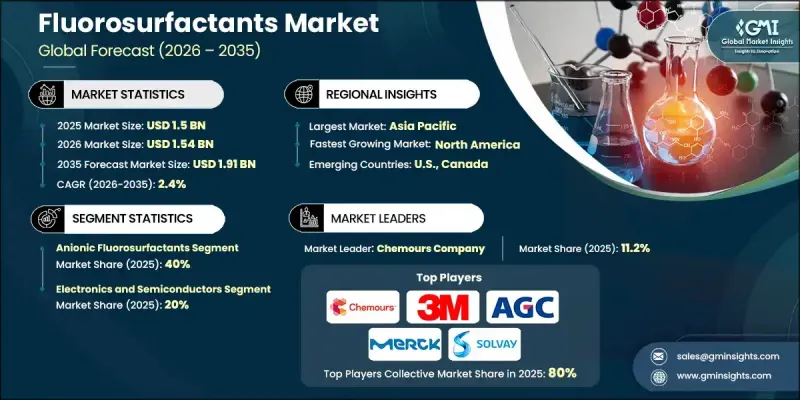
Market stability is supported by the critical role fluorosurfactants play in advanced manufacturing environments, particularly where precision, reliability, and performance cannot be compromised. These materials remain deeply embedded in high-end industrial processes despite increasing regulatory oversight and shifting supplier dynamics. Heightened scrutiny around PFAS compounds, rising compliance expenses, and strategic exits by select producers are reshaping procurement strategies and accelerating efforts to qualify alternative chemistries. However, replacement timelines remain lengthy, especially in microelectronics, where process reliability depends on exact surface behavior and ultra-clean conditions. As manufacturing tolerances tighten, demand for consistent wetting control and defect prevention remains essential. Buyers increasingly pursue diversified sourcing models to mitigate supply risks, while suppliers focus on refined formulations that balance performance with improved environmental profiles. The market outlook reflects a combination of regulatory pressure and structural demand durability, particularly where substitution is technically complex and qualification cycles extend over many years.
| Market Scope | |
|---|---|
| Start Year | 2025 |
| Forecast Year | 2026-2035 |
| Start Value | $1.5 Billion |
| Forecast Value | $1.91 Billion |
| CAGR | 2.4% |
The anionic fluorosurfactants segment held 40% share in 2025. This distribution reflects application requirements for chemical stability, compatibility, and performance under extreme processing conditions. These chemistries are valued for their ability to achieve extremely low surface tension at minimal concentrations while maintaining reliability in harsh environments. Anionic variants continue to play a key role in coatings and polymer processing by enhancing flow characteristics and dispersion stability.
The electronics and semiconductor applications segment accounted for 20% share in 2025. This segment relies heavily on fluorosurfactants to maintain precise surface interactions during complex manufacturing stages where defect tolerance is minimal. Long qualification cycles and stringent purity requirements continue to reinforce sustained demand across advanced fabrication environments.
North America Fluorosurfactants Market held 26% share in 2025, led by the United States, where fluorosurfactants are used across semiconductor manufacturing, aerospace production, and specialty chemical processing. Expanding regulatory frameworks have increased compliance obligations, influencing sourcing decisions and risk management practices. Ongoing investment in advanced manufacturing capacity continues to support demand for high-purity formulations. Canada contributes through its industrial base while aligning with evolving environmental oversight structures.
Key participants active in the Global Fluorosurfactants Market include Solvay, Daikin Industries, The Chemours Company, AGC, Mitsubishi Chemical Corporation, Merck KGaA, Asahi Glass, DIC Corporation, Shamrock Technologies, The Dow Chemical Company, Pilot Chemical Company, OMNOVA Solutions, Innovative Chemical Technologies, Advanced Polymer, and 3M. Companies operating in the Global Fluorosurfactants Market focus on reinforcing their competitive position through formulation innovation, regulatory alignment, and customer collaboration. Significant investment is directed toward developing short-chain and alternative chemistries that preserve performance while addressing environmental concerns. Suppliers emphasize ultra-high-purity manufacturing, contamination control, and technical support to meet demanding customer specifications. Strategic portfolio optimization and selective capacity investment help manage regulatory exposure and cost pressures. Long-term partnerships with critical end users support early-stage qualification and application-specific customization.
Table of Contents
Chapter 1 Methodology & Scope
- 1.1 Market scope and definition
- 1.2 Research design
- 1.2.1 Research approach
- 1.2.2 Data collection methods
- 1.3 Data mining sources
- 1.3.1 Global
- 1.3.2 Regional/Country
- 1.4 Base estimates and calculations
- 1.4.1 Base year calculation
- 1.4.2 Key trends for market estimation
- 1.5 Primary research and validation
- 1.5.1 Primary sources
- 1.6 Forecast model
- 1.7 Research assumptions and limitations
Chapter 2 Executive Summary
- 2.1 Industry 360° synopsis
- 2.2 Key market trends
- 2.2.1 Product type
- 2.2.2 Application
- 2.2.3 Distribution channel
- 2.3 TAM analysis, 2025-2034
- 2.4 CXO perspectives: Strategic imperatives
- 2.4.1 Executive decision points
- 2.4.2 Critical success factors
- 2.5 Outlook and strategic recommendations
Chapter 3 Industry Insights
- 3.1 Industry ecosystem analysis
- 3.1.1 Supplier landscape
- 3.1.2 Profit margin
- 3.1.3 Value addition at each stage
- 3.1.4 Factor affecting the value chain
- 3.1.5 Disruptions
- 3.2 Industry impact forces
- 3.2.1 Growth drivers
- 3.2.2 Industry pitfalls and challenges
- 3.2.3 Market opportunities
- 3.3 Growth potential analysis
- 3.4 Regulatory landscape
- 3.4.1 North America
- 3.4.2 Europe
- 3.4.3 Asia Pacific
- 3.4.4 Latin America
- 3.4.5 Middle East & Africa
- 3.5 Porter';s analysis
- 3.6 PESTEL analysis
- 3.7 Price trends
- 3.7.1 By region
- 3.8 Future market trends
- 3.9 Technology and innovation landscape
- 3.9.1 Current technological trends
- 3.9.2 Emerging technologies
- 3.10 Patent landscape
- 3.11 Trade statistics (HS code) (Note: the trade statistics will be provided for key countries only)
- 3.11.1 Major importing countries
- 3.11.2 Major exporting countries
- 3.12 Sustainability and environmental aspects
- 3.12.1 Sustainable practices
- 3.12.2 Waste reduction strategies
- 3.12.3 Energy efficiency in production
- 3.12.4 Eco-friendly initiatives
- 3.13 Carbon footprint considerations
Chapter 4 Competitive Landscape, 2025
- 4.1 Introduction
- 4.2 Company market share analysis
- 4.2.1 By region
- 4.2.1.1 North America
- 4.2.1.2 Europe
- 4.2.1.3 Asia Pacific
- 4.2.1.4 Latin America
- 4.2.1.5 Middle East & Africa
- 4.2.1 By region
- 4.3 Company matrix analysis
- 4.4 Competitive analysis of major market players
- 4.5 Competitive positioning matrix
- 4.6 Key developments
- 4.6.1 Mergers & acquisitions
- 4.6.2 Partnerships & collaborations
- 4.6.3 New product launches
- 4.6.4 Expansion plans
Chapter 5 Market, By Product Type, 2022-2035 (USD Billion, Kilo Tons)
- 5.1 Key trends
- 5.2 Anionic fluorosurfactant
- 5.3 Non-ionic fluorosurfactant
- 5.4 Cationic fluorosurfactant
- 5.5 Amphoteric fluorosurfactant
Chapter 6 Market, By Application, 2022-2035 (USD Billion, Kilo Tons)
- 6.1 Key trends
- 6.2 Paints & coatings
- 6.3 Adhesives & sealants
- 6.4 Firefighting foams
- 6.5 Polymer dispersion
- 6.6 Industrial & institutional cleaners
- 6.7 Electronics & semiconductors
- 6.8 Oil & gas
- 6.9 Textiles & leather
- 6.10 Others
Chapter 7 Market, By Distribution Channel, 2022-2035 (USD Billion, Kilo Tons)
- 7.1 Key trends
- 7.2 Direct sales
- 7.3 Distributors & wholesalers
- 7.4 Online/e-commerce platforms
- 7.5 Others
Chapter 8 Market Size and Forecast, By Region, 2022-2035 (USD Billion, Kilo Tons)
- 8.1 Key trends
- 8.2 North America
- 8.2.1 U.S.
- 8.2.2 Canada
- 8.3 Europe
- 8.3.1 UK
- 8.3.2 Germany
- 8.3.3 France
- 8.3.4 Italy
- 8.3.5 Spain
- 8.3.6 Rest of Europe
- 8.4 Asia Pacific
- 8.4.1 China
- 8.4.2 India
- 8.4.3 Japan
- 8.4.4 South Korea
- 8.4.5 Australia
- 8.4.6 Rest of Asia Pacific
- 8.5 Latin America
- 8.5.1 Brazil
- 8.5.2 Mexico
- 8.5.3 Argentina
- 8.5.4 Rest of Latin America
- 8.6 Middle East & Africa
- 8.6.1 South Africa
- 8.6.2 Saudi Arabia
- 8.6.3 UAE
- 8.6.4 Rest of Middle East & Africa
Chapter 9 Company Profiles
- 9.1 3M
- 9.2 The Chemours Company
- 9.3 The Dow Chemical Company
- 9.4 AGC
- 9.5 Asahi Glass
- 9.6 Daikin Industries
- 9.7 Merck KGaA
- 9.8 Solvay
- 9.9 Shamrock Technologies
- 9.10 Mitsubishi Chemical Corporation
- 9.11 DIC Corporation
- 9.12 OMNOVA Solutions
- 9.13 Advanced Polymer
- 9.14 Innovative Chemical Technologies
- 9.15 Pilot Chemical Company

