PUBLISHER: Global Market Insights Inc. | PRODUCT CODE: 1928972

PUBLISHER: Global Market Insights Inc. | PRODUCT CODE: 1928972
Built-in Kitchen Appliances Market Opportunity, Growth Drivers, Industry Trend Analysis, and Forecast 2026 - 2035
The Global Built-in Kitchen Appliances Market was valued at USD 19.6 billion in 2025 and is estimated to grow at a CAGR of 5.2% to reach USD 32.4 billion by 2035.
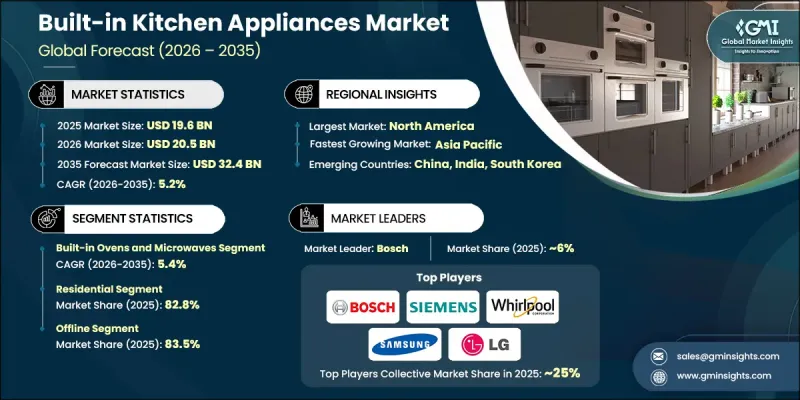
Market expansion is linked to accelerated urban development, which continues to reshape residential construction patterns in major cities. As living spaces become more compact, homeowners increasingly prioritize efficient layouts that maximize functionality without compromising design. This shift has supported strong adoption of integrated kitchen solutions that deliver a cohesive and space-efficient appearance. Built-in appliances align well with modern interior planning by blending seamlessly into modular kitchen structures. Rising disposable income levels and changing lifestyle preferences are also influencing purchasing behavior, with consumers showing a clear inclination toward premium kitchen solutions that reflect modern living standards. Demand is further reinforced by the desire for advanced performance, refined design, and long-term durability. Together, these factors are transforming kitchens into design-focused living spaces and positioning built-in appliances as essential components of contemporary residential environments.
| Market Scope | |
|---|---|
| Start Year | 2025 |
| Forecast Year | 2026-2035 |
| Start Value | $19.6 Billion |
| Forecast Value | $32.4 Billion |
| CAGR | 5.2% |
The built-in ovens and microwaves category generated USD 5 billion in 2025 and is forecast to grow at a CAGR of 5.4% from 2026 to 2035. This segment benefits from strong alignment with modular kitchen layouts, offering efficient space utilization and advanced operational capabilities while maintaining visual continuity.
The residential application segment accounted for 82.8% share in 2025 and is projected to grow at a CAGR of 5.3% through 2035. Urban housing trends and evolving lifestyle expectations continue to drive demand for integrated kitchen solutions that deliver organized, streamlined environments.
United States Built-in Kitchen Appliances Market reached USD 5.2 billion in 2025 and is expected to grow at a CAGR of 5.1% from 2026 to 2035. Market leadership is supported by strong consumer demand for high-end integrated appliances that align with contemporary home designs and premium living preferences.
Key participants operating in the Global Built-in Kitchen Appliances Market include Whirlpool, Samsung, LG, Bosch, Siemens, Miele, Electrolux, Panasonic, Haier, KitchenAid, Gaggenau, IFB, Hindware, Elica, and Faber. Companies in the Built-in Kitchen Appliances Market strengthen their competitive position through continuous product innovation, premium brand positioning, and expanded distribution networks. Investment in energy-efficient technologies, smart connectivity, and design-led engineering helps manufacturers meet evolving consumer expectations. Firms emphasize customization options and seamless integration capabilities to align with modern kitchen layouts. Strategic partnerships with real estate developers and interior designers support early product adoption in residential projects.
Table of Contents
Chapter 1 Methodology & Scope
- 1.1 Market scope & definitions
- 1.2 Research design
- 1.2.1 Research approach
- 1.2.2 Data collection methods
- 1.3 Base estimates and calculations
- 1.3.1 Base year calculation
- 1.3.2 Market estimates & forecasts parameters
- 1.4 Forecast Model
- 1.4.1 Key trends for market estimates
- 1.4.2 Quantified market impact analysis
- 1.4.2.1 Mathematical impact of growth parameters on forecast
- 1.4.3 Scenario analysis framework
- 1.5 Primary research and validation
- 1.5.1 Some of the primary sources (but not limited to)
- 1.6 Data mining sources
- 1.6.1 Paid Sources
- 1.7 Primary research and validation
- 1.7.1 Primary sources
- 1.8 Research Trail & confidence scoring
- 1.8.1 Research trail components
- 1.8.2 Scoring components
- 1.9 Research transparency addendum
- 1.9.1 Source attribution framework
- 1.9.2 Quality assurance metrics
- 1.9.3 Our commitment to trust
- 1.10 Market Definitions
Chapter 2 Executive Summary
- 2.1 Industry 3600 synopsis
- 2.2 Key market trends
- 2.2.1 Regional
- 2.2.2 Product Type
- 2.2.3 Price range
- 2.2.4 End use
- 2.2.5 Distribution channels
- 2.3 CXO perspectives: Strategic imperatives
- 2.3.1 Key decision points for industry executives
- 2.3.2 Critical success factors for market players
- 2.4 Future outlook and strategic recommendations
Chapter 3 Industry Insights
- 3.1 Industry ecosystem analysis
- 3.1.1 Supplier landscape
- 3.1.2 Profit margin
- 3.1.3 Value addition at each stage
- 3.1.4 Factor affecting the value chain
- 3.2 Industry impact forces
- 3.2.1 Growth drivers
- 3.2.1.1 Urbanization and modular kitchen adoption
- 3.2.1.2 Premiumization and lifestyle upgrades
- 3.2.1.3 Smart home integration
- 3.2.2 Pitfalls & Challenges
- 3.2.2.1 High initial cost and installation complexity
- 3.2.2.2 Limited retrofit options
- 3.2.3 Opportunities
- 3.2.3.1 Growth in residential construction and renovation
- 3.2.3.2 Sustainability and energy efficiency focus
- 3.2.1 Growth drivers
- 3.3 Growth potential analysis
- 3.4 Future market trends
- 3.5 Technology and innovation landscape
- 3.5.1 Current technological trends
- 3.5.2 Emerging technologies
- 3.6 Price trends
- 3.6.1 By region
- 3.6.2 By product
- 3.7 Regulatory landscape
- 3.7.1 North America
- 3.7.1.1 US: Consumer Product Safety Commission (CPSC) 16 Code of Federal Regulations (CFR) part 1512
- 3.7.1.2 Canada: International Organization for Standardization (ISO) 4210
- 3.7.2 Europe
- 3.7.2.1 Germany: Deutsches Institut fur Normung (DIN) European Norm (EN) ISO 4210
- 3.7.2.2 UK: European Norm (EN) ISO 4210 / United Kingdom Conformity Assessed (UKCA)
- 3.7.2.3 France: European Norm (EN) ISO 4210
- 3.7.3 Asia Pacific
- 3.7.3.1 China: Guobiao (GB) 3565
- 3.7.3.2 India: Indian Standard (IS) 10613
- 3.7.3.3 Japan: Japanese Industrial Standard (JIS) D 9110
- 3.7.4 Latin America
- 3.7.4.1 Brazil: Associacao Brasileira de Normas Tecnicas (ABNT) Norma Brasileira (NBR) ISO 4210
- 3.7.4.2 Mexico: International Organization for Standardization (ISO) 4210
- 3.7.5 Middle East & Africa
- 3.7.5.1 South Africa: South African National Standard (SANS) 311
- 3.7.5.2 Saudi Arabia: Saudi Standards, Metrology and Quality Organization (SASO) Gulf Standardization Organization (GSO) ISO 4210
- 3.7.1 North America
- 3.8 Trade statistics (HS Code - 8516)
- 3.8.1 Major importing countries
- 3.8.2 Major exporting countries
- 3.9 Porter';s analysis
- 3.10 PESTEL analysis
Chapter 4 Competitive Landscape, 2025
- 4.1 Introduction
- 4.2 Company market share analysis
- 4.2.1 By Region
- 4.2.1.1 North America
- 4.2.1.2 Europe
- 4.2.1.3 Asia Pacific
- 4.2.1.4 Latin America
- 4.2.1.5 Middle East & Africa
- 4.2.1 By Region
- 4.3 Company matrix analysis
- 4.4 Competitive analysis of major market players
- 4.5 Competitive positioning matrix
- 4.6 Key developments
- 4.6.1 Mergers & acquisitions
- 4.6.2 Partnerships & collaborations
- 4.6.3 New product launches
- 4.6.4 Expansion plans
Chapter 5 Market Estimates & Forecast, By Product Type, 2022 - 2035, (USD Billion) (Million Units)
- 5.1 Key trends
- 5.2 Built-in ovens & microwaves
- 5.3 Built-in refrigerator
- 5.4 Built-in hob
- 5.5 Built-in hoods
- 5.6 Others
Chapter 6 Market Estimates & Forecast, By Price Range, 2022 - 2035, (USD Billion) (Million Units)
- 6.1 Key trends
- 6.2 Low
- 6.3 Medium
- 6.4 High
Chapter 7 Market Estimates & Forecast, By End User, 2022 - 2035, (USD Billion) (Million Units)
- 7.1 Key trends
- 7.2 Residential
- 7.3 Commercial
- 7.3.1 HoReCa
- 7.3.2 Bars & pubs
- 7.3.3 Others (offices, etc.)
Chapter 8 Market Estimates & Forecast, By Distribution Channel, 2022 - 2035, (USD Billion) (Million Units)
- 8.1 Key trends
- 8.2 Online channels
- 8.2.1 E-commerce
- 8.2.2 Company websites
- 8.3 Offline channels
- 8.3.1 Specialty stores
- 8.3.2 Mega retail stores
- 8.3.3 Others (departmental stores, contract sales, etc.)
Chapter 9 Market Estimates & Forecast, By Region, 2022 - 2035, (USD Billion) (Million Units)
- 9.1 Key trends
- 9.2 North America
- 9.2.1 U.S.
- 9.2.2 Canada
- 9.3 Europe
- 9.3.1 Germany
- 9.3.2 UK
- 9.3.3 France
- 9.3.4 Italy
- 9.3.5 Spain
- 9.4 Asia Pacific
- 9.4.1 China
- 9.4.2 India
- 9.4.3 Japan
- 9.4.4 South Korea
- 9.4.5 Australia
- 9.5 Latin America
- 9.5.1 Brazil
- 9.5.2 Mexico
- 9.5.3 Argentina
- 9.6 MEA
- 9.6.1 Saudi Arabia
- 9.6.2 UAE
- 9.6.3 South Africa
Chapter 10 Company Profiles
- 10.1 Bosch
- 10.2 Electrolux
- 10.3 Elica
- 10.4 Faber
- 10.5 Gaggenau
- 10.6 Haier
- 10.7 Hindware
- 10.8 IFB
- 10.9 KitchenAid
- 10.10 LG
- 10.11 Miele
- 10.12 Panasonic
- 10.13 Samsung
- 10.14 Siemens
- 10.15 Whirlpool

