PUBLISHER: Global Market Insights Inc. | PRODUCT CODE: 1928989

PUBLISHER: Global Market Insights Inc. | PRODUCT CODE: 1928989
Weaving Machine Market Opportunity, Growth Drivers, Industry Trend Analysis, and Forecast 2026 - 2035
The Global Weaving Machine Market was valued at USD 7 billion in 2025 and is estimated to grow at a CAGR of 4.5% to reach USD 10.8 billion by 2035.
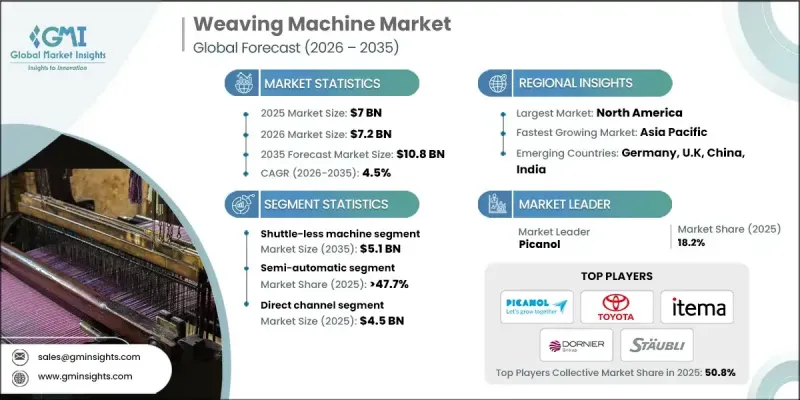
Market growth is driven by rising demand for durable and high-performance fabrics across multiple end-use industries, including transportation, sportswear, and apparel. Manufacturers are increasingly integrating advanced digital technologies such as AI-enabled controls and connected systems to streamline operations and improve production accuracy. These technologies support automation by reducing manual intervention, lowering error rates, and improving overall manufacturing efficiency. Government-backed initiatives that encourage industrial automation and modernization are also contributing to higher adoption of advanced weaving equipment. Automated production environments enable higher output levels while reducing dependence on labor-intensive processes. At the same time, sustainability considerations are influencing purchasing decisions, with manufacturers shifting toward energy-efficient looms to lower power consumption and emissions. Environmental regulations and incentives promoting cleaner manufacturing practices continue to support long-term market expansion, reinforcing investment in modern weaving solutions.
| Market Scope | |
|---|---|
| Start Year | 2025 |
| Forecast Year | 2026-2035 |
| Start Value | $7 Billion |
| Forecast Value | $10.8 Billion |
| CAGR | 4.5% |
The shuttle-less weaving machine segment generated USD 3.3 billion in 2025 and is projected to reach USD 5.1 billion by 2035. Growing demand for technologically advanced textile machinery is accelerating the adoption of shuttle-less systems, as they enhance productivity, reduce material waste, and lower operating expenses while delivering higher output consistency.
The semi-automatic segment accounted for 47.7% share in 2025. These machines remain widely adopted in regions where manufacturers seek to balance efficiency improvements with controlled capital investment. Semi-automatic systems allow producers to expand capacity and meet rising textile demand without transitioning to fully automated setups.
United States Weaving Machine Market held 65.5% share in 2025. Strong focus on manufacturing modernization and automation across textile facilities continues to support market leadership. Public-sector initiatives aimed at strengthening domestic manufacturing capabilities are enabling investments in advanced weaving technologies and digital production systems.
Key companies active in the Global Weaving Machine Market include Picanol, Itema, Toyota, Staubli, Dornier, Tsudakoma, Van de Wiele, Laxmi, Smit, Rifa, Jingwei, Qingdao Dongjia, Bonas, Zhejiang Hengtai, and Lohia. Companies operating in the Global Weaving Machine Market are strengthening their market position through continuous technology upgrades and automation-focused product development. Many players are investing heavily in research to improve machine speed, precision, and energy efficiency. Expanding product portfolios to address both high-volume industrial users and mid-scale manufacturers is a common strategy. Firms are also enhancing after-sales services, including maintenance support and digital monitoring solutions, to build long-term customer relationships. Strategic collaborations with textile producers and equipment distributors are helping improve regional reach. Additionally, manufacturers are emphasizing sustainability by designing machines that reduce energy consumption and material waste.
Table of Contents
Chapter 1 Methodology & Scope
- 1.1 Market scope and definition
- 1.2 Research design
- 1.2.1 Research approach
- 1.2.2 Data collection methods
- 1.3 Data mining sources
- 1.3.1 Global
- 1.3.2 Regional/Country
- 1.4 Base estimates and calculations
- 1.4.1 Base year calculation
- 1.4.2 Key trends for market estimation
- 1.5 Primary research and validation
- 1.5.1 Primary sources
- 1.6 Forecast model
- 1.7 Research assumptions and limitations
Chapter 2 Executive Summary
- 2.1 Industry 360° synopsis
- 2.2 Key market trends
- 2.2.1 Regional
- 2.2.2 Type
- 2.2.3 Operation
- 2.2.4 Usage
- 2.2.5 Distribution channel
- 2.3 CXO perspectives: Strategic imperatives
- 2.3.1 Key decision points for industry executives
- 2.3.2 Critical success factors for market players
- 2.4 Future outlook and strategic recommendations
Chapter 3 Industry Insights
- 3.1 Industry ecosystem analysis
- 3.1.1 Supplier landscape
- 3.1.2 Profit margin
- 3.1.3 Value addition at each stage
- 3.1.4 Factor affecting the value chain
- 3.2 Industry impact forces
- 3.2.1 Growth drivers
- 3.2.1.1 Technological advancements in automation
- 3.2.1.2 Rising demand for customized fabrics
- 3.2.1.3 Increased production efficiency and speed
- 3.2.2 Industry pitfalls & challenges
- 3.2.2.1 High initial investment costs
- 3.2.2.2 Fluctuating raw material prices
- 3.2.3 Opportunities
- 3.2.3.1 Sustainability policies & circular economy push
- 3.2.3.2 Integration of iot & predictive maintenance solutions
- 3.2.1 Growth drivers
- 3.3 Growth potential analysis
- 3.4 Future market trends
- 3.5 Technology and innovation landscape
- 3.5.1 Current technological trends
- 3.5.2 Emerging technologies
- 3.6 Price trends
- 3.6.1 By Type
- 3.6.2 By Region
- 3.7 Regulatory landscape
- 3.7.1 Standards and compliance requirements
- 3.7.2 Regional regulatory frameworks
- 3.7.3 Certification standards
- 3.8 Trade statistics (HS code 8446)
- 3.8.1 Major importing countries
- 3.8.2 Major exporting countries
- 3.9 Gap analysis
- 3.10 Risk assessment and mitigation
- 3.11 Porter';s analysis
- 3.12 PESTEL analysis
Chapter 4 Competitive Landscape, 2025
- 4.1 Introduction
- 4.2 Company market share analysis
- 4.2.1 By Region
- 4.2.1.1 North America
- 4.2.1.2 Europe
- 4.2.1.3 Asia Pacific
- 4.2.1.4 Latin America
- 4.2.1.5 Middle East and Africa
- 4.2.1 By Region
- 4.3 Company matrix analysis
- 4.4 Competitive analysis of major market players
- 4.5 Competitive positioning matrix
- 4.6 Key developments
- 4.6.1 Mergers & acquisitions
- 4.6.2 Partnerships & collaborations
- 4.6.3 New product launches
- 4.6.4 Expansion plans
Chapter 5 Market Estimates & Forecast, By Type, 2022-2035 (USD Billion) (Thousand Units)
- 5.1 Key trends
- 5.2 Shuttle machines
- 5.3 Shuttle-less machines
- 5.4 Specialized machines
- 5.5 Others
Chapter 6 Market Estimates & Forecast, By Operation, 2022-2035 (USD Billion) (Thousand Units)
- 6.1 Key trends
- 6.2 Manual
- 6.3 Semi-automatic
- 6.4 Automatic
Chapter 7 Market Estimates & Forecast, By Usage, 2022-2035 (USD Billion) (Thousand Units)
- 7.1 Key trends
- 7.2 Upholstery fabric
- 7.3 Automotive textiles
- 7.4 Sportswear
- 7.5 Other
Chapter 8 Market Estimates & Forecast, By Distribution Channel, 2022-2035 (USD Billion) (Thousand Units)
- 8.1 Key trends
- 8.2 Direct
- 8.3 Indirect
Chapter 9 Market Estimates & Forecast, By Region, 2022-2035 (USD Billion) (Thousand Units)
- 9.1 Key trends
- 9.2 North America
- 9.2.1 U.S.
- 9.2.2 Canada
- 9.3 Europe
- 9.3.1 Germany
- 9.3.2 France
- 9.3.3 UK
- 9.3.4 Italy
- 9.3.5 Spain
- 9.4 Asia Pacific
- 9.4.1 China
- 9.4.2 India
- 9.4.3 Japan
- 9.4.4 South Korea
- 9.4.5 Australia
- 9.5 Latin America
- 9.5.1 Brazil
- 9.5.2 Mexico
- 9.5.3 Argentina
- 9.6 MEA
- 9.6.1 South Africa
- 9.6.2 Saudi Arabia
- 9.6.3 UAE
Chapter 10 Company Profiles
- 10.1 Bonas
- 10.2 Dornier
- 10.3 Itema
- 10.4 Jingwei
- 10.5 Laxmi
- 10.6 Lohia
- 10.7 Picanol
- 10.8 Qingdao Dongjia
- 10.9 Rifa
- 10.10 Smit
- 10.11 Staubli
- 10.12 Toyota
- 10.13 Tsudakoma
- 10.14 Van de Wiele
- 10.15 Zhejiang Hengtai

