PUBLISHER: Global Market Insights Inc. | PRODUCT CODE: 1928993

PUBLISHER: Global Market Insights Inc. | PRODUCT CODE: 1928993
Glass Tableware Market Opportunity, Growth Drivers, Industry Trend Analysis, and Forecast 2026 - 2035
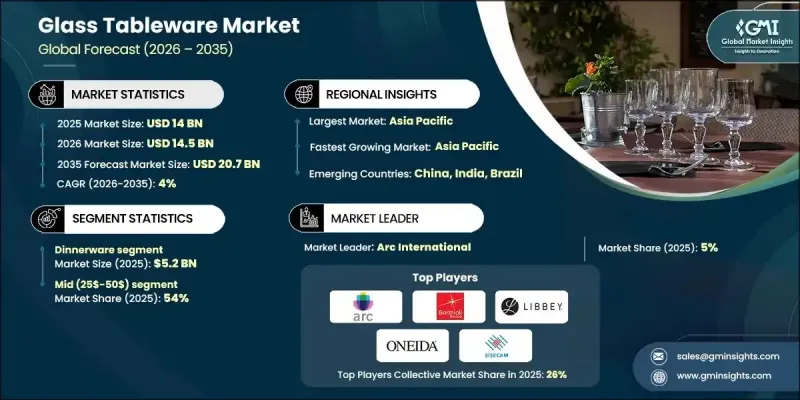
The Global Glass Tableware Market was valued at USD 14 billion in 2025 and is estimated to grow at a CAGR of 4% to reach USD 20.7 billion by 2035.
The market continues to evolve as changing lifestyles, shifting dining preferences, and growing interest in visually appealing home products influence purchasing decisions. Consumers increasingly prefer tableware that delivers everyday usability and refined design, reflecting a broader desire to elevate home dining experiences. As more time is spent at home, glass tableware has become an expression of personal taste and interior styling, rather than a purely functional item. This growing focus on aesthetics has encouraged manufacturers to innovate with contemporary shapes, textures, and finishes while maintaining durability and practicality. The hospitality sector plays a vital role in shaping demand patterns, as foodservice operators prioritize tableware that enhances presentation and complements dining experiences. This influence has prompted suppliers to broaden their product portfolios to meet diverse serving environments, driving continuous design evolution and supporting consistent market expansion.
| Market Scope | |
|---|---|
| Start Year | 2025 |
| Forecast Year | 2026-2035 |
| Start Value | $14 Billion |
| Forecast Value | $20.7 Billion |
| CAGR | 4% |
The mid-priced range between USD 25 and USD 50 segment held 54% share in 2025. This segment benefits from a strong balance between affordability and perceived quality, making it highly attractive to a broad consumer base. Products in this price bracket typically offer reliable performance, modern features, and acceptable durability without the premium pricing associated with high-end alternatives. As value-conscious consumers increasingly seek products that deliver functionality and style at reasonable costs, the mid-range category continues to gain traction.
The dinnerware segment generated USD 5.2 billion in 2025, as it remains central to both everyday dining and special occasions. Consumers increasingly favor coordinated table settings that balance functionality with refined appearance, encouraging steady replacement and upgrade cycles. The rising popularity of home dining, social gatherings, and visually appealing meal presentation continues to strengthen demand. Manufacturers are responding by offering versatile dinnerware collections that combine durability with contemporary styling, allowing products to transition easily between casual and formal use.
U.S. Glass Tableware Market accounted for 77% share and generated USD 2.9 billion in 2025, reflecting strong consumer purchasing power and mature retail infrastructure. Demand is reinforced by a culture that values quality dining experiences at home as well as a robust hospitality industry that consistently upgrades tableware. Ongoing advancements in glass processing, including improved strength and clarity, continue to enhance product appeal. These factors position the U.S. as a key revenue contributor while sustaining long-term growth across both residential and commercial segments.
Key companies active in the Global Glass Tableware Market include Arc International, Libbey Inc., Villeroy & Boch AG, Pasabahce, Anchor Hocking LLC, Sisecam Glassware, WMF, Oneida, Bormioli Rocco S.p.A, Borosil, LaOpala RG Ltd., Ocean Glass Public Company Limited, Krosno Glass S.A., Lenox Corporation, and Utopia Tableware LTD. Companies operating in the Glass Tableware Market focus on design innovation, material enhancement, and brand positioning to strengthen their market presence. Many players invest in developing scratch-resistant, lightweight, and durable glass solutions to meet evolving consumer expectations. Sustainability initiatives, including eco-friendly production processes and recyclable materials, are increasingly central to long-term strategies. Firms also expand distribution through omnichannel retail models, balancing strong offline presence with growing online sales.
Table of Contents
Chapter 1 Methodology and Scope
- 1.1 Market scope and definition
- 1.2 Research design
- 1.2.1 Research approach
- 1.2.2 Data collection methods
- 1.3 Data mining sources
- 1.3.1 Global
- 1.3.2 Regional/Country
- 1.4 Base estimates and calculations
- 1.4.1 Base year calculation
- 1.4.2 Key trends for market estimation
- 1.5 Primary research and validation
- 1.5.1 Primary sources
- 1.6 Forecast model
- 1.7 Research assumptions and limitations
Chapter 2 Executive Summary
- 2.1 Industry 360° synopsis
- 2.2 Key market trends
- 2.2.1 By regional
- 2.2.2 By product type
- 2.2.3 By price range
- 2.2.4 By end Use
- 2.2.5 By distribution channel
- 2.3 CXO perspectives: Strategic imperatives
- 2.3.1 Key decision points for industry executives
- 2.3.2 Critical success factors for market players
- 2.4 Future outlook and strategic recommendations
Chapter 3 Industry Insights
- 3.1 Industry ecosystem analysis
- 3.1.1 Supplier landscape
- 3.1.2 Profit margin
- 3.1.3 Value addition at each stage
- 3.1.4 Factor affecting the value chain
- 3.2 Industry impact forces
- 3.2.1 Growth drivers
- 3.2.1.1 Expansion of the hospitality and foodservice industry
- 3.2.1.2 Rising consumer shift toward aesthetic and premium dining experiences
- 3.2.1.3 Growing preference for sustainable and eco-friendly materials
- 3.2.2 Industry pitfalls & challenges
- 3.2.2.1 Rising costs of raw materials and production
- 3.2.2.2 Vulnerability to breakage and logistics complexity
- 3.2.3 Opportunities
- 3.2.3.1 Strong growth potential in Asia-Pacific due to hospitality expansion
- 3.2.3.2 Advancements in glass manufacturing and product innovation
- 3.2.1 Growth drivers
- 3.3 Growth potential analysis
- 3.4 Major market trends and disruption
- 3.5 Future market trends
- 3.6 Risk and mitigation analysis
- 3.7 Technology and innovation landscape
- 3.7.1 Current technological trends
- 3.7.2 Emerging technologies
- 3.8 Price trends
- 3.8.1 By region
- 3.8.2 By product type
- 3.9 Regulatory landscape
- 3.9.1 North America
- 3.9.2 Europe
- 3.9.3 Asia-Pacific
- 3.9.4 Middle East and Africa
- 3.9.5 Latin America
- 3.10 Porter';s analysis
- 3.11 PESTEL analysis
- 3.12 Consumer behaviour analysis
- 3.12.1 Purchasing patterns
- 3.12.2 Preference analysis
- 3.12.3 Regional variations in consumer behavior
- 3.12.4 Impact of e-commerce on buying decisions
Chapter 4 Competitive Landscape, 2025
- 4.1 Introduction
- 4.2 Company market share analysis
- 4.2.1 By region
- 4.2.1.1 North America
- 4.2.1.2 Europe
- 4.2.1.3 Asia Pacific
- 4.2.1.4 Latin America
- 4.2.1.5 Middle East and Africa
- 4.2.1 By region
- 4.3 Company matrix analysis
- 4.4 Competitive analysis of major market players
- 4.5 Competitive positioning matrix
- 4.6 Key developments
- 4.6.1 Mergers & acquisitions
- 4.6.2 Partnerships & collaborations
- 4.6.3 New product launches
- 4.6.4 Expansion plans
Chapter 5 Market Estimates & Forecast, By Product Type, 2022-2035 (USD Billion) (Thousand Units)
- 5.1 Key trends
- 5.2 Dinnerware
- 5.2.1 Dinner sets
- 5.2.2 Plates
- 5.2.3 Bowls
- 5.2.4 Spoons & forks
- 5.2.5 Others
- 5.3 Serve-ware
- 5.3.1 Serving bowls
- 5.3.2 Serving trays
- 5.3.3 Platters
- 5.3.4 Teapots
- 5.4 Drinkware
- 5.4.1 Glasses
- 5.4.2 Cups
- 5.4.3 Mugs
- 5.4.4 Cocktail glasses
- 5.4.5 Shot glasses
- 5.4.6 Tumblers
- 5.5 Others
Chapter 6 Market Estimates & Forecast, By Price Range, 2022-2035 (USD Billion) (Thousand Units)
- 6.1 Key trends
- 6.2 Low (<25$)
- 6.3 Mid(25$-50$)
- 6.4 High (>50$)
Chapter 7 Market Estimates & Forecast, By Size, 2022-2035 (USD Billion) (Thousand Units)
- 7.1 Key trends
- 7.2 Commercial
- 7.2.1 HoReCa
- 7.2.2 Catering services
- 7.2.3 Bars & pubs
- 7.2.4 Spa & beauty centers
- 7.2.5 Retailers
- 7.2.6 Others
- 7.3 Household
Chapter 8 Market Estimates & Forecast, By Distribution Channel, 2022-2035 (USD Billion) (Thousand Units)
- 8.1 Key trends
- 8.2 Online
- 8.3 Offline
Chapter 9 Market Estimates and Forecast, By Region, 2022 - 2035 (USD Billion) (Thousand Units)
- 9.1 Key trends
- 9.2 North America
- 9.2.1 U.S.
- 9.2.2 Canada
- 9.3 Europe
- 9.3.1 Germany
- 9.3.2 UK
- 9.3.3 France
- 9.3.4 Italy
- 9.3.5 Spain
- 9.3.6 Turkey
- 9.4 Asia Pacific
- 9.4.1 China
- 9.4.2 Japan
- 9.4.3 India
- 9.4.4 Australia
- 9.4.5 South Korea
- 9.5 Latin America
- 9.5.1 Brazil
- 9.5.2 Mexico
- 9.5.3 Argentina
- 9.6 Middle East and Africa
- 9.6.1 South Africa
- 9.6.2 Saudi Arabia
- 9.6.3 UAE
Chapter 10 Company Profiles
- 10.1 Anchor Hocking LLC
- 10.2 Arc International
- 10.3 Bormioli Rocco S.p.A
- 10.4 Borosil
- 10.5 LaOpala RG Ltd.
- 10.6 Lenox Corporation
- 10.7 Libbey Inc.
- 10.8 Oneida
- 10.9 Pasabahce
- 10.10 Sisecam Glassware
- 10.11 Utopia Tableware LTD
- 10.12 WMF
- 10.13 Villeroy & Boch AG
- 10.14 Krosno Glass S.A.
- 10.15 Ocean Glass Public Company Limited

