
PUBLISHER: Global Market Insights Inc. | PRODUCT CODE: 1936486

PUBLISHER: Global Market Insights Inc. | PRODUCT CODE: 1936486
Soft Robotics for Industrial Applications Market Opportunity, Growth Drivers, Industry Trend Analysis, and Forecast 2026 - 2035
The Global Soft Robotics for Industrial Applications Market was valued at USD 2.02 billion in 2025 and is estimated to grow at a CAGR of 7.1% to reach USD 33.3 billion by 2035.
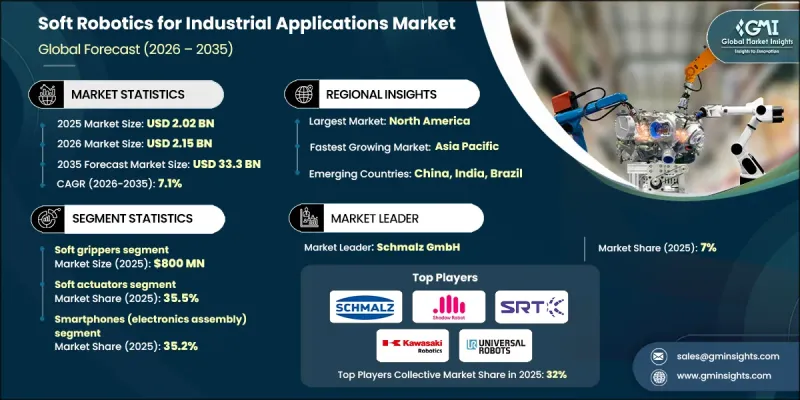
Growth is driven by advances in flexible actuation technologies and rapid progress in bio-inspired material science, which are enabling robots to perform complex industrial tasks with enhanced adaptability and precision. Industrial manufacturers are increasingly moving away from rigid automation systems toward compliant robotic solutions that can safely handle delicate, irregular, or variable products. This transition is further supported by consolidation across the robotics ecosystem, as leading companies expand their technological capabilities and global reach through strategic integration. Soft robotics solutions powered by AI-driven control architectures are replacing traditional fixed automation by offering real-time responsiveness, environmental sensing, and adaptive motion control. These systems continuously evaluate parameters such as force, deformation, and movement to optimize operations dynamically. The shift toward customized production, shorter product lifecycles, and high-mix manufacturing environments is significantly reinforcing demand for soft robotics across industrial settings.
| Market Scope | |
|---|---|
| Start Year | 2025 |
| Forecast Year | 2026-2035 |
| Start Value | $2.02 Billion |
| Forecast Value | $33.3 Billion |
| CAGR | 7.1% |
The soft grippers segment held 35.7% share in 2026, generating USD 0.8 billion. Segment expansion is supported by growing demand for advanced motion control, multi-directional flexibility, and intelligent path optimization when handling fragile or precision components. Soft grippers continue to gain preference due to their ability to minimize surface damage while maintaining high throughput. Their steady adoption reflects long-term industrial reliance on low-impact robotic solutions, particularly in environments where product integrity and consistency are critical to operational success.
In 2026, the smartphones and electronics assembly segment captured 35.2% share, underscoring the importance of precision handling in advanced manufacturing. This segment benefits from the inherent advantages of soft robotics in delivering controlled force application and surface-safe interaction with sensitive components. Manufacturers increasingly favor AI-enabled soft robotic systems that can adapt to changing geometries, improve localized efficiency, and maintain consistent performance across complex assembly lines where precision directly impacts yield and quality.
North America Soft Robotics for Industrial Applications Market reached USD 0.5 billion in 2025 and will grow at 7.3% through 2035. The United States accounted for 85% share and is projected to grow at a rate of 7.4%. Market expansion is supported by a well-established manufacturing base and a strong push toward domestic production to reduce reliance on extended supply chains. Manufacturers in the region are increasingly investing in advanced soft-actuator systems and AI-integrated control platforms to improve operational intelligence, enable predictive maintenance, and enhance autonomous motion planning capabilities.
Key companies active in the Global Soft Robotics for Industrial Applications Market include NVIDIA Corporation, ABB Ltd, FANUC Corporation, KUKA SE & Co. KGaA, Yaskawa Electric Corporation, Omron Corporation, Kawasaki Heavy Industries Ltd., Boston Dynamics, Inc., Teradyne, Inc., Agility Robotics, Inc., Figure AI, Inc., Symbiotic Inc., Keyence Corporation, Standard Bots, and Tesla, Inc. Companies operating in the Soft Robotics for Industrial Applications Market are strengthening their competitive position through continuous innovation, portfolio expansion, and strategic collaboration. Market leaders are investing heavily in advanced materials, AI-enabled control systems, and sensor integration to improve adaptability and performance. Many firms are expanding their solution offerings to support high-mix and customized manufacturing environments while ensuring seamless integration with existing production lines.
Table of Contents
Chapter 1 Methodology and Scope
- 1.1 Market scope and definition
- 1.2 Research design
- 1.2.1 Research approach
- 1.2.2 Data collection methods
- 1.3 Data mining sources
- 1.3.1 Global
- 1.3.2 Regional/Country
- 1.4 Base estimates and calculations
- 1.4.1 Base year calculation
- 1.4.2 Key trends for market estimation
- 1.5 Primary research and validation
- 1.5.1 Primary sources
- 1.6 Forecast model
- 1.7 Research assumptions and limitations
Chapter 2 Executive Summary
- 2.1 Industry 360° synopsis
- 2.2 Key market trends
- 2.2.1 Regional
- 2.2.2 Robot Type
- 2.2.3 Price
- 2.3 CXO perspectives: Strategic imperatives
- 2.3.1 Key decision points for industry executives
- 2.3.2 Critical success factors for market players
- 2.4 Future outlook and strategic recommendations
Chapter 3 Industry Insights
- 3.1 Industry ecosystem analysis
- 3.1.1 Supplier landscape
- 3.1.2 Profit margin
- 3.1.3 Value addition at each stage
- 3.1.4 Factor affecting the value chain
- 3.2 Industry impact forces
- 3.2.1 Growth drivers
- 3.2.1.1 Rising Participation Among Youth & Women
- 3.2.1.2 Labor shortages & reshoring
- 3.2.1.3 Generative AI & LLM Integration
- 3.2.1.4 IT/OT Convergence
- 3.2.2 Industry pitfalls & challenges
- 3.2.2.1 High Integration Complexity
- 3.2.2.2 Data Privacy & Cybersecurity
- 3.2.3 Opportunities
- 3.2.3.1 Robot-as-a-Service (RaaS)
- 3.2.3.2 Humanoid General-Purpose Robots
- 3.2.1 Growth drivers
- 3.3 Growth potential analysis
- 3.4 Future market trends
- 3.5 Technology and innovation landscape
- 3.5.1 Current technological trends
- 3.5.2 Emerging technologies
- 3.6 Price trends
- 3.6.1 By region
- 3.6.2 By Robot type
- 3.7 Regulatory landscape
- 3.7.1 Standards and compliance requirements
- 3.7.2 Regional regulatory frameworks
- 3.7.3 Certification standards
- 3.8 Porter's analysis
- 3.9 PESTEL analysis
Chapter 4 Competitive Landscape, 2025
- 4.1 Introduction
- 4.2 Company market share analysis
- 4.2.1 By region
- 4.2.1.1 North America
- 4.2.1.2 Europe
- 4.2.1.3 Asia Pacific
- 4.2.1.4 Latin America
- 4.2.1.5 Middle East and Africa
- 4.2.1 By region
- 4.3 Company matrix analysis
- 4.4 Competitive analysis of major market players
- 4.5 Competitive positioning matrix
- 4.6 Key developments
- 4.6.1 Mergers & acquisitions
- 4.6.2 Partnerships & collaborations
- 4.6.3 New product launches
- 4.6.4 Expansion plans
Chapter 5 Market Estimates and Forecast, By Type, 2022 - 2035 (USD Billion) (Thousand Units)
- 5.1 Key trends
- 5.2 Soft Grippers
- 5.3 Inflatable Robots
- 5.4 Exoskeletons
- 5.5 Wearables
- 5.6 Others
Chapter 6 Market Estimates and Forecast, By Component, 2022 - 2035 (USD Billion) (Thousand Units)
- 6.1 Key trends
- 6.2 Soft Actuators
- 6.3 Soft sensors
- 6.4 Control systems
- 6.5 Power sources
- 6.6 Others
Chapter 7 Market Estimates and Forecast, By Material, 2022 - 2035 (USD Billion) (Thousand Units)
- 7.1 Key trends
- 7.2 Elastomers
- 7.3 Gels
- 7.4 Fabrics
- 7.5 Others
Chapter 8 Market Estimates and Forecast, By End User, 2022 - 2035 (USD Billion) (Thousand Units)
- 8.1 Key trends
- 8.2 Smartphones
- 8.3 Tablet
- 8.4 Desktop PC
- 8.5 Laptop
- 8.6 Connected home devices
- 8.7 Others
Chapter 9 Market Estimates and Forecast, By Region, 2022 - 2035 (USD Billion) (Thousand Units)
- 9.1 Key trends
- 9.2 North America
- 9.2.1 U.S.
- 9.2.2 Canada
- 9.3 Europe
- 9.3.1 Germany
- 9.3.2 UK
- 9.3.3 France
- 9.3.4 Italy
- 9.3.5 Spain
- 9.4 Asia Pacific
- 9.4.1 China
- 9.4.2 Japan
- 9.4.3 India
- 9.4.4 Australia
- 9.4.5 South Korea
- 9.5 Latin America
- 9.5.1 Brazil
- 9.5.2 Mexico
- 9.5.3 Argentina
- 9.6 Middle East and Africa
- 9.6.1 South Africa
- 9.6.2 Saudi Arabia
- 9.6.3 UAE
Chapter 10 Company Profiles
- 10.1 Beijing Soft Robot Tech
- 10.2 Festo SE & Co. KG
- 10.3 Kawasaki Robotics
- 10.4 OnRobot A/S
- 10.5 Piab AB
- 10.6 RightHand Robotics
- 10.7 Rochu
- 10.8 Schmalz GmbH
- 10.9 Schunk GmbH
- 10.10 Shadow Robot Company
- 10.11 SMC Corporation
- 10.12 Soft Robotics Inc.
- 10.13 Ubiros
- 10.14 Universal Robots

