PUBLISHER: Global Market Insights Inc. | PRODUCT CODE: 1936492

PUBLISHER: Global Market Insights Inc. | PRODUCT CODE: 1936492
Living Room Furniture Market Opportunity, Growth Drivers, Industry Trend Analysis, and Forecast 2026 - 2035
The Global Living Room Furniture Market was valued at USD 231.8 billion in 2025 and is estimated to grow at a CAGR of 3.9% to reach USD 339.6 billion by 2035.
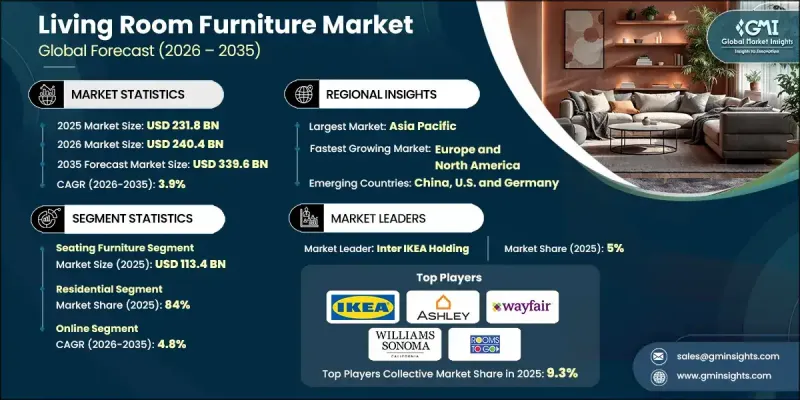
Market growth is driven by rising consumer preference for visually appealing and versatile furniture, alongside increasing disposable income levels and accelerating urban development. Higher spending on home decor and residential upgrades continues to support demand across mid-range and premium furniture categories. Urban living trends are encouraging the adoption of space-efficient and modular designs, particularly as households prioritize functionality without compromising style. Digital retail channels have significantly improved product accessibility, allowing consumers to explore a wider variety of designs and price points with greater convenience. Ongoing advancements in furniture manufacturing and materials are reshaping product offerings, while sustainability and durability considerations are increasingly influencing purchasing decisions. Strong interest in interior design trends and home remodeling activities is motivating consumers to invest in high-quality living room furnishings that combine comfort, longevity, and visual consistency with modern living spaces.
| Market Scope | |
|---|---|
| Start Year | 2025 |
| Forecast Year | 2026-2035 |
| Start Value | $231.8 Billion |
| Forecast Value | $339.6 Billion |
| CAGR | 3.9% |
In 2025, the seating furniture segment generated USD 113.4 billion and is forecast to grow at a CAGR of 4.2% through 2025. Growth within this category is supported by increasing demand for comfort-focused and design-oriented furniture among urban households. Higher disposable incomes and growing preference for adaptable seating solutions are reinforcing adoption rates. Customization and personalization trends tied to home improvement activities are also encouraging consumers to select premium seating options that align with individual style preferences and interior themes.
The residential segment accounted for 84% share in 2025 and is expected to grow at a CAGR of 3.8% from 2026 to 2035. Ongoing urbanization and rising housing development continue to strengthen residential demand. Consumers are prioritizing furniture that balances aesthetics with everyday usability, supported by growing interest in home renovation and decor enhancement. The expansion of online furniture retail platforms has further contributed to market growth by offering broader product variety, competitive pricing, and convenient delivery options tailored to residential buyers.
United States Living Room Furniture Market held 77% share generating USD 52.7 billion in 2025. Market growth in the country is supported by strong consumer spending on home improvement and interior styling, along with steady increases in disposable income. Demand for adaptable and space-efficient furniture continues to rise as urban living spaces become more compact. Online furniture purchasing trends are expanding consumer choice and accelerating sales activity. Ongoing residential construction and heightened focus on sustainable and responsibly sourced furniture materials are also contributing positively to market expansion.
Key companies operating in the Global Living Room Furniture Market include Inter Ikea Holding, Ashley Furniture, Wayfair, RH, Williams-Sonoma, Herman Miller, Knoll, Steelcase, Rooms To Go, Flexsteel, B&B Italia, BoConcept, Burrow, Skyline Furniture, and Emeco. Companies in the Living Room Furniture Market are strengthening their competitive position through a combination of product innovation, digital expansion, and strategic partnerships. Many players are investing in design differentiation and material development to align with evolving consumer preferences. Expansion of e-commerce platforms and omnichannel retail strategies is helping brands reach wider audiences while improving customer engagement. Manufacturers are also optimizing supply chains and production efficiency to manage costs and ensure timely delivery.
Table of Contents
Chapter 1 Methodology and scope
- 1.1 Market scope and definition
- 1.2 Research design
- 1.2.1 Research approach
- 1.2.2 Data collection methods
- 1.3 Data mining sources
- 1.3.1 Global
- 1.3.2 Regional/country
- 1.4 Base estimates and calculations
- 1.4.1 Base year calculation
- 1.4.2 Key trends for market estimation
- 1.5 Primary research and validation
- 1.5.1 Primary sources
- 1.6 Forecast model
- 1.7 Research assumptions and limitations
Chapter 2 Executive summary
- 2.1 Industry 360° synopsis
- 2.2 Key market trends
- 2.2.1 Regional
- 2.2.2 Product type
- 2.2.3 Material type
- 2.2.4 Design style
- 2.2.5 Price
- 2.2.6 End users
- 2.2.7 Distribution channel
- 2.3 CXO perspectives: strategic imperatives
- 2.3.1 Key decision points for industry executives
- 2.3.2 Critical success factors for market players
- 2.4 Future outlook and strategic recommendations
Chapter 3 Industry insights
- 3.1 Industry ecosystem analysis
- 3.1.1 Supplier landscape
- 3.1.2 Profit margin
- 3.1.3 Value addition at each stage
- 3.1.4 Factor affecting the value chain
- 3.1.5 Disruptions
- 3.2 Industry impact forces
- 3.2.1 Growth drivers
- 3.2.2 Industry pitfalls & challenges
- 3.2.3 Opportunities
- 3.3 Growth potential analysis
- 3.4 Future market trends
- 3.5 Technology and innovation landscape
- 3.5.1 Current technological trends
- 3.5.2 Emerging technologies
- 3.6 Price trends
- 3.6.1 By region
- 3.6.2 By product type
- 3.7 Regulatory framework
- 3.7.1 Standards and certifications
- 3.7.2 Environmental regulations
- 3.7.3 Import export regulations
- 3.8 Trade statistics
- 3.8.1 Major importing countries
- 3.8.2 Major exporting countries
- 3.9 Porter's five forces analysis
- 3.10 PESTEL analysis
- 3.11 Consumer behavior analysis
- 3.11.1 Purchasing patterns
- 3.11.2 Preference analysis
- 3.11.3 Regional variations in consumer behavior
- 3.11.4 Impact of e-commerce on buying decisions
Chapter 4 Competitive landscape, 2025
- 4.1 Introduction
- 4.2 Company market share analysis
- 4.2.1 By region
- 4.2.1.1 North America
- 4.2.1.2 Europe
- 4.2.1.3 Asia Pacific
- 4.2.1.4 Latin America
- 4.2.1.5 MEA
- 4.2.1 By region
- 4.3 Company matrix analysis
- 4.4 Competitive analysis of major market players
- 4.5 Competitive positioning matrix
- 4.6 Key developments
- 4.6.1 Mergers & acquisitions
- 4.6.2 Partnerships & collaborations
- 4.6.3 New product launches
- 4.6.4 Expansion plans
Chapter 5 Market Estimates & Forecast, By Product Type, 2022 - 2035 ($Billion, Thousand Units)
- 5.1 Key trends
- 5.2 Seating furniture
- 5.2.1 Sofas
- 5.2.2 Sectionals
- 5.2.3 Armchairs
- 5.2.4 Recliners
- 5.2.5 Ottomans
- 5.2.6 Others (benches etc.)
- 5.3 Tables
- 5.3.1 Coffee tables
- 5.3.2 Side tables
- 5.3.3 End tables
- 5.3.4 Console tables
- 5.3.5 Others (accent tables etc.)
- 5.4 Storage & display units
- 5.4.1 Bookcases
- 5.4.2 Shelving units
- 5.4.3 Cabinets
- 5.4.4 Others (display cases etc.)
- 5.5 Entertainment & media units
- 5.5.1 TV stands
- 5.5.2 entertainment centers
- 5.5.3 Others (media consoles etc.)
- 5.6 Others (room dividers, decorative furniture etc.)
Chapter 6 Market Estimates & Forecast, By Material Type, 2022 - 2035 ($Billion, Thousand Units)
- 6.1 Key trends
- 6.2 Wood furniture
- 6.3 Upholstered furniture
- 6.4 Metal furniture
- 6.5 Glass furniture
- 6.6 Plastic & composite materials
- 6.7 Mixed materials
Chapter 7 Market Estimates & Forecast, By Design Style, 2022 - 2035 ($Billion, Thousand Units)
- 7.1 Key trends
- 7.2 Traditional
- 7.3 Modern/contemporary
- 7.4 Transitional
- 7.5 Mid-century modern
- 7.6 Others (rustic/farmhouse etc.)
Chapter 8 Market Estimates & Forecast, By Price, 2022 - 2035 ($Billion, Thousand Units)
- 8.1 Key trends
- 8.2 Up to $499
- 8.3 $500 to 999
- 8.4 $1000 to $1499
- 8.5 Above $1500
Chapter 9 Market Estimates & Forecast, By End Use, 2022 - 2035 ($Billion, Thousand Units)
- 9.1 Key trends
- 9.2 Residential
- 9.3 Commercial
Chapter 10 Market Estimates & Forecast, By Distribution Channel, 2022 - 2035 ($Billion, Thousand Units)
- 10.1 Key trends
- 10.2 Online
- 10.2.1 E-commerce
- 10.2.2 Company websites
- 10.3 Offline
- 10.3.1 Supermarkets/hypermarket
- 10.3.2 Big-box retailers
- 10.3.3 Others (designer studios etc.)
Chapter 11 Market Estimates & Forecast, By Region, 2022 - 2035 ($Billion, Thousand Units)
- 11.1 Key trends
- 11.2 North America
- 11.2.1 U.S.
- 11.2.2 Canada
- 11.3 Europe
- 11.3.1 Germany
- 11.3.2 UK
- 11.3.3 France
- 11.3.4 Spain
- 11.3.5 Italy
- 11.3.6 Netherlands
- 11.4 Asia Pacific
- 11.4.1 China
- 11.4.2 Japan
- 11.4.3 India
- 11.4.4 Australia
- 11.4.5 South Korea
- 11.5 Latin America
- 11.5.1 Brazil
- 11.5.2 Mexico
- 11.5.3 Argentina
- 11.6 MEA
- 11.6.1 South Africa
- 11.6.2 Saudi Arabia
- 11.6.3 UAE
Chapter 12 Company Profiles
- 12.1 Ashley Furniture
- 12.2 B&B Italia
- 12.3 BoConcept
- 12.4 Burrow
- 12.5 Emeco
- 12.6 Flexsteel
- 12.7 Herman Miller
- 12.8 Inter Ikea Holding
- 12.9 Knoll
- 12.10 RH
- 12.11 Rooms To Go
- 12.12 Skyline Furniture
- 12.13 Steelcase
- 12.14 Wayfair
- 12.15 Williams-Sonoma

