
PUBLISHER: Global Market Insights Inc. | PRODUCT CODE: 1936511

PUBLISHER: Global Market Insights Inc. | PRODUCT CODE: 1936511
Biocides For Industrial Water Market Opportunity, Growth Drivers, Industry Trend Analysis, and Forecast 2026 - 2035
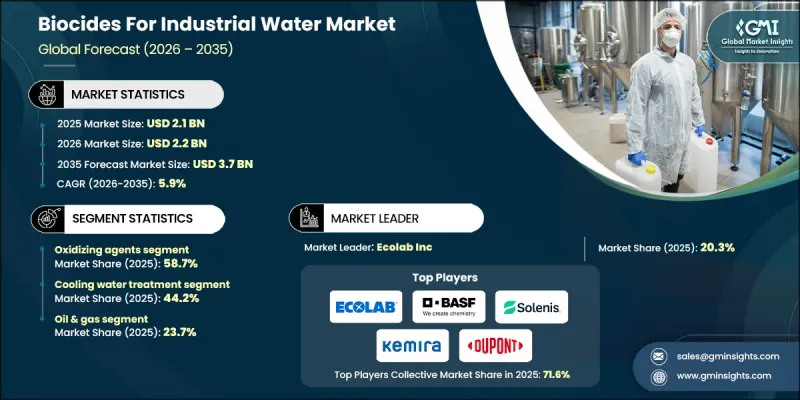
The Global Biocides For Industrial Water Market was valued at USD 2.1 billion in 2025 and is estimated to grow at a CAGR of 5.9% to reach USD 3.7 billion by 2035.
This growth is fueled by rapid industrialization, stricter environmental regulations, and increasing emphasis on sustainable water management practices. Industrial water treatment biocides are critical for controlling microbial growth, preventing biofilms, and maintaining system efficiency across various sectors. Oxidizing biocides remain the most widely adopted due to their proven effectiveness in eliminating bacteria, fungi, and biofilm deposits from water circuits. Meanwhile, non-oxidizing biocides are gaining traction for applications such as corrosion prevention and construction water systems. Rising regulatory pressures and sustainability initiatives are also accelerating the development of eco-friendly and plant-based biocides, which reduce environmental impact and appeal to industries prioritizing green operations. High-value applications such as boiler treatments, process water, and wastewater treatment are driving consistent demand, particularly in industries where water reuse and strict quality standards are essential.
| Market Scope | |
|---|---|
| Start Year | 2025 |
| Forecast Year | 2026-2035 |
| Start Value | $2.1 Billion |
| Forecast Value | $3.7 Billion |
| CAGR | 5.9% |
The oxidizing biocides segment held 58.7% share in 2025 and is projected to grow at a CAGR of 5.3% through 2035. Compounds such as chlorine, bromine, chlorine dioxide, peracetic acid, and ozone lead the segment due to their exceptional efficacy in controlling microbial contamination and biofilm formation in industrial cooling and boiler water systems.
The cooling water treatment segment held 44.2% share and is expected to grow at a CAGR of 5.1% from 2026 to 2035. Cooling water systems require continuous antimicrobial treatment to maintain operational efficiency, and ongoing industrial growth, especially in emerging economies, along with stricter water quality regulations, will continue to drive demand in this segment.
North America Biocides For Industrial Water Market reached USD 498.2 million in 2025 and is expected to experience steady growth throughout the forecast period. The region represents a mature market where regulatory-compliant, technologically advanced, and environmentally friendly biocides are widely implemented. Growth is supported by EPA regulations, industrial water reuse projects, and sustainability mandates in sectors such as power generation, chemical processing, and food and beverage production. Digital water treatment solutions are further enhancing operational efficiency and driving the adoption of eco-friendly formulations.
Key players operating in the Global Biocides For Industrial Water Market include BASF SE, Kemira Oyj, DuPont, Nouryon Chemicals Holding B.V., B&V Chemicals Ltd., Kurita Water Industries Ltd., Lanxess AG, Ecolab Inc. (Nalco Water Division), Italmatch Chemicals SpA (Advanced Water Solutions), and Solenis LLC. Leading companies in the biocides for industrial water market are employing strategies to strengthen their presence and market foothold through innovation, partnerships, and operational efficiency. These strategies include developing eco-friendly and plant-based products to meet sustainability regulations, investing in R&D for next-generation biocide formulations, and forming strategic alliances with industrial end-users to ensure long-term contracts. Companies are also expanding regional production facilities to reduce lead times and logistics costs, implementing digital water treatment platforms for monitoring and efficiency, and optimizing supply chains to secure raw material availability.
Table of Contents
Chapter 1 Methodology & Scope
- 1.1 Research approach
- 1.2 Quality Commitments
- 1.2.1 GMI AI policy & data integrity commitment
- 1.2.1.1 Source consistency protocol
- 1.2.1 GMI AI policy & data integrity commitment
- 1.3 Research Trail & Confidence Scoring
- 1.3.1 Research Trail Components
- 1.3.2 Scoring Components
- 1.4 Data Collection
- 1.4.1 Partial list of primary sources
- 1.5 Data mining sources
- 1.5.1 Paid sources
- 1.5.1.1 Sources, by region
- 1.5.1 Paid sources
- 1.6 Base estimates and calculations
- 1.6.1 Base year calculation for any one approach
- 1.7 Forecast model
- 1.7.1 Quantified market impact analysis
- 1.7.1.1 Mathematical impact of growth parameters on forecast
- 1.7.1 Quantified market impact analysis
- 1.8 Research transparency addendum
- 1.8.1 Source attribution framework
- 1.8.2 Quality assurance metrics
- 1.8.3 Our commitment to trust
Chapter 2 Executive Summary
- 2.1 Industry 360° synopsis
- 2.2 Key market trends
- 2.2.1 Regional
- 2.2.2 Product Type
- 2.2.3 Application
- 2.2.4 End User
- 2.3 TAM Analysis, 2025-2034
- 2.4 CXO perspectives: Strategic imperatives
- 2.4.1 Executive decision points
- 2.4.2 Critical success factors
- 2.5 Future Outlook and Strategic Recommendations
Chapter 3 Industry Insights
- 3.1 Industry ecosystem analysis
- 3.1.1 Supplier landscape
- 3.1.2 Profit margin
- 3.1.3 Value addition at each stage
- 3.1.4 Factor affecting the value chain
- 3.1.5 Disruptions
- 3.2 Industry impact forces
- 3.2.1 Growth drivers
- 3.2.1.1 Stringent Water Quality Regulations
- 3.2.1.2 Rising Industrial Water Reuse & ZLD
- 3.2.1.3 Industrialization in Emerging Economies
- 3.2.2 Industry pitfalls and challenges
- 3.2.2.1 Complex Biocide Registration
- 3.2.2.2 Volatile Raw Material Costs
- 3.2.2.3 Environmental & Ecotoxicity Concerns
- 3.2.3 Market opportunities
- 3.2.3.1 Untapped Wastewater Treatment Market
- 3.2.3.2 Rising Demand for Eco-Friendly Biocides
- 3.2.3.3 Digital Water Treatment Optimization
- 3.2.1 Growth drivers
- 3.3 Growth potential analysis
- 3.4 Regulatory landscape
- 3.4.1 North America
- 3.4.2 Europe
- 3.4.3 Asia Pacific
- 3.4.4 Latin America
- 3.4.5 Middle East & Africa
- 3.5 Porter's analysis
- 3.6 PESTEL analysis
- 3.7 Price trends
- 3.7.1 By region
- 3.7.2 By product type
- 3.8 Future market trends
- 3.9 Technology and Innovation landscape
- 3.9.1 Current technological trends
- 3.9.2 Emerging technologies
- 3.10 Patent Landscape
- 3.11 Trade statistics (HS code)
- 3.11.1 Major importing countries
- 3.11.2 Major exporting countries
- 3.12 Sustainability and environmental aspects
- 3.12.1 Sustainable practices
- 3.12.2 Waste reduction strategies
- 3.12.3 Energy efficiency in production
- 3.12.4 Eco-friendly initiatives
- 3.13 Carbon footprint consideration
Chapter 4 Competitive Landscape, 2025
- 4.1 Introduction
- 4.2 Company market share analysis
- 4.2.1 By region
- 4.2.1.1 North America
- 4.2.1.2 Europe
- 4.2.1.3 Asia Pacific
- 4.2.1.4 LATAM
- 4.2.1.5 MEA
- 4.2.1 By region
- 4.3 Company matrix analysis
- 4.4 Competitive analysis of major market players
- 4.5 Competitive positioning matrix
- 4.6 Key developments
- 4.6.1 Mergers & acquisitions
- 4.6.2 Partnerships & collaborations
- 4.6.3 New Product Launches
- 4.6.4 Expansion Plans
Chapter 5 Market Estimates and Forecast, By Product Type, 2022-2035 (USD Billion) (Kilo Tons)
- 5.1 Key trends
- 5.2 Oxidizing Biocides
- 5.2.1 Chlorine-Based
- 5.2.2 Bromine-Based
- 5.2.3 Chlorine Dioxide
- 5.2.4 Peracetic Acid
- 5.2.5 Ozone
- 5.2.6 Others
- 5.3 Non-Oxidizing Biocides
- 5.3.1 Glutaraldehyde
- 5.3.2 Isothiazolinones
- 5.3.3 Quaternary Ammonium Compounds (Quats)
- 5.3.4 DBNPA
- 5.3.5 Bronopol
- 5.3.6 Others
Chapter 6 Market Estimates and Forecast, By Application, 2022-2035 (USD Billion) (Kilo Tons)
- 6.1 Key trends
- 6.2 Cooling Water Treatment
- 6.3 Boiler Water Treatment
- 6.4 Process Water Treatment
- 6.5 Wastewater & Effluent Treatment
- 6.6 Others
Chapter 7 Market Estimates and Forecast, By End User, 2022-2035 (USD Billion) (Kilo Tons)
- 7.1 Key trends
- 7.2 Oil & Gas
- 7.3 Power Generation
- 7.4 Pulp & Paper
- 7.5 Chemical & Petrochemical
- 7.6 Food & Beverage
- 7.7 Mining & Metallurgy
- 7.8 Pharmaceuticals
- 7.9 Textile & Leather
- 7.10 Others
Chapter 8 Market Estimates and Forecast, By Region, 2022-2035 (USD Billion) (Kilo Tons)
- 8.1 Key trends
- 8.2 North America
- 8.2.1 U.S.
- 8.2.2 Canada
- 8.3 Europe
- 8.3.1 Germany
- 8.3.2 UK
- 8.3.3 France
- 8.3.4 Spain
- 8.3.5 Italy
- 8.3.6 Rest of Europe
- 8.4 Asia Pacific
- 8.4.1 China
- 8.4.2 India
- 8.4.3 Japan
- 8.4.4 Australia
- 8.4.5 South Korea
- 8.4.6 Rest of Asia Pacific
- 8.5 Latin America
- 8.5.1 Brazil
- 8.5.2 Mexico
- 8.5.3 Argentina
- 8.5.4 Rest of Latin America
- 8.6 Middle East and Africa
- 8.6.1 Saudi Arabia
- 8.6.2 South Africa
- 8.6.3 UAE
- 8.6.4 Rest of Middle East and Africa
Chapter 9 Company Profiles
- 9.1 B&V Chemicals Ltd.
- 9.2 BASF SE
- 9.3 Dupont
- 9.4 Ecolab Inc. (Nalco Water Division)
- 9.5 Italmatch Chemicals SpA (Advanced Water Solutions)
- 9.6 Kemira Oyj
- 9.7 Kurita Water Industries Ltd. (Kurita-GK Chemical)
- 9.8 Lanxess AG
- 9.9 Nouryon Chemicals Holding B.V.
- 9.10 Solenis LLC

