
PUBLISHER: Global Market Insights Inc. | PRODUCT CODE: 1936514

PUBLISHER: Global Market Insights Inc. | PRODUCT CODE: 1936514
Industrial Burner on Incineration Market Opportunity, Growth Drivers, Industry Trend Analysis, and Forecast 2026 - 2035
The Global Industrial Burner on Incineration Market was valued at USD 382 million in 2025 and is estimated to grow at a CAGR of 7.9% to reach USD 806 million by 2035.
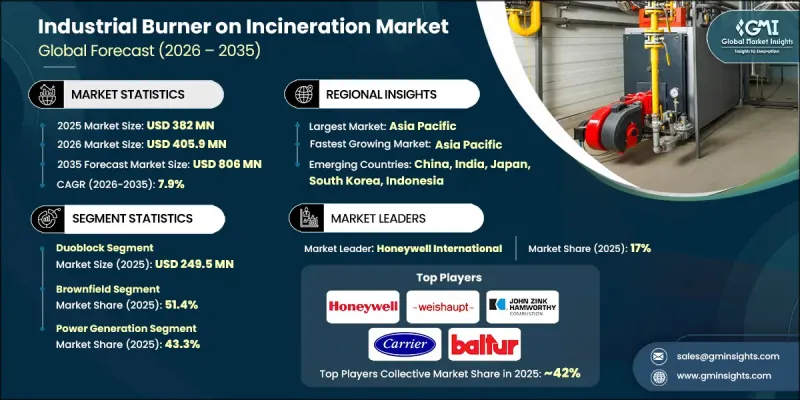
The market growth is driven by rising volumes of hazardous and industrial waste across chemical, healthcare, and manufacturing sectors, which require reliable and compliant disposal methods. Industrial burners in incineration systems ensure complete combustion of toxic compounds and minimize harmful emissions, making them critical for regulatory compliance and environmental protection. As waste generation intensifies, operational hours for incinerators increase, creating demand for durable and efficient burner systems capable of maintaining optimal temperature with precision. Modern burners offer superior control over combustion processes, improving safety, operational reliability, and emission efficiency. Waste management facility operators are increasingly investing in advanced burner solutions to meet regulatory standards while achieving cost-effective and dependable performance.
| Market Scope | |
|---|---|
| Start Year | 2025 |
| Forecast Year | 2026-2035 |
| Start Value | $382 Million |
| Forecast Value | $806 Million |
| CAGR | 7.9% |
The duoblock burner segment accounted for USD 249.5 million in 2025 and is expected to grow at a CAGR of 7.4% through 2035. Duoblock designs integrate the burner and fan into a single unit, ensuring precise air-fuel mixing, stable flame control, and highly efficient combustion. Their compact construction simplifies installation and maintenance, making them ideal for industrial incinerators, hazardous waste treatment facilities, and waste-to-energy plants. Rising industrial waste volumes and the push for energy-efficient, environmentally compliant solutions are driving the adoption of duoblock burners across regions.
The power generation segment held a 43.3% share in 2025 and is projected to grow at a CAGR of 7.9% from 2026 to 2035. Burners are essential in thermal power plants and waste-to-energy facilities to ensure stable flame performance, efficient heat generation, and minimized emissions. Increasing electricity demand, growth in renewable and alternative energy initiatives, and stringent environmental regulations are fueling the adoption of high-performance burners. The requirement for continuous, reliable operation under high thermal loads makes industrial burners indispensable for energy production, reinforcing the dominance of the power generation segment.
China Industrial Burner on Incineration Market reached USD 50.9 million in 2025 and is expected to grow at a CAGR of 8.3% between 2026 and 2035. Rapid industrialization, increasing municipal and hazardous waste, and expansion of waste-to-energy and chemical plants are driving demand for high-capacity burners. Government policies promoting emission control and efficient waste management further support market adoption. Industrial sectors require burners that are reliable, high-performing, and capable of handling multiple fuel types under continuous operations. Urbanization and growing municipal waste treatment infrastructure also contribute to sustained market growth in China.
Key players in the Global Industrial Burner on Incineration Market include Babcock Wanson, Alfa Laval, Bloom Engineering Company, Selas Heat Technology Company, Carrier, Miura America Co., Fives Group, John Zink Hamworthy Combustion, Limpsfield Combustion Engineering, Honeywell International, Baltur, Forbes Marshall Pvt. Ltd., Max Weishaupt, Oilon Group Oy, and QED Combustion. Companies in the industrial burner on incineration market focus on strategies such as expanding regional distribution networks and increasing manufacturing capacities to meet growing demand. R&D investments enable the development of energy-efficient, low-emission burner systems with enhanced precision and durability. Strategic partnerships and collaborations with waste management operators and energy facilities strengthen market reach. Firms are integrating advanced combustion technologies and automated controls to optimize performance, reduce operational downtime, and comply with regulatory standards.
Table of Contents
Chapter 1 Methodology & Scope
- 1.1 Market scope and definition
- 1.2 Research design
- 1.2.1 Research approach
- 1.2.2 Data collection methods
- 1.3 Data mining sources
- 1.3.1 Global
- 1.3.2 Regional/Country
- 1.4 Base estimates and calculations
- 1.4.1 Base year calculation
- 1.4.2 Key trends for market estimation
- 1.5 Primary research and validation
- 1.5.1 Primary sources
- 1.6 Forecast model
- 1.7 Research assumptions and limitations
Chapter 2 Executive Summary
- 2.1 Industry 360° synopsis
- 2.2 Key market trends
- 2.2.1 Regional
- 2.2.2 Burner design
- 2.2.3 Installation
- 2.2.4 Power Range
- 2.2.5 End Use Industry
- 2.3 CXO perspectives: Strategic imperatives
- 2.3.1 Key decision points for industry executives
- 2.3.2 Critical success factors for market players
- 2.4 Future outlook and strategic recommendations
Chapter 3 Industry Insights
- 3.1 Industry ecosystem analysis
- 3.1.1 Supplier landscape
- 3.1.2 Profit margin
- 3.1.3 Value addition at each stage
- 3.1.4 Factor affecting the value chain
- 3.2 Industry impact forces
- 3.2.1 Growth drivers
- 3.2.1.1 Rising volumes of hazardous and industrial waste requiring safe disposal
- 3.2.1.2 Expansion of industrial and municipal waste-to-energy facilities
- 3.2.1.3 Stricter environmental regulations on waste treatment and emission control
- 3.2.2 Pitfalls & Challenges
- 3.2.2.1 High capital cost of advanced low-emission burner systems
- 3.2.2.2 Public opposition and regulatory scrutiny toward incineration facilities
- 3.2.3 Opportunities
- 3.2.3.1 Development of ultra-low NOx and high-efficiency burner technologies
- 3.2.3.2 Retrofit demand for aging incinerators to meet updated regulations
- 3.2.1 Growth drivers
- 3.3 Growth potential analysis
- 3.4 Future market trends
- 3.5 Technology and innovation landscape
- 3.5.1 Current technological trends
- 3.5.2 Emerging technologies
- 3.6 Price trends
- 3.6.1 By region
- 3.6.2 By product
- 3.7 Regulatory landscape
- 3.7.1 Standards and compliance requirements
- 3.7.2 Regional regulatory frameworks
- 3.7.3 Certification standards
- 3.8 Porter's analysis
- 3.9 PESTEL analysis
Chapter 4 Competitive Landscape, 2025
- 4.1 Introduction
- 4.2 Company market share analysis
- 4.2.1 By Region
- 4.2.1.1 North America
- 4.2.1.2 Europe
- 4.2.1.3 Asia Pacific
- 4.2.1.4 Latin America
- 4.2.1.5 Middle East & Africa
- 4.2.1 By Region
- 4.3 Company matrix analysis
- 4.4 Competitive analysis of major market players
- 4.5 Competitive positioning matrix
- 4.6 Key developments
- 4.6.1 Mergers & acquisitions
- 4.6.2 Partnerships & collaborations
- 4.6.3 New product launches
- 4.6.4 Expansion plans
Chapter 5 Market Estimates & Forecast, By Burner Design, 2022 - 2035, (USD Million) (Thousand Units)
- 5.1 Key trends
- 5.2 Monoblock
- 5.3 Duoblock
Chapter 6 Market Estimates & Forecast, By Installation, 2022 - 2035, (USD Million) (Thousand Units)
- 6.1 Key trends
- 6.2 Brownfield
- 6.3 Greenfield
Chapter 7 Market Estimates & Forecast, By Power Range, 2022 - 2035, (USD Million) (Thousand Units)
- 7.1 Key trends
- 7.2 < 300 kW
- 7.3 300 kW - 1 MW
- 7.4 1 - 5 MW
- 7.5 5 - 20MW
- 7.6 20 - 50 MW
- 7.7 > 50 MW
Chapter 8 Market Estimates & Forecast, By End Use Industry, 2022 - 2035, (USD Million) (Thousand Units)
- 8.1 Key trends
- 8.2 Power generation
- 8.3 Chemical and petrochemical
- 8.4 Metalworking
- 8.5 Food processing
- 8.6 Textile
- 8.7 Pulp and paper
- 8.8 Others
Chapter 9 Market Estimates & Forecast, By Region, 2022 - 2035, (USD Million) (Thousand Units)
- 9.1 Key trends
- 9.2 North America
- 9.2.1 U.S.
- 9.2.2 Canada
- 9.3 Europe
- 9.3.1 Germany
- 9.3.2 UK
- 9.3.3 France
- 9.3.4 Italy
- 9.3.5 Spain
- 9.4 Asia Pacific
- 9.4.1 China
- 9.4.2 India
- 9.4.3 Japan
- 9.4.4 South Korea
- 9.4.5 Australia
- 9.5 Latin America
- 9.5.1 Brazil
- 9.5.2 Mexico
- 9.5.3 Argentina
- 9.6 MEA
- 9.6.1 Saudi Arabia
- 9.6.2 UAE
- 9.6.3 South Africa
Chapter 10 Company Profiles
- 10.1 Alfa Laval
- 10.2 Babcock Wanson
- 10.3 Baltur
- 10.4 Bloom Engineering Company
- 10.5 Carrier
- 10.6 Fives Group
- 10.7 Forbes Marshall Pvt. Ltd.
- 10.8 Honeywell International
- 10.9 John Zink Hamworthy Combustion
- 10.10 Limpsfield Combustion Engineering
- 10.11 Max Weishaupt
- 10.12 Miura America Co.
- 10.13 Oilon Group Oy
- 10.14 QED Combustion
- 10.15 Selas Heat Technology Company

