
PUBLISHER: Global Market Insights Inc. | PRODUCT CODE: 1936517

PUBLISHER: Global Market Insights Inc. | PRODUCT CODE: 1936517
Gut Health Beverages Market Opportunity, Growth Drivers, Industry Trend Analysis, and Forecast 2026 - 2035
The Global Gut Health Beverages Market was valued at USD 24.2 billion in 2025 and is estimated to grow at a CAGR of 10.9% to reach USD 67.8 billion by 2035.
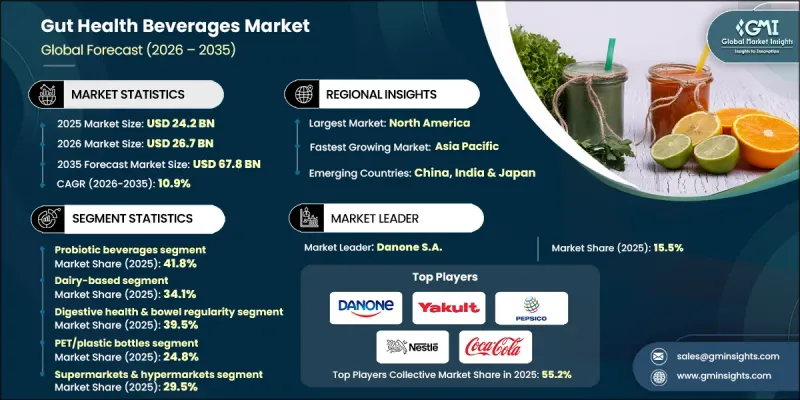
Market growth is driven by rising consumer awareness of the connection between digestive function and overall health. The increasing incidence of digestive discomfort and lifestyle-related gastrointestinal conditions has encouraged consumers to adopt functional beverages formulated to support gut balance. Shifting preferences toward natural, organic, and lightly processed options continue to influence purchasing behavior, with buyers actively seeking beverages that deliver digestive benefits through beneficial gut-supporting ingredients. Manufacturers are responding with advanced formulations and improved nutrient delivery systems that enhance both effectiveness and convenience. Packaging innovations support on-the-go consumption, expanding appeal among busy and health-focused consumers. Gut health beverages are increasingly associated with digestive efficiency, immune resilience, cognitive well-being, and physical performance. Probiotic components play a critical role in maintaining a balanced gut microbiome, which supports multiple biological functions. Growing scientific understanding of gut health has increased demand for beverages designed to address specific wellness needs. Product differentiation through improved taste profiles and diversified consumption formats continues to support broader market adoption.
| Market Scope | |
|---|---|
| Start Year | 2025 |
| Forecast Year | 2026-2035 |
| Start Value | $24.2 Billion |
| Forecast Value | $67.8 Billion |
| CAGR | 10.9% |
The probiotic beverages segment accounted for 41.8% share in 2025 and is forecast to grow at a CAGR of 10.7% through 2035. Segment leadership is supported by rising consumer knowledge of digestive wellness and immune support. Products containing live beneficial microorganisms remain highly favored due to their ability to enhance intestinal balance and contribute to overall health outcomes.
The dairy-based beverages segment held a 34.1% share in 2025 and is expected to register a CAGR of 9.9% from 2026 to 2035. These products maintain strong consumer trust due to their long-standing association with digestive health and naturally high probiotic content. At the same time, the market continues to diversify as demand grows for alternative base options, influenced by evolving dietary preferences, clean-label expectations, and increased awareness of ingredient sensitivity.
North America Gut Health Beverages Market captured a 36.2% share in 2025, positioning the region as a major contributor to global revenue. The United States and Canada demonstrate high consumer awareness of digestive wellness trends and maintain strong demand for functional, natural beverages. A well-developed retail infrastructure, expanding digital sales channels, and strong brand presence accelerate market penetration. Regulatory clarity and continued product innovation further reinforce regional growth, while clean-label positioning and science-backed formulations remain central to consumer trust.
Key companies operating in the Global Gut Health Beverages Market include Nestle S.A., Danone S.A., Yakult Honsha Co., Ltd., PepsiCo, The Coca-Cola Company, Chobani LLC, Lifeway Foods, Bio-K+ International, Morinaga Milk Industry Co., Ltd., Health-Ade Kombucha, and GT's Living Foods. To strengthen market presence, companies in the gut health beverages industry focus on continuous formulation innovation, portfolio expansion, and strategic partnerships. Investment in research and development enables brands to enhance probiotic stability, shelf life, and functional efficacy. Companies prioritize clean-label ingredients, transparent sourcing, and clinical validation to build consumer confidence. Expansion across retail and digital distribution channels improves accessibility and brand visibility.
Table of Contents
Chapter 1 Methodology & Scope
- 1.1 Market scope and definition
- 1.2 Research design
- 1.2.1 Research approach
- 1.2.2 Data collection methods
- 1.3 Data mining sources
- 1.3.1 Global
- 1.3.2 Regional/Country
- 1.4 Base estimates and calculations
- 1.4.1 Base year calculation
- 1.4.2 Key trends for market estimation
- 1.5 Primary research and validation
- 1.5.1 Primary sources
- 1.6 Forecast model
- 1.7 Research assumptions and limitations
Chapter 2 Executive Summary
- 2.1 Industry 360° synopsis
- 2.2 Key market trends
- 2.2.1 Regional
- 2.2.2 Product type
- 2.2.3 Base
- 2.2.4 Function
- 2.2.5 Packaging type
- 2.2.6 Distribution channel
- 2.3 TAM Analysis, 2026-2035
- 2.4 CXO perspectives: Strategic imperatives
- 2.4.1 Executive decision points
- 2.4.2 Critical success factors
- 2.5 Future Outlook and Strategic Recommendations
Chapter 3 Industry Insights
- 3.1 Industry ecosystem analysis
- 3.1.1 Supplier landscape
- 3.1.2 Profit margin
- 3.1.3 Value addition at each stage
- 3.1.4 Factor affecting the value chain
- 3.1.5 Disruptions
- 3.2 Industry impact forces
- 3.2.1 Growth drivers
- 3.2.2 Industry pitfalls and challenges
- 3.2.3 Market opportunities
- 3.3 Growth potential analysis
- 3.4 Regulatory landscape
- 3.4.1 North America
- 3.4.2 Europe
- 3.4.3 Asia Pacific
- 3.4.4 Latin America
- 3.4.5 Middle East & Africa
- 3.5 Porter's analysis
- 3.6 PESTEL analysis
- 3.7 Price trends
- 3.7.1 By region
- 3.7.2 By type
- 3.8 Future market trends
- 3.9 Technology and Innovation landscape
- 3.9.1 Current technological trends
- 3.9.2 Emerging technologies
- 3.10 Patent Landscape
- 3.11 Trade statistics (HS code)
- 3.11.1 Major importing countries
- 3.11.2 Major exporting countries
- 3.12 Sustainability and environmental aspects
- 3.12.1 Sustainable practices
- 3.12.2 Waste reduction strategies
- 3.12.3 Energy efficiency in production
- 3.12.4 Eco-friendly initiatives
- 3.13 Carbon footprint consideration
Chapter 4 Competitive Landscape, 2025
- 4.1 Introduction
- 4.2 Company market share analysis
- 4.2.1 By region
- 4.2.1.1 North America
- 4.2.1.2 Europe
- 4.2.1.3 Asia Pacific
- 4.2.1.4 LATAM
- 4.2.1.5 MEA
- 4.2.1 By region
- 4.3 Company matrix analysis
- 4.4 Competitive analysis of major market players
- 4.5 Competitive positioning matrix
- 4.6 Key developments
- 4.6.1 Mergers & acquisitions
- 4.6.2 Partnerships & collaborations
- 4.6.3 New Product Launches
- 4.6.4 Expansion Plans
Chapter 5 Market Estimates and Forecast, By Product Type, 2022-2035 (USD Billion) (Thousand Litres)
- 5.1 Key trends
- 5.2 Probiotic beverages
- 5.3 Prebiotic beverages
- 5.4 Postbiotic beverages
- 5.5 Fermented beverages
- 5.6 Others
Chapter 6 Market Estimates and Forecast, By Base, 2022-2035 (USD Billion) (Thousand Litres)
- 6.1 Key trends
- 6.2 Dairy-based
- 6.3 Plant-based
- 6.4 Juice-based
- 6.5 Water-based
- 6.6 Tea-based
Chapter 7 Market Estimates and Forecast, By Function, 2022-2035 (USD Billion) (Thousand Litres)
- 7.1 Key trends
- 7.2 Digestive health & bowel regularity
- 7.3 Immune support & defense
- 7.4 Weight management & metabolic
- 7.5 Mental wellness & gut-brain axis
- 7.6 Bone health & mineral absorption
- 7.7 Others
Chapter 8 Market Estimates and Forecast, By Packaging Type, 2022-2035 (USD Billion) (Thousand Litres)
- 8.1 Key trends
- 8.2 Glass bottle
- 8.3 PET/plastic bottle
- 8.4 Cans (aluminum)
- 8.5 Tetra packs/cartons
- 8.6 Others
Chapter 9 Market Estimates and Forecast, By Distribution Channel, 2022-2035 (USD Billion) (Thousand Litres)
- 9.1 Key trends
- 9.2 Supermarkets & hypermarkets
- 9.3 Convenience stores
- 9.4 Specialty health stores
- 9.5 Online/E-commerce
- 9.6 Others
Chapter 10 Market Estimates and Forecast, By Region, 2022-2035 (USD Billion) (Thousand Litres)
- 10.1 Key trends
- 10.2 North America
- 10.2.1 U.S.
- 10.2.2 Canada
- 10.3 Europe
- 10.3.1 Germany
- 10.3.2 UK
- 10.3.3 France
- 10.3.4 Spain
- 10.3.5 Italy
- 10.3.6 Rest of Europe
- 10.4 Asia Pacific
- 10.4.1 China
- 10.4.2 India
- 10.4.3 Japan
- 10.4.4 Australia
- 10.4.5 South Korea
- 10.4.6 Rest of Asia Pacific
- 10.5 Latin America
- 10.5.1 Brazil
- 10.5.2 Mexico
- 10.5.3 Argentina
- 10.5.4 Rest of Latin America
- 10.6 Middle East and Africa
- 10.6.1 Saudi Arabia
- 10.6.2 South Africa
- 10.6.3 UAE
- 10.6.4 Rest of Middle East and Africa
Chapter 11 Company Profiles
- 11.1 Bio-K+ International
- 11.2 Chobani LLC
- 11.3 Danone S.A.
- 11.4 GT’s Living Foods
- 11.5 Health-Ade Kombucha
- 11.6 Lifeway Foods
- 11.7 Morinaga Milk Industry Co., Ltd.
- 11.8 Nestle S.A.
- 11.9 PepsiCo
- 11.10 The Coca-Cola Company
- 11.11 Yakult Honsha Co., Ltd.

