PUBLISHER: Global Market Insights Inc. | PRODUCT CODE: 1936529

PUBLISHER: Global Market Insights Inc. | PRODUCT CODE: 1936529
Acrylic Emulsion Market Opportunity, Growth Drivers, Industry Trend Analysis, and Forecast 2026 - 2035
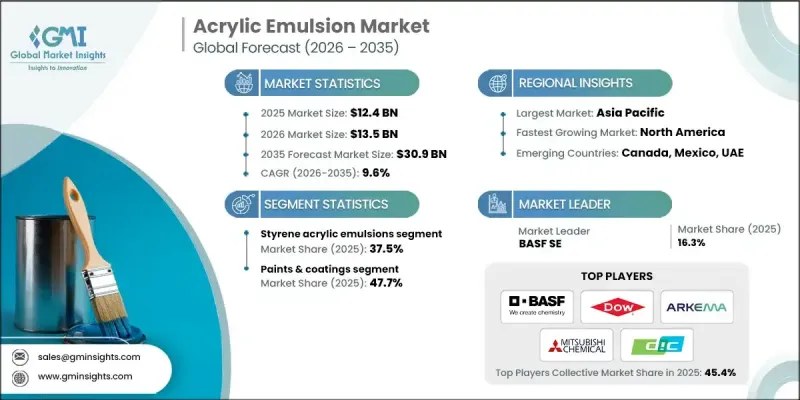
The Global Acrylic Emulsion Market was valued at USD 12.4 billion in 2025 and is estimated to grow at a CAGR of 9.6% to reach USD 30.9 billion by 2035.
Acrylic emulsions are synthetic elastomers known for their excellent resistance to heat, chemicals, and a variety of fluids, making them indispensable in industries that demand high-performance sealing and coating solutions. Key applications span automotive, aerospace, chemical processing, and oil and gas sectors. Market dynamics are strongly influenced by the availability and pricing of raw materials, including acrylic monomers and other chemical inputs, which can fluctuate due to geopolitical events or natural disruptions. Sudden cost volatility can challenge manufacturers in maintaining stable product pricing, potentially compressing profit margins and affecting operational efficiency. Sustainability trends are shaping the industry, with water-based, low-VOC acrylic emulsions gaining prominence in response to stricter environmental regulations and increasing consumer demand for eco-friendly formulations. The drive for greener, safer solutions is expected to shape the market's long-term growth trajectory.
| Market Scope | |
|---|---|
| Start Year | 2025 |
| Forecast Year | 2026-2035 |
| Start Value | $12.4 Billion |
| Forecast Value | $30.9 Billion |
| CAGR | 9.6% |
The styrene acrylic emulsions segment accounted for 37.5% share in 2025 and is anticipated to grow at a CAGR of 9.4% through 2035. These emulsions are highly valued for their combination of performance and cost efficiency, particularly in applications such as decorative coatings, adhesives, and sealants. They offer water-resistance, durability, and cost-effective coverage, which make them suitable for both consumer-grade products and rapidly urbanizing markets.
The paints & coatings segment held a 47.7% share in 2025. Acrylic emulsions are extensively used across architectural, interior, exterior, and industrial coatings. Interior coatings, in particular, benefit from strong adhesion, long-lasting durability, and low VOC emissions, making them suitable for residential and commercial environments. The consistent demand for high-quality paints and coatings continues to drive market expansion globally.
North America Acrylic Emulsion Market is projected to grow at a CAGR of 9.4% share from 2026 to 2035. Growth is fueled by industrial innovations in wastewater recycling, effluent treatment, and sustainable manufacturing aligned with circular economy principles. Additionally, increasing consumer awareness and preference for environmentally friendly products across personal care, cleaning, and healthcare sectors are encouraging companies to adopt acrylic emulsions that meet stricter ecological standards, further supporting market development.
Leading players in the Global Acrylic Emulsion Market include BASF SE, AkzoNobel N.V., Allnex, Arkema S.A., Asian Paints, Celanese Corporation, DIC Corporation, Dow Inc., Evonik Industries AG, Lubrizol Corporation, Mitsubishi Chemical Corporation, Momentive Performance Materials Inc., Sika AG, Synthomer plc, and Wacker Chemie AG. Companies in the acrylic emulsion industry are employing diverse strategies to strengthen their market position. They are investing heavily in research and development to create eco-friendly, low-VOC, and water-based formulations that comply with evolving environmental regulations. Strategic partnerships with regional distributors and suppliers help expand supply chains and reach new end-use markets. Continuous product innovation, branding initiatives, and marketing campaigns emphasize sustainability and performance benefits, while targeted pricing strategies and flexible production capacities ensure competitiveness across price-sensitive and premium markets.
Table of Contents
Chapter 1 Methodology & Scope
- 1.1 Market scope and definition
- 1.2 Research design
- 1.2.1 Research approach
- 1.2.2 Data collection methods
- 1.3 Data mining sources
- 1.3.1 Global
- 1.3.2 Regional/Country
- 1.4 Base estimates and calculations
- 1.4.1 Base year calculation
- 1.4.2 Key trends for market estimation
- 1.5 Primary research and validation
- 1.5.1 Primary sources
- 1.6 Forecast model
- 1.7 Research assumptions and limitations
Chapter 2 Executive Summary
- 2.1 Industry 360° synopsis
- 2.2 Key market trends
- 2.2.1 Regional
- 2.2.2 Type
- 2.2.3 Application
- 2.2.4 End use industry
- 2.3 TAM Analysis, 2026-2035
- 2.4 CXO perspectives: Strategic imperatives
- 2.4.1 Executive decision points
- 2.4.2 Critical success factors
- 2.5 Future Outlook and Strategic Recommendations
Chapter 3 Industry Insights
- 3.1 Industry ecosystem analysis
- 3.1.1 Supplier landscape
- 3.1.2 Profit margin
- 3.1.3 Value addition at each stage
- 3.1.4 Factor affecting the value chain
- 3.1.5 Disruptions
- 3.2 Industry impact forces
- 3.2.1 Growth drivers
- 3.2.1.1 Increasing demand for eco-friendly and low-VOC coatings
- 3.2.1.2 Growth in the construction industry, driving demand for acrylic emulsion-based paints
- 3.2.1.3 Growth in the textile industry, leveraging acrylic emulsions in functional finishes
- 3.2.2 Industry pitfalls and challenges
- 3.2.2.1 Increasing demand for eco-friendly and low-VOC coatings
- 3.2.2.2 Growth in the construction industry, driving demand for acrylic emulsion-based paints
- 3.2.3 Market opportunities
- 3.2.3.1 Growing demand in packaging and labeling industries
- 3.2.3.2 Expansion into innovative and eco-friendly formulations
- 3.2.1 Growth drivers
- 3.3 Growth potential analysis
- 3.4 Regulatory landscape
- 3.4.1 North America
- 3.4.2 Europe
- 3.4.3 Asia Pacific
- 3.4.4 Latin America
- 3.4.5 Middle East & Africa
- 3.5 Porter's analysis
- 3.6 PESTEL analysis
- 3.7 Price trends
- 3.7.1 By region
- 3.7.2 By type
- 3.8 Future market trends
- 3.9 Technology and innovation landscape
- 3.9.1 Current technological trends
- 3.9.2 Emerging technologies
- 3.10 Patent Landscape
- 3.11 Trade statistics (HS code)
( Note: the trade statistics will be provided for key countries only)
- 3.11.1 Major importing countries
- 3.11.2 Major exporting countries
- 3.12 Sustainability and environmental aspects
- 3.12.1 Sustainable practices
- 3.12.2 Waste reduction strategies
- 3.12.3 Energy efficiency in production
- 3.12.4 Eco-friendly initiatives
- 3.13 Carbon footprint consideration
Chapter 4 Competitive Landscape, 2025
- 4.1 Introduction
- 4.2 Company market share analysis
- 4.2.1 By region
- 4.2.1.1 North America
- 4.2.1.2 Europe
- 4.2.1.3 Asia Pacific
- 4.2.1.4 LATAM
- 4.2.1.5 MEA
- 4.2.1 By region
- 4.3 Company matrix analysis
- 4.4 Competitive analysis of major market players
- 4.5 Competitive positioning matrix
- 4.6 Key developments
- 4.6.1 Mergers & acquisitions
- 4.6.2 Partnerships & collaborations
- 4.6.3 New Product Launches
- 4.6.4 Expansion Plans
Chapter 5 Market Estimates and Forecast, By Type, 2022-2035 (USD Billion) (Kilo Tons)
- 5.1 Key trends
- 5.2 Pure acrylic emulsions
- 5.3 Styrene acrylic emulsions
- 5.4 Vinyl acrylic emulsions
- 5.5 Acrylic silicone emulsions
- 5.6 Others
Chapter 6 Market Estimates and Forecast, By Application, 2022-2035 (USD Billion) (Kilo Tons)
- 6.1 Key trends
- 6.2 Paints & coatings
- 6.2.1 Architectural coatings
- 6.2.1.1 Interior coatings
- 6.2.1.2 Exterior coatings
- 6.2.1.3 Industrial coatings
- 6.2.2 Automotive coatings
- 6.2.2.1 Wood coatings
- 6.2.2.2 Metal coatings
- 6.2.2.3 Others
- 6.2.3 Special purpose coatings
- 6.2.3.1 Marine coatings
- 6.2.3.2 Protective coatings
- 6.2.3.3 Others
- 6.2.1 Architectural coatings
- 6.3 Adhesives & sealants
- 6.3.1 Pressure-sensitive adhesives
- 6.3.2 Construction adhesives
- 6.3.3 Packaging adhesives
- 6.3.4 Others
- 6.4 Construction materials
- 6.4.1 Cement modifiers
- 6.4.2 Waterproofing compounds
- 6.4.3 Grouts and mortars
- 6.4.4 Others
- 6.5 Textiles & nonwovens
- 6.5.1 Textile finishes
- 6.5.2 Nonwoven binders
- 6.5.3 Others
- 6.6 Paper & packaging
- 6.6.1 Paper coatings
- 6.6.2 Packaging coatings
- 6.6.3 Others
- 6.7 Others
Chapter 7 Market Estimates and Forecast, By End Use Industry, 2022-2035 (USD Billion) (Kilo Tons)
- 7.1 Key trends
- 7.2 Building & construction
- 7.2.1 Residential construction
- 7.2.2 Commercial construction
- 7.2.3 Infrastructure development
- 7.3 Automotive & transportation
- 7.3.1 Passenger vehicles
- 7.3.2 Commercial vehicles
- 7.3.3 Others
- 7.4 Industrial
- 7.4.1 Metal processing
- 7.4.2 Chemical processing
- 7.4.3 Others
- 7.5 Consumer goods
- 7.5.1 Furniture
- 7.5.2 Appliances
- 7.5.3 Others
- 7.6 Packaging
- 7.6.1 Food & beverage packaging
- 7.6.2 Consumer goods packaging
- 7.6.3 Industrial packaging
- 7.7 Textile & leather
- 7.8 Others
Chapter 8 Market Estimates and Forecast, By Region, 2022-2035 (USD Billion) (Kilo Tons)
- 8.1 Key trends
- 8.2 North America
- 8.2.1 U.S.
- 8.2.2 Canada
- 8.3 Europe
- 8.3.1 Germany
- 8.3.2 UK
- 8.3.3 France
- 8.3.4 Spain
- 8.3.5 Italy
- 8.3.6 Rest of Europe
- 8.4 Asia Pacific
- 8.4.1 China
- 8.4.2 India
- 8.4.3 Japan
- 8.4.4 Australia
- 8.4.5 South Korea
- 8.4.6 Rest of Asia Pacific
- 8.5 Latin America
- 8.5.1 Brazil
- 8.5.2 Mexico
- 8.5.3 Argentina
- 8.5.4 Rest of Latin America
- 8.6 Middle East and Africa
- 8.6.1 Saudi Arabia
- 8.6.2 South Africa
- 8.6.3 UAE
- 8.6.4 Rest of Middle East and Africa
Chapter 9 Company Profiles
- 9.1 BASF SE
- 9.2 AkzoNobel N.V
- 9.3 Allnex
- 9.4 Arkema S.A
- 9.5 Asian Paints
- 9.6 Celanese Corporation
- 9.7 DIC Corporation
- 9.8 Dow Inc.
- 9.9 Evonik Industries AG
- 9.10 Lubrizol Corporation
- 9.11 Mitsubishi Chemical Corporation
- 9.12 Momentive Performance Materials Inc
- 9.13 Sika AG
- 9.14 Synthomer plc
- 9.15 Wacker Chemie AG

