
PUBLISHER: Global Market Insights Inc. | PRODUCT CODE: 1936539

PUBLISHER: Global Market Insights Inc. | PRODUCT CODE: 1936539
Material Handling Equipment Market Opportunity, Growth Drivers, Industry Trend Analysis, and Forecast 2026 - 2035
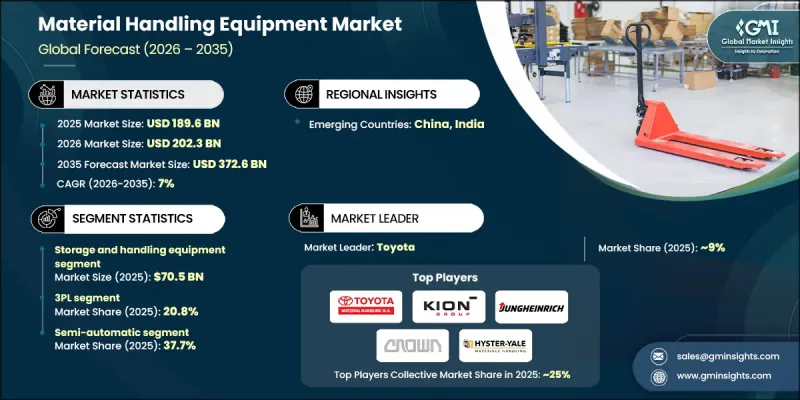
The Global Material Handling Equipment Market was valued at USD 189.6 billion in 2025 and is estimated to grow at CAGR of 7% to reach USD 372.6 billion by 2035.
Market expansion is influenced by the rapid evolution of digital commerce and the growing need for faster, more reliable order fulfillment systems. Businesses are under increasing pressure to modernize warehouse and distribution operations to meet rising expectations for speed, accuracy, and product availability. As online purchasing volumes continue to grow, companies are prioritizing automated material movement, storage efficiency, and integrated logistics workflows to support high-throughput operations. The convergence of advanced manufacturing practices and connected supply chains is reshaping how materials are stored, transported, and tracked across facilities. The adoption of smart technologies allows organizations to synchronize operations, reduce handling errors, optimize labor utilization, and improve overall cost efficiency. These advancements are enabling scalable infrastructure capable of managing higher order volumes while maintaining service quality. As supply chains become more complex and customer expectations continue to rise, material handling solutions are increasingly viewed as strategic investments rather than operational expenses.
| Market Scope | |
|---|---|
| Start Year | 2025 |
| Forecast Year | 2026-2035 |
| Start Value | $189.6 Billion |
| Forecast Value | $372.6 Billion |
| CAGR | 7% |
The storage and handling equipment segment generated USD 70.5 billion in 2025 and is forecast to grow at a CAGR of 7.6% between 2026 and 2035. This segment remains fundamental to material handling operations due to its widespread use across logistics facilities, manufacturing plants, and distribution hubs. Efficient storage systems support space optimization, inventory control, and workflow continuity, allowing businesses to maintain operational stability while accommodating growing product volumes and throughput requirements.
The third-party logistics segment accounted for 20.8% share in 2025 and is expected to register a CAGR of 7.2% through 2035. Growth within this segment is supported by the increasing reliance on outsourced logistics services, as organizations seek flexible, scalable solutions to manage complex supply chains. The expanding role of logistics service providers is driving sustained demand for advanced material handling equipment across multi-client operations.
United States Material Handling Equipment Market USD 35 billion in 2025 and is projected to grow at a CAGR of 6.4% from 2026 to 2035. Market leadership is supported by advanced distribution infrastructure, strong investment in automation, and continuous modernization of warehousing operations. Ongoing integration of smart systems and digital manufacturing initiatives further reinforces the country's dominant position.
Key companies operating in the Global Material Handling Equipment Market include Toyota Material Handling, Daifuku Co., Ltd., KION Group, Jungheinrich AG, SSI SCHAEFER, BEUMER Group, Dematic (KION Group), Crown Equipment Corporation, Mitsubishi Logisnext, Columbus McKinnon Corporation, Murata Machinery, Komatsu Ltd., Fives Group, Honeywell Intelligrated, and Hyster-Yale Materials Handling. Companies in the material handling equipment market are strengthening their competitive position through continuous innovation, strategic partnerships, and expansion of automation-focused product portfolios. Manufacturers are investing heavily in smart, connected equipment that integrates seamlessly with digital warehouse management systems. Many firms are prioritizing modular and scalable solutions to address evolving customer requirements across diverse industries. Geographic expansion into high-growth logistics and industrial hubs is supporting revenue diversification, while service-based offerings such as lifecycle maintenance and system optimization are improving customer retention.
Table of Contents
Chapter 1 Methodology & Scope
- 1.1 Market scope & definitions
- 1.2 Research design
- 1.2.1 Research approach
- 1.2.2 Data collection methods
- 1.3 Base estimates and calculations
- 1.3.1 Base year calculation
- 1.3.2 Market estimates & forecasts parameters
- 1.4 Forecast Model
- 1.4.1 Key trends for market estimates
- 1.4.2 Quantified market impact analysis
- 1.4.2.1 Mathematical impact of growth parameters on forecast
- 1.4.3 Scenario analysis framework
- 1.5 Primary research and validation
- 1.5.1 Some of the primary sources (but not limited to)
- 1.6 Data mining sources
- 1.6.1 Paid Sources
- 1.7 Primary research and validation
- 1.7.1 Primary sources
- 1.8 Research Trail & confidence scoring
- 1.8.1 Research trail components
- 1.8.2 Scoring components
- 1.9 Research transparency addendum
- 1.9.1 Source attribution framework
- 1.9.2 Quality assurance metrics
- 1.9.3 Our commitment to trust
- 1.10 Market Definitions
Chapter 2 Executive Summary
- 2.1 Industry 360° synopsis
- 2.2 Key market trends
- 2.2.1 Regional
- 2.2.2 Product Type
- 2.2.3 Automation
- 2.2.4 Application
- 2.2.5 Distribution channel
- 2.3 CXO perspectives: Strategic imperatives
- 2.3.1 Key decision points for industry executives
- 2.3.2 Critical success factors for market players
- 2.4 Future outlook and strategic recommendations
Chapter 3 Industry Insights
- 3.1 Industry ecosystem analysis
- 3.1.1 Supplier landscape
- 3.1.2 Profit margin
- 3.1.3 Value addition at each stage
- 3.1.4 Factor affecting the value chain
- 3.2 Industry impact forces
- 3.2.1 Growth drivers
- 3.2.1.1 E-commerce expansion
- 3.2.1.2 Industry 4.0 & automation
- 3.2.1.3 Global supply chain complexity
- 3.2.2 Pitfalls & Challenges
- 3.2.2.1 High initial investment
- 3.2.2.2 Workforce skill gap
- 3.2.3 Opportunities
- 3.2.3.1 Green & energy-efficient solutions
- 3.2.3.2 Emerging markets growth
- 3.2.1 Growth drivers
- 3.3 Growth potential analysis
- 3.4 Future market trends
- 3.5 Technology and innovation landscape
- 3.5.1 Current technological trends
- 3.5.2 Emerging technologies
- 3.6 Price trends
- 3.6.1 By region
- 3.6.2 By product
- 3.7 Regulatory landscape
- 3.7.1 North America
- 3.7.1.1 US: Consumer Product Safety Commission (CPSC) 16 Code of Federal Regulations (CFR) part 1512
- 3.7.1.2 Canada: International Organization for Standardization (ISO) 4210
- 3.7.2 Europe
- 3.7.2.1 Germany: Deutsches Institut fur Normung (DIN) European Norm (EN) ISO 4210
- 3.7.2.2 UK: European Norm (EN) ISO 4210 / United Kingdom Conformity Assessed (UKCA)
- 3.7.2.3 France: European Norm (EN) ISO 4210
- 3.7.3 Asia Pacific
- 3.7.3.1 China: Guobiao (GB) 3565
- 3.7.3.2 India: Indian Standard (IS) 10613
- 3.7.3.3 Japan: Japanese Industrial Standard (JIS) D 9110
- 3.7.4 Latin America
- 3.7.4.1 Brazil: Associacao Brasileira de Normas Tecnicas (ABNT) Norma Brasileira (NBR) ISO 4210
- 3.7.4.2 Mexico: International Organization for Standardization (ISO) 4210
- 3.7.5 Middle East & Africa
- 3.7.5.1 South Africa: South African National Standard (SANS) 311
- 3.7.5.2 Saudi Arabia: Saudi Standards, Metrology and Quality Organization (SASO) Gulf Standardization Organization (GSO) ISO 4210
- 3.7.1 North America
- 3.8 Trade statistics (HS Code -8428)
- 3.8.1 Major importing countries
- 3.8.2 Major exporting countries
- 3.9 Porter's analysis
- 3.10 PESTEL analysis
Chapter 4 Competitive Landscape, 2025
- 4.1 Introduction
- 4.2 Company market share analysis
- 4.2.1 By Region
- 4.2.1.1 North America
- 4.2.1.2 Europe
- 4.2.1.3 Asia Pacific
- 4.2.1.4 Latin America
- 4.2.1.5 Middle East & Africa
- 4.2.1 By Region
- 4.3 Company matrix analysis
- 4.4 Competitive analysis of major market players
- 4.5 Competitive positioning matrix
- 4.6 Key developments
- 4.6.1 Mergers & acquisitions
- 4.6.2 Partnerships & collaborations
- 4.6.3 New product launches
- 4.6.4 Expansion plans
Chapter 5 Market Estimates & Forecast, By Product Type, 2022 - 2035, (USD Billion) (Thousand Units)
- 5.1 Key trends
- 5.2 Storage and handling equipment
- 5.2.1 Racks
- 5.2.2 Stacking frames
- 5.2.3 Shelves, bins, and drawers
- 5.2.4 Mezzanines
- 5.3 Industrial trucks
- 5.3.1 Automated Guided Vehicles (AGVs)
- 5.3.2 Hand, platform & pallet trucks
- 5.3.3 Order pickers
- 5.3.4 Pallet jacks
- 5.3.5 Side-loaders
- 5.3.6 Walkie stackers
- 5.4 Bulk material handling equipment
- 5.4.1 Conveyor belts
- 5.4.2 Case conveyors
- 5.4.3 Pallet conveyors
- 5.4.4 Stackers
- 5.4.5 Reclaimers
- 5.4.6 Elevators
- 5.4.7 Others
- 5.5 Robotics
- 5.5.1 Autonomous Mobile Robots
- 5.5.2 Cobots
- 5.5.3 Scara robots
- 5.5.4 Industrial robots
- 5.5.5 Others
- 5.5.6 AS/RS
- 5.5.6.1 Unit-load AS/RS
- 5.5.6.2 Mini-load AS/RS
Chapter 6 Market Estimates & Forecast, By Automation, 2022 - 2035, (USD Billion) (Thousand Units)
- 6.1 Key trends
- 6.2 Manual
- 6.3 Semi-automatic
- 6.4 Fully automatic
Chapter 7 Market Estimates & Forecast, By Application, 2022 - 2035, (USD Billion) (Thousand Units)
- 7.1 Key trends
- 7.2 3PL
- 7.3 E-commerce
- 7.4 General merchandise
- 7.5 Food retail
- 7.6 Food & beverage
- 7.7 Manufacturing
- 7.8 Durable
- 7.9 Non-durable
- 7.10 Pharmaceutical/healthcare
Chapter 8 Market Estimates & Forecast, By Distribution Channel, 2022 - 2035, (USD Billion) (Thousand Units)
- 8.1 Key trends
- 8.2 Direct
- 8.3 Indirect
Chapter 9 Market Estimates & Forecast, By Region, 2022 - 2035, (USD Billion) (Thousand Units)
- 9.1 Key trends
- 9.2 North America
- 9.2.1 U.S.
- 9.2.2 Canada
- 9.3 Europe
- 9.3.1 Germany
- 9.3.2 UK
- 9.3.3 France
- 9.3.4 Italy
- 9.3.5 Spain
- 9.4 Asia Pacific
- 9.4.1 China
- 9.4.2 India
- 9.4.3 Japan
- 9.4.4 South Korea
- 9.4.5 Australia
- 9.5 Latin America
- 9.5.1 Brazil
- 9.5.2 Mexico
- 9.5.3 Argentina
- 9.6 MEA
- 9.6.1 Saudi Arabia
- 9.6.2 UAE
- 9.6.3 South Africa
Chapter 10 Company Profiles
- 10.1 BEUMER Group
- 10.2 Columbus McKinnon Corporation
- 10.3 Crown Equipment Corporation
- 10.4 Daifuku Co., Ltd.
- 10.5 Dematic (KION Group)
- 10.6 Fives Group
- 10.7 Honeywell Intelligrated
- 10.8 Hyster-Yale Materials Handling
- 10.9 Jungheinrich AG
- 10.10 KION Group
- 10.11 Komatsu Ltd.
- 10.12 Mitsubishi Logisnext
- 10.13 Murata Machinery
- 10.14 SSI SCHAEFER
- 10.15 Toyota Material Handling

