
PUBLISHER: Global Market Insights Inc. | PRODUCT CODE: 1936545

PUBLISHER: Global Market Insights Inc. | PRODUCT CODE: 1936545
Europe Antimicrobial Additives Market Opportunity, Growth Drivers, Industry Trend Analysis, and Forecast 2026 - 2035
Europe Antimicrobial Additives Market was valued at USD 761.8 million in 2025 and is estimated to grow at a CAGR of 6% to reach USD 1.4 billion by 2035.
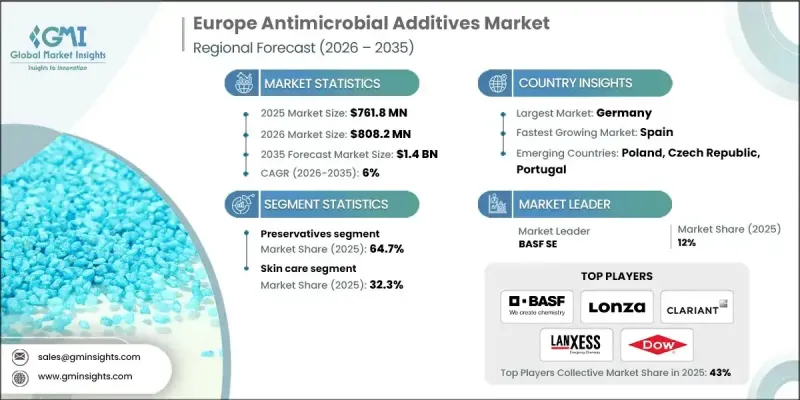
The post-pandemic period saw a notable rebound in demand, particularly across hygiene and personal care products. Consumers increasingly sought hand cleansers, wipes, and other personal care items containing antimicrobial and preservative ingredients. Regulatory frameworks, including the Biocidal Products and EU Cosmetic regulations, have tightened limits on preservative levels, encouraging brands to adopt compliant, low-dose systems. Growing consumer preference for clean, sensitive, and microbiome-friendly formulations has driven a shift toward gentler, transparent preservation systems. Modern preservative solutions now focus on multifunctional ingredients that offer antimicrobial properties alongside conditioning benefits. This has prompted brands to reduce the use of strong preservatives, especially in sensitive applications, and to explore ingredients that combine efficacy with safety, skin compatibility, and minimal chemical load, driving overall innovation in antimicrobial additive formulations.
| Market Scope | |
|---|---|
| Start Year | 2025 |
| Forecast Year | 2026-2035 |
| Start Value | $761.8 Million |
| Forecast Value | $1.4 Billion |
| CAGR | 6% |
The preservatives segment held a 64.7% share in 2025 and is expected to grow at a CAGR of 5.8% from 2026 to 2035. In Europe, the antimicrobial additives market is influenced by both economic pressures and trends toward premiumization. Leading chemical and specialty ingredient companies are leveraging in-house toxicologists, regulatory experts, and application scientists to develop proprietary preservative systems in collaboration with brand owners. Customized blends, technical services, and supply agreements tailored for specific skin and hair claims are becoming increasingly important.
The skin care segment held 32.3% share in 2025 and is projected to grow at a CAGR of 5.8% through 2035. Brands across hair care, skin care, toiletries, fragrances, baby products, and wet wipes are shifting to preservative systems that balance consumer-friendly sensory experiences with preservation efficacy. The strictest demand for gentle, multifunctional, and nature-identical ingredients is observed in products for baby and sensitive skin, while high-volume categories continue to rely on robust and cost-effective antimicrobial systems.
Germany Antimicrobial Additives Market reached USD 145.9 million in 2025, owing to strong research and development, export-oriented brands, and close collaboration between formulators and ingredient suppliers to deliver compliant, high-performance preservative systems.
Leading companies operating in the Europe Antimicrobial Additives Market include Clariant AG, Croda International Plc, BASF SE, Evonik Industries AG, DSM-Firmenich, Ashland Global Holdings Inc., LANXESS AG, Lonza Group AG (now Arxada), Solvay S.A., Symrise AG, and The Dow Chemical Company. Companies in the Europe antimicrobial additives market are strengthening their foothold through strategies such as developing proprietary and multifunctional preservative systems, collaborating directly with brand owners, and offering customized technical solutions for specific applications. They are investing in R&D to create gentler, consumer-friendly formulations while ensuring compliance with strict EU regulations. Strategic supply contracts, co-development partnerships, and tailored blends for sensitive skin and premium products enhance market penetration. Additionally, marketing their sustainability, transparency, and safety credentials helps companies build brand trust.
Table of Contents
Chapter 1 Methodology & Scope
- 1.1 Market scope and definition
- 1.2 Research design
- 1.2.1 Research approach
- 1.2.2 Data collection methods
- 1.3 Data mining sources
- 1.3.1 Global
- 1.3.2 Country
- 1.4 Base estimates and calculations
- 1.4.1 Base year calculation
- 1.4.2 Key trends for market estimation
- 1.5 Primary research and validation
- 1.5.1 Primary sources
- 1.6 Forecast model
- 1.7 Research assumptions and limitations
Chapter 2 Executive Summary
- 2.1 Industry 3600 synopsis
- 2.2 Key market trends
- 2.2.1 Regional
- 2.2.2 Product
- 2.2.3 Application
- 2.3 TAM Analysis, 2026-2035
- 2.4 CXO perspectives: Strategic imperatives
- 2.4.1 Executive decision points
- 2.4.2 Critical success factors
- 2.5 Future Outlook and Strategic Recommendations
Chapter 3 Industry Insights
- 3.1 Industry ecosystem analysis
- 3.1.1 Supplier landscape
- 3.1.2 Profit margin
- 3.1.3 Value addition at each stage
- 3.1.4 Factor affecting the value chain
- 3.1.5 Disruptions
- 3.2 Industry impact forces
- 3.2.1 Growth drivers
- 3.2.1.1 Rising demand for safe, long-lasting cosmetics
- 3.2.1.2 Stringent EU cosmetic and biocidal regulations
- 3.2.1.3 Growth in skin, hair, baby care segments
- 3.2.2 Industry pitfalls and challenges
- 3.2.2.1 Regulatory restrictions on legacy preservative chemistries
- 3.2.2.2 Clean-label, preservative-free consumer positioning
- 3.2.3 Market opportunities
- 3.2.3.1 Microbiome-friendly and natural-derived antimicrobials
- 3.2.3.2 Technological synergies with multifunctional cosmetic ingredients
- 3.2.1 Growth drivers
- 3.3 Growth potential analysis
- 3.4 Regulatory landscape
- 3.5 Porter's analysis
- 3.6 PESTEL analysis
- 3.7 Price trends
- 3.7.1 By country
- 3.7.2 By Product
- 3.8 Future market trends
- 3.9 Technology and Innovation landscape
- 3.9.1 Current technological trends
- 3.9.2 Emerging technologies
- 3.10 Patent Landscape
- 3.11 Trade statistics (HS code) ( Note: the trade statistics will be provided for key countries only)
- 3.11.1 Major importing countries
- 3.11.2 Major exporting countries
- 3.12 Sustainability and environmental aspects
- 3.12.1 Sustainable practices
- 3.12.2 Waste reduction strategies
- 3.12.3 Energy efficiency in production
- 3.12.4 Eco-friendly initiatives
- 3.13 Carbon footprint consideration
Chapter 4 Competitive Landscape, 2025
- 4.1 Introduction
- 4.2 Company market share analysis
- 4.2.1 By country
- 4.3 Company matrix analysis
- 4.4 Competitive analysis of major market players
- 4.5 Competitive positioning matrix
- 4.6 Key developments
- 4.6.1 Mergers & acquisitions
- 4.6.2 Partnerships & collaborations
- 4.6.3 New Product Launches
- 4.6.4 Expansion Plans
Chapter 5 Market Estimates and Forecast, By Product, 2022-2035 (USD Million) (Kilo Tons)
- 5.1 Key trends
- 5.2 Preservatives
- 5.2.1 2-bromo-2-nitropropane-1,3-diol
- 5.2.2 Benzoic Acid
- 5.2.3 Benzyl Alcohol
- 5.2.4 Chlorphenesin
- 5.2.5 Dehydroacetic Acid
- 5.2.6 Diazolidinyl Urea
- 5.2.7 DMDM Hydantoin
- 5.2.8 Ethylparaben
- 5.2.9 Methylchloroisothiazolinone
- 5.2.10 Methylparaben
- 5.2.11 Phenoxyethanol
- 5.2.12 Potassium Sorbate
- 5.2.13 Propylparaben
- 5.2.14 Sodium Benzoate
- 5.2.15 Triclosan
- 5.2.16 Others
- 5.3 Ingredients
- 5.3.1 1,2-hexanediol
- 5.3.2 Caprylhydroxamic Acid
- 5.3.3 Caprylyl Glycol
- 5.3.4 Ethylhexylglycerin
- 5.3.5 Glyceryl Caprylate
- 5.3.6 Levulinic Acid
- 5.3.7 Octenidine HCl
- 5.3.8 P-anisic Acid
- 5.3.9 Pentylene Glycol
- 5.3.10 Phenethyl Alcohol
- 5.3.11 Propylene Glycol
- 5.3.12 Sorbitan Caprylate
- 5.3.13 Others
Chapter 6 Market Estimates and Forecast, By Application, 2022-2035 (USD Million) (Kilo Tons)
- 6.1 Key trends
- 6.2 Hair Care
- 6.3 Skin Care
- 6.4 Toiletries
- 6.5 Fragrances and Perfumes
- 6.6 Baby Products
- 6.7 Wet wipes
- 6.8 Others
Chapter 7 Market Estimates and Forecast, By Region, 2022-2035 (USD Million) (Kilo Tons)
- 7.1 Key trends
- 7.2 Germany
- 7.3 France
- 7.4 United Kingdom
- 7.5 Italy
- 7.6 Spain
- 7.7 Netherlands
- 7.8 Switzerland
- 7.9 Sweden
- 7.10 Belgium
- 7.11 Rest of Europe
Chapter 8 Company Profiles
- 8.1 BASF SE
- 8.2 Clariant AG
- 8.3 Lonza Group AG (now Arxada)
- 8.4 LANXESS AG
- 8.5 Solvay S.A.
- 8.6 The Dow Chemical Company
- 8.7 Evonik Industries AG
- 8.8 Croda International Plc
- 8.9 Ashland Global Holdings Inc.
- 8.10 Symrise AG
- 8.11 DSM-Firmenich

