
PUBLISHER: Global Market Insights Inc. | PRODUCT CODE: 1936550

PUBLISHER: Global Market Insights Inc. | PRODUCT CODE: 1936550
Biosurfactants Market Opportunity, Growth Drivers, Industry Trend Analysis, and Forecast 2026 - 2035
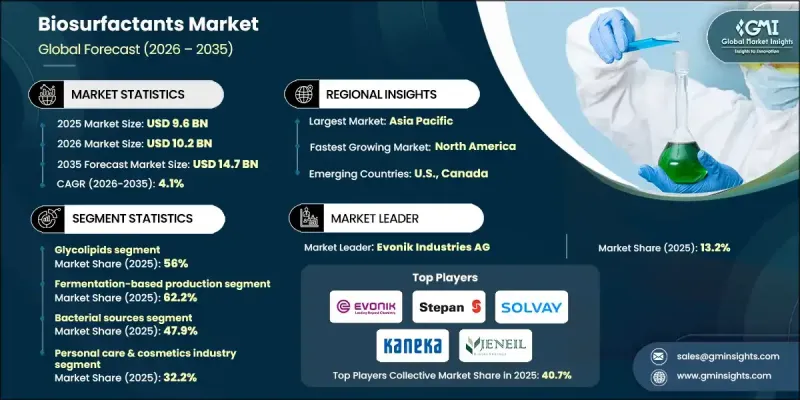
The Global Biosurfactants Market was valued at USD 9.6 billion in 2025 and is estimated to grow at a CAGR of 4.1% to reach USD 14.7 billion by 2035.
The market is gaining momentum as industries worldwide shift toward sustainable and eco-friendly alternatives to traditional chemical surfactants. Biosurfactants are biologically derived compounds produced by microorganisms, including bacteria, fungi, and yeast, which reduce surface and interfacial tension between liquids, solids, and gases. They serve multiple functions, acting as natural emulsifiers, detergents, foaming agents, and antimicrobial agents. Their biodegradability, low toxicity, and renewable nature make them ideal replacements for synthetic, petrochemical-based surfactants. Biosurfactants are resilient under extreme pH, temperature, and salinity, making them versatile for diverse industrial applications. They are widely adopted in pharmaceuticals and cosmetics for gentle cleansing, in food for product stabilization, and in oil and gas for enhanced oil recovery. Rising environmental awareness, coupled with global regulatory pressure and sustainability initiatives, further accelerates their adoption across regions, particularly in North America, Europe, and Asia-Pacific.
| Market Scope | |
|---|---|
| Start Year | 2025 |
| Forecast Year | 2026-2035 |
| Start Value | $9.6 Billion |
| Forecast Value | $14.7 Billion |
| CAGR | 4.1% |
The glycolipids segment held a 56% in 2025 and is projected to grow at a CAGR of 4.1% by 2035. Glycolipids dominate due to their exceptional emulsifying, foaming, and biodegradability properties, making them highly effective in environmental remediation and industrial applications. These biosurfactants, produced by specific microbial strains, facilitate bioremediation processes, including oil spill degradation, and are highly valued for their eco-friendly and efficient performance. Their versatility and functional reliability across multiple industries continue to drive the glycolipids segment forward.
The fermentation-based production segment accounted for 62.2% share in 2025 and is expected to grow at a CAGR of 4.2% during 2026-2035. Fermentation remains the preferred manufacturing method due to its cost-effectiveness, high purity output, and environmentally safe processes. Advanced biotechnological techniques optimize microbial strains such as Candida, Bacillus, and Pseudomonas to enhance biosurfactant yields, quality, and consistency. The scalability and economic feasibility of fermentation processes make it a cornerstone of the global biosurfactants supply chain.
North America Biosurfactants Market held a 29.2% share in 2025, emerging as a key regional leader. The market growth is fueled by consumer preference for natural and sustainable products, stringent regulations on synthetic chemicals, and rising adoption across personal care, household, and environmental remediation industries. The presence of major industry players, continuous research and development, and technology-driven innovations further strengthen North America's market position, encouraging manufacturers to invest in advanced production techniques and eco-friendly formulations.
Major companies operating in the Global Biosurfactants Market include GlycoSurf LLC, Solvay S.A., Stepan Company, Allied Carbon Solutions Co., Ltd., Jeneil Biotech, Inc., Kaneka Corporation, Evonik Industries AG, Synthezyme LLC, Givaudan, and Saraya Co. Ltd. Companies in the biosurfactants market are focusing on several key strategies to strengthen their market position and expand global presence. They are investing heavily in R&D to develop high-performance, sustainable biosurfactant formulations tailored for different industrial applications. Strategic partnerships with manufacturers in pharmaceuticals, cosmetics, food, and oil and gas enhance market reach and technology adoption. Companies are also expanding production capacities, optimizing fermentation processes, and introducing multi-functional biosurfactants with improved efficiency and stability.
Table of Contents
Chapter 1 Methodology & Scope
- 1.1 Market scope and definition
- 1.2 Research design
- 1.2.1 Research approach
- 1.2.2 Data collection methods
- 1.3 Data mining sources
- 1.3.1 Global
- 1.3.2 Regional/Country
- 1.4 Base estimates and calculations
- 1.4.1 Base year calculation
- 1.4.2 Key trends for market estimation
- 1.5 Primary research and validation
- 1.5.1 Primary sources
- 1.6 Forecast model
- 1.7 Research assumptions and limitations
Chapter 2 Executive Summary
- 2.1 Industry 360° synopsis
- 2.2 Key market trends
- 2.2.1 Regional
- 2.2.2 Product type
- 2.2.3 Production method
- 2.2.4 Microbial sources
- 2.2.5 End use industry
- 2.3 TAM Analysis, 2026-2035
- 2.4 CXO perspectives: Strategic imperatives
- 2.4.1 Executive decision points
- 2.4.2 Critical success factors
- 2.5 Future Outlook and Strategic Recommendations
Chapter 3 Industry Insights
- 3.1 Industry ecosystem analysis
- 3.1.1 Supplier landscape
- 3.1.2 Profit margin
- 3.1.3 Value addition at each stage
- 3.1.4 Factor affecting the value chain
- 3.1.5 Disruptions
- 3.2 Industry impact forces
- 3.2.1 Growth drivers
- 3.2.2 Industry pitfalls and challenges
- 3.2.3 Market opportunities
- 3.3 Growth potential analysis
- 3.4 Regulatory landscape
- 3.4.1 North America
- 3.4.2 Europe
- 3.4.3 Asia Pacific
- 3.4.4 Latin America
- 3.4.5 Middle East & Africa
- 3.5 Porter's analysis
- 3.6 PESTEL analysis
- 3.7 Price trends
- 3.7.1 By region
- 3.7.2 By type
- 3.8 Future market trends
- 3.9 Technology and Innovation landscape
- 3.9.1 Current technological trends
- 3.9.2 Emerging technologies
- 3.10 Patent Landscape
- 3.11 Trade statistics (HS code)
( Note: the trade statistics will be provided for key countries only)
- 3.11.1 Major importing countries
- 3.11.2 Major exporting countries
- 3.12 Sustainability and environmental aspects
- 3.12.1 Sustainable practices
- 3.12.2 Waste reduction strategies
- 3.12.3 Energy efficiency in production
- 3.12.4 Eco-friendly initiatives
- 3.13 Carbon footprint consideration
Chapter 4 Competitive Landscape, 2025
- 4.1 Introduction
- 4.2 Company market share analysis
- 4.2.1 By region
- 4.2.1.1 North America
- 4.2.1.2 Europe
- 4.2.1.3 Asia Pacific
- 4.2.1.4 LATAM
- 4.2.1.5 MEA
- 4.2.1 By region
- 4.3 Company matrix analysis
- 4.4 Competitive analysis of major market players
- 4.5 Competitive positioning matrix
- 4.6 Key developments
- 4.6.1 Mergers & acquisitions
- 4.6.2 Partnerships & collaborations
- 4.6.3 New Product Launches
- 4.6.4 Expansion Plans
Chapter 5 Market Estimates and Forecast, By Product Type, 2022-2035 (USD Billion) (Kilo Tons)
- 5.1 Key trends
- 5.2 Glycolipids
- 5.2.1 Rhamnolipids
- 5.2.2 Sophorolipids
- 5.2.3 Trehalolipids
- 5.3 Lipopeptides
- 5.4 Phospholipids
- 5.5 Synthetic & semi-synthetic biosurfactants
- 5.5.1 Methyl ester sulfonates (MES)
- 5.5.2 Alkyl polyglucosides (APG)
- 5.5.3 Sorbitan esters
- 5.5.4 Sucrose esters
Chapter 6 Market Estimates and Forecast, By Production Method, 2022-2035 (USD Billion) (Kilo Tons)
- 6.1 Key trends
- 6.2 Fermentation-based production
- 6.3 Chemical & enzymatic synthesis
- 6.4 Hybrid & emerging methods
Chapter 7 Market Estimates and Forecast, By Microbial Source, 2022-2035 (USD Billion) (Kilo Tons)
- 7.1 Key trends
- 7.2 Bacterial sources
- 7.3 Yeast & fungal sources
- 7.4 Engineered & recombinant strains
Chapter 8 Market Estimates and Forecast, By End Use Industry, 2022-2035 (USD Billion) (Kilo Tons)
- 8.1 Key trends
- 8.2 Oil & gas industry
- 8.3 Agriculture industry
- 8.3.1 Agricultural chemicals
- 8.3.2 Crop protection
- 8.3.3 Animal nutrition
- 8.4 Chemical manufacturing
- 8.4.1 Industrial cleaners
- 8.4.2 Paints & coatings
- 8.4.3 Metal cleaning & processing
- 8.5 Food & beverage industry
- 8.6 Pharmaceutical & healthcare industry
- 8.6.1 Pharmaceutical applications
- 8.6.2 Antimicrobial/antiviral agents
- 8.6.3 Anticancer applications
- 8.7 Personal care & cosmetics industry
- 8.7.1 Personal care products
- 8.7.2 Oral care
- 8.7.3 Skin microbiome products
- 8.8 Household cleaning industry
- 8.8.1 Household detergents
- 8.8.2 Hard surface cleaners
- 8.8.3 Specialty cleaners
- 8.9 Others
Chapter 9 Market Estimates and Forecast, By Region, 2022-2035 (USD Billion) (Kilo Tons)
- 9.1 Key trends
- 9.2 North America
- 9.2.1 U.S.
- 9.2.2 Canada
- 9.3 Europe
- 9.3.1 Germany
- 9.3.2 UK
- 9.3.3 France
- 9.3.4 Spain
- 9.3.5 Italy
- 9.3.6 Rest of Europe
- 9.4 Asia Pacific
- 9.4.1 China
- 9.4.2 India
- 9.4.3 Japan
- 9.4.4 Australia
- 9.4.5 South Korea
- 9.4.6 Rest of Asia Pacific
- 9.5 Latin America
- 9.5.1 Brazil
- 9.5.2 Mexico
- 9.5.3 Argentina
- 9.5.4 Rest of Latin America
- 9.6 Middle East and Africa
- 9.6.1 Saudi Arabia
- 9.6.2 South Africa
- 9.6.3 UAE
- 9.6.4 Rest of Middle East and Africa
Chapter 10 Company Profiles
- 10.1 Allied Carbon Solutions Co., Ltd.
- 10.2 Evonik Industries AG
- 10.3 Givaudan
- 10.4 GlycoSurf LLC
- 10.5 Jeneil Biotech, Inc.
- 10.6 Kaneka Corporation
- 10.7 Saraya Co., Ltd.
- 10.8 Solvay S.A.
- 10.9 Stepan Company
- 10.10 Synthezyme LLC

